
Eurozone economic growth is likely to slow in the third quarter, and the ECB may stand still this week
The Zhitong Finance App learned that the weakening momentum of economic growth may be one of the reasons why the ECB temporarily suspends interest rate hikes. Although most of the Eurozone's attention is currently focused on France's fiscal difficulties and bond market issues, the latest survey shows that data to be released this Friday will show that the Eurozone's economic growth rate in the third quarter may slow to 0.2% from 0.6% in the second quarter. Meanwhile, several other surveys showed that the inflation rate of the Eurozone's four largest economies did not show a clear general upward trend in October.
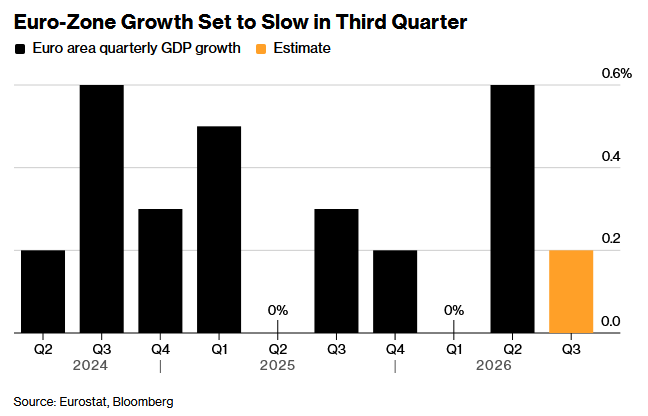
Eurozone economic growth is expected to slow in the third quarter
The European economy, which has shown strong resilience since the outbreak of war in the Middle East at the end of February, may be starting to lose momentum, and commercial activity is beginning to show signs of fatigue. Although the overall performance is still good, Simona Delle Chiaie, chief eurozone economist at Bloomberg Economics, believes that the market still has reasons to be cautious. She said, “The bigger question is what will happen next. As inflation continues to be high and the financial environment tightens sharply, the downside risks facing economic growth are accumulating.”
During the third quarter, European economic output was impacted by a number of factors, including summer heatwaves, low water levels in major waterways, and a sharp rise in global bond yields. Since then, the overall environment has deteriorated further. France has faced large-scale protests, and its public finance situation has raised more and more questions.
As the French private sector shrank in October, Carrefour SA (Carrefour SA) warned that robberies across France would have a heavy impact on the company's performance. The supermarket operator's stock price recorded its worst week since the global financial crisis.
As the largest economy in the Eurozone, Germany's economic performance has improved after years of hardship thanks to large-scale government spending. Even so, the Bundesbank still anticipates that the German economy may stagnate in the third quarter.
In terms of inflation, the Eurozone inflation rate seems destined to rise to 4% by the end of this year, but the performance of countries this month was quite mixed. This is partly due to Germany's fuel tax relief policy; however, analysts also expect Spain's inflation data to decline somewhat.
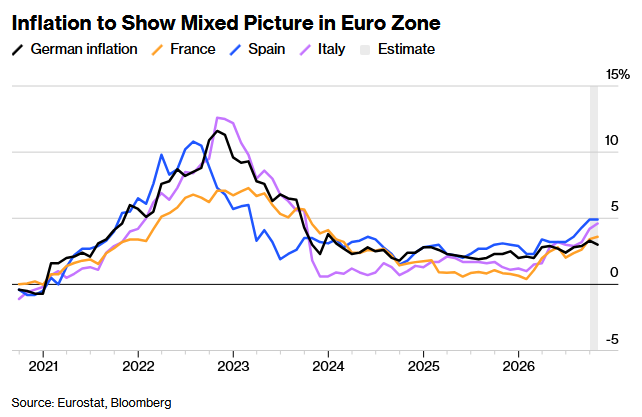
Eurozone inflation performance will be divided
Eurostat data shows that the Eurozone inflation rate rose to 3.8% in September, up from 3.2% in August; energy prices rose 18.8% year on year, which is an important factor driving up inflation. Faced with rising energy prices, many European governments have responded by reducing fuel taxes, interfering with energy prices, and providing subsidies to residents and businesses. However, subsidies can only ease short-term burdens; it is difficult to eliminate the root causes of rising energy prices.
The sharp rise in energy prices caused by the Middle East conflict is putting pressure on inflation in the Eurozone. However, policymakers emphasized that they have yet to see second-round effects such as wage increases. Some officials, including ECB chief economist Philip Lane, said that adopting a “controlled” policy response should be sufficient to restore price stability.
ECB President Lagarde said earlier that high inflation in the Eurozone, driven by high energy prices, has not yet spread to the wider economy. She said that ECB officials are evaluating “how much indirect impact is being transmitted through the economy and see how we can best make early judgments if the second round of effects begins to appear.”
Bank of France Governor Emmanuel Moulin also took a position similar to Lagarde on the issue of inflation. He said that the ECB expects “indirect effects and second-round effects to continue to be controlled,” while Eurozone core price indicators will only accelerate “moderately”.
Economic growth is slowing, and inflationary pressure has not worsened further or made it less urgent for the ECB to act. For economists, this means that the ECB will probably not raise deposit mechanism interest rates for the third and last time until December, rather than this week. At this week's meeting, the ECB is expected to keep the deposit mechanism interest rate unchanged at 2.5%.
Institutional views are divided
Some institutions remain optimistic about economic growth. BNP Paribas believes that if the volatile Irish economic data is excluded, the European economy continued to show resilience in the third quarter, which is partly due to the low unemployment rate.
However, Jens Eisenschmidt, chief European economist at Morgan Stanley, believes that risks are gradually accumulating. He listed energy shortages as one of the risks he may face in the future. He said, “In the short term, there doesn't seem to be a solution to the energy crisis that will work quickly. Given Germany's low level of gas reserves, we may even have to consider the risk of implementing energy allocations if the winter temperatures are cold.”
The bond market is also a factor to consider. In France alone, investors holding the additional yield premium required by French 10-year treasury bonds rather than German treasury bonds for the same period have risen to the level since the European debt crisis.
ECB President Christine Lagarde said this month that bond yields have risen “significantly” since the September meeting. This change will slow economic growth and reduce the extent to which high energy costs are transmitted to the overall economy. Despite denying various claims about the debt crisis, Bank of Italy Governor Fabio Panetta admitted on Thursday that the current situation will “drag down” economic growth.
Bank of America believes that, given all of these factors, ECB policymakers will hope to release a milder policy signal at the upcoming meeting than at the September meeting. Bank of America economists led by Ruben Segura-Cayuela said, “The financial environment remains tense and is likely to tighten further; interest spreads continue to widen, and the political situation in France has intensified these pressures.” They pointed out that the ECB “needs to pay more attention than recently to the impact of current developments on economic growth.”