
Wall Street Alert: The “canary” of AI trading is crying! CoreWeave may break the US stock market
The Zhitong Finance App learned that Wall Street strategists are warning that the fall in AI cloud computing service provider stock prices will spill over into other corners of technology trading and may drag the US stock market all the way back to June lows.
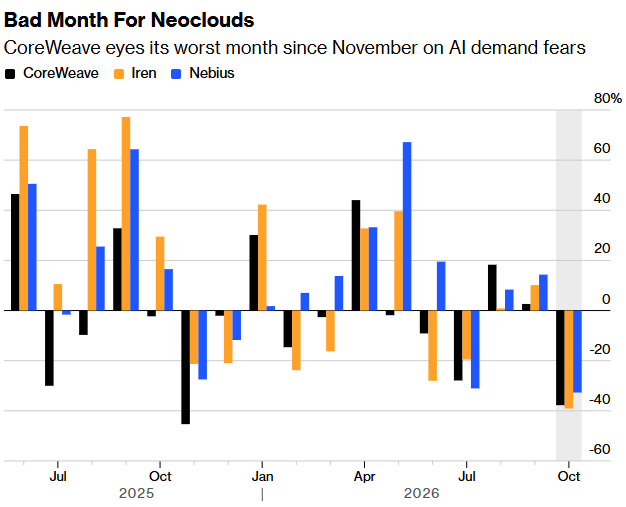
At the center of the storm is CoreWeave (CRWV.US). After its bonds fell to difficult levels this month, the company's stock price has dropped 41% since October 6 — the day major US stock indices hit record highs. Other “neocloud” (neocloud, that is, companies that rent computing power to companies that build and run AI models) also recorded double-digit declines during the same period: Iren Ltd. (IREN.US) fell 40%, and Nebius Group NV (NBIS.US) fell 36%.
Bonds won first, not stocks
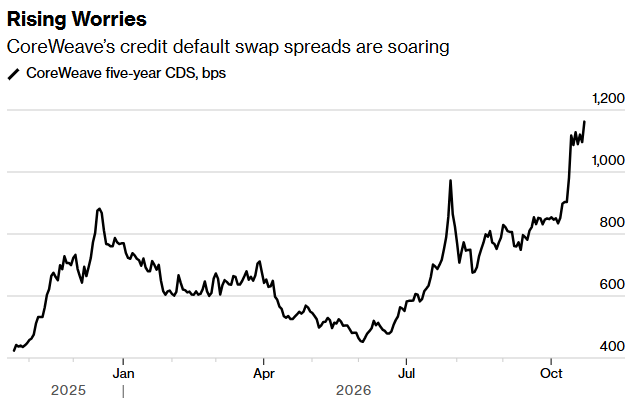
What really comes first is debt. On October 14, CoreWeave's bond, which matures in 2032 and has a coupon interest rate of 9.625%, once reached 15% in the secondary market; venture capitalist Chamath Palihapitiya posted this yield chart on social platforms, and Musk only replied with one word: “Yikes” (scary). In the same period, CoreWeave's 5-year credit default swap (CDS) spread exceeded 1,000 basis points — in comparison, SoftBank Group was about 424 basis points and Oracle was about 288 basis points; the implicit default probability of a 5-year CDS rose to about 60%.
Behind the numbers is the shape of this business: CoreWeave buys GPUs in large quantities, builds data centers, and then rents computing power to AI companies on an hourly basis. Expansion is almost entirely dependent on borrowing. Its total debt rose from about 15 billion US dollars a year ago to about 52 billion US dollars at the end of June; interest expenses in the second quarter were 640 million US dollars, compared to 267 million US dollars in the same period last year; revenue for the quarter more than doubled to 2.58 billion US dollars, but still had a net loss of 626 million US dollars. Some analysts put it bluntly: if a company borrows money at 9% of the cost, and the best return on these investments is only 5%, then every step of expansion destroys the value of the enterprise.
Wall Street gave it a name — the “canary in the mine” of AI trading. The reason is not volume; it is one of the few samples of high-frequency public credit quotes in the AI capital expenditure chain: bonds are priced for cash flow, stocks are priced for narrative, so alarms are always issued first from the bond market.
It's not just the secondary market valve being tightened. In mid-October, South Korean AI computing power provider Elice plummeted 32% on the first day of its listing in Seoul; Australia's Firmus Grid abandoned its public listing plan; and the UK's nScale faced resistance in valuing its IPO target. CoreWeave CEO Mike Intrator also acknowledged in an internal memo that “the weakness and delays surrounding competitors' IPOs and debt financing” are infiltrating CoreWeave's narrative, while calling the market's performance “irrational.”
From “micro” to “macro”
Investors are worried not only about how much they have borrowed, but also how much more they will borrow after the earnings season. Last week, the credit risk indicators of some major AI spending technology companies were pushed to new highs.
On that difficult Thursday, October 22, the Nasdaq 100 index fell nearly 3%, the S&P 500 index recorded its worst single-day performance since the end of July, and the Philadelphia Semiconductor Index fell 6.72% in a single day. Prior to that, Fee Half had been falling for 8 consecutive trading days, the longest losing streak since the 2008 financial crisis.
“It's now moving from a micro event to a macro event.” Brian Reynolds, chief market strategist at Reynolds Strategy LLC, said about the sell-off of Xinyun shares, “In other words, it not only impacted Xinyun, but the entire credit market, and then the stock market.”
Reynolds expects further sell-off, which could bring the S&P 500 back to its low in early June — meaning another 4.7% drop from the index's closing last Friday. Based on the calculation of the S&P 500 index closing at 7,623.68 points on October 23 and a low of 7,265.99 points on June 10, this decline was about 4.7%, which is in line with his estimates. He also pointed out that the S&P 500 has already fallen below the 50-day moving average on Thursday and may fall all the way back to the June low, and that is where he is willing to take action. “I'm going to be defensive in the next few weeks,” Reynolds said. “I really want to buy as low as 7,200 points.”
How are financing costs transmitted to the chip?
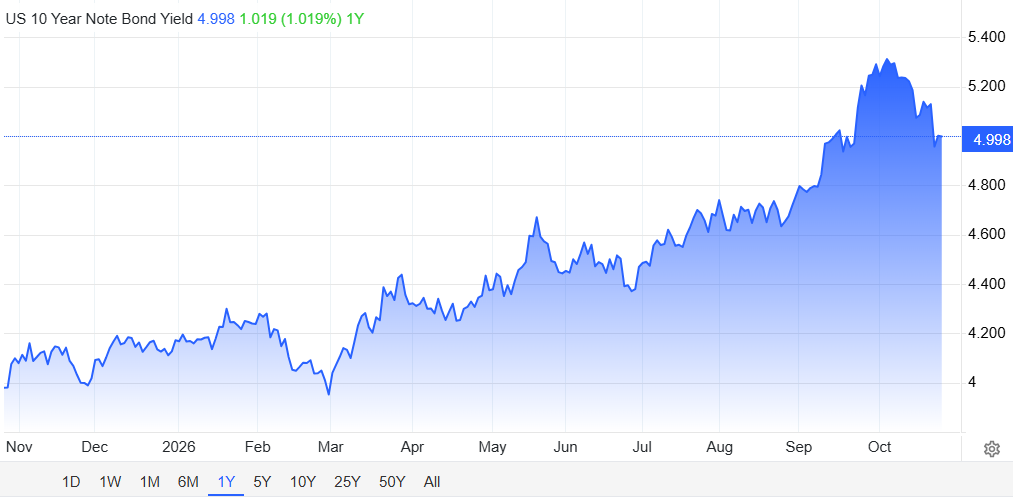
Xinyun is highly dependent on issuing bonds to support expenses. As US bond yields rise and inflation remains stubborn, financing costs are rising.
Luis Alvarado, co-head of global fixed income strategy at Wells Fargo Investment Research Institute, put it more bluntly: The wave of loose financing experienced in the first nine months of this year is beginning to subside. “Now every additional capital, especially marginal additional capital, will be subject to more strict scrutiny,” and investors will carefully evaluate how much additional income compensation issuers are willing to provide.
CoreWeave is also looking for cheaper money — the company is reportedly trying to get more chip-backed debt to get investment-grade ratings in order to use the insurance institutions' capital pool; co-founder Brannin McBee said the insurers' capital was “limitless,” and emphasized that he didn't view such debt as a “terrible debt.”
Ohsung Kwon, chief stock strategist at Wells Fargo Bank, pointed out that if Xinyun cuts future capital expenditure plans to appease investors, it will be a major headwind for the semiconductor sector — the latter's revenue comes directly from data center developers that pay huge sums of money for chips.
“If they start to see risks on the financing side, and the market is far more resistant to their capital expenses than today, if they cut capital expenses next year, then it is a risk for semiconductors.” Kwon said in an interview.
This concern has weighed on the Philadelphia Semiconductor Index: the index has fallen 15% since October.
More than technology: a “reality test”
More than tech stocks. A number of Wall Street strategists have warned that the collapse of the new cloud is providing a “reality test” for the wider market — at a time when investors are already anxious about the AI bubble.
“If the AI bubble were to burst, it is likely to start with a credit incident: Xinyun and high-risk AI debt defaults, triggering a series of valuation contractions, and spending cuts and contractions (both valuation multiples and growth contractions).” Tom Essaye, founder of Sevens Report, wrote in a report last week. He added that he continues to monitor pressure signals in the credit market.
Barclays's team of strategists led by Venu Krishna pointed out that Xinyun shares are currently showing an “asymmetric” response to credit pressure — “The widening spread has caused an excessive decline, and the relief brought about by the narrowing of interest spreads is very limited, which highlights the market's doubts about the durability of Xinyun's business model.” They wrote in last week's report.
However, Krishna also said that although he is looking for “signs of infection” in the stock market, he has yet to see any evidence that the problem has spread beyond technology and growth stocks. Investors have been rotating from high-ranking tech stocks to the defensive sector. This is more like uncertainty about AI transactions, rather than the indiscriminate decline of all assets being sold at the same time.
However, once the sector with the most weight is sold, the index will be dragged down. Also on Thursday, the S&P 500 fell by more than 1%, and the number of companies that rose that day was actually higher than the number of companies that fell.
“Tail wagging dog” or “here comes the wolf”?
The market's characterization of this alert is still divided. One view is that CoreWeave is limited in size and highly leveraged, and is a secondary link in the industrial chain. Now disrupting trillion-dollar AI transactions, it is a typical “tail wagger” — a real local credit incident has been excessively extrapolated into a reversal of the entire AI transaction. Another view emphasizes that pressure has spread from the bond market to the stock market, and giants such as Nvidia and Meta have also been involved in sell-offs.
The earnings season's performance was intriguing: Meta's revenue exceeded expectations, but it experienced a sharp drop due to huge capital expenditure and cash flow pressure; ultra-microcomputers revealed strong preliminary revenue data, which still did not dispel doubts; Tesla lowered its capital expenditure plan, which also raised concerns about insufficient investment in AI. Even if Western Digital handed over perfect financial reports, it was not favored by investors. Simply put, too much investment falls, and investment falls when it falls short of expectations — AI narratives that were once chased by capital suddenly welcomed picky readers.
Gartner, on the other hand, gave a longer-term warning: AI infrastructure investments of more than $3.5 trillion are at risk of depreciation, and it may be difficult for more than 80% of new cloud service providers to operate independently by 2030.
There are still a few hurdles this week: the Federal Reserve's October 27-28 interest rate meeting (market expectations remain on hold), as well as financial reports from Microsoft, Google, and Amazon, will all provide new evidence about technology spending and profitability. Reynolds' choice was to wait a few weeks on the sidelines first — wait for that 7,200 points.