
Dividend Reset Could Be A Key Test For Blue Owl Capital Stock
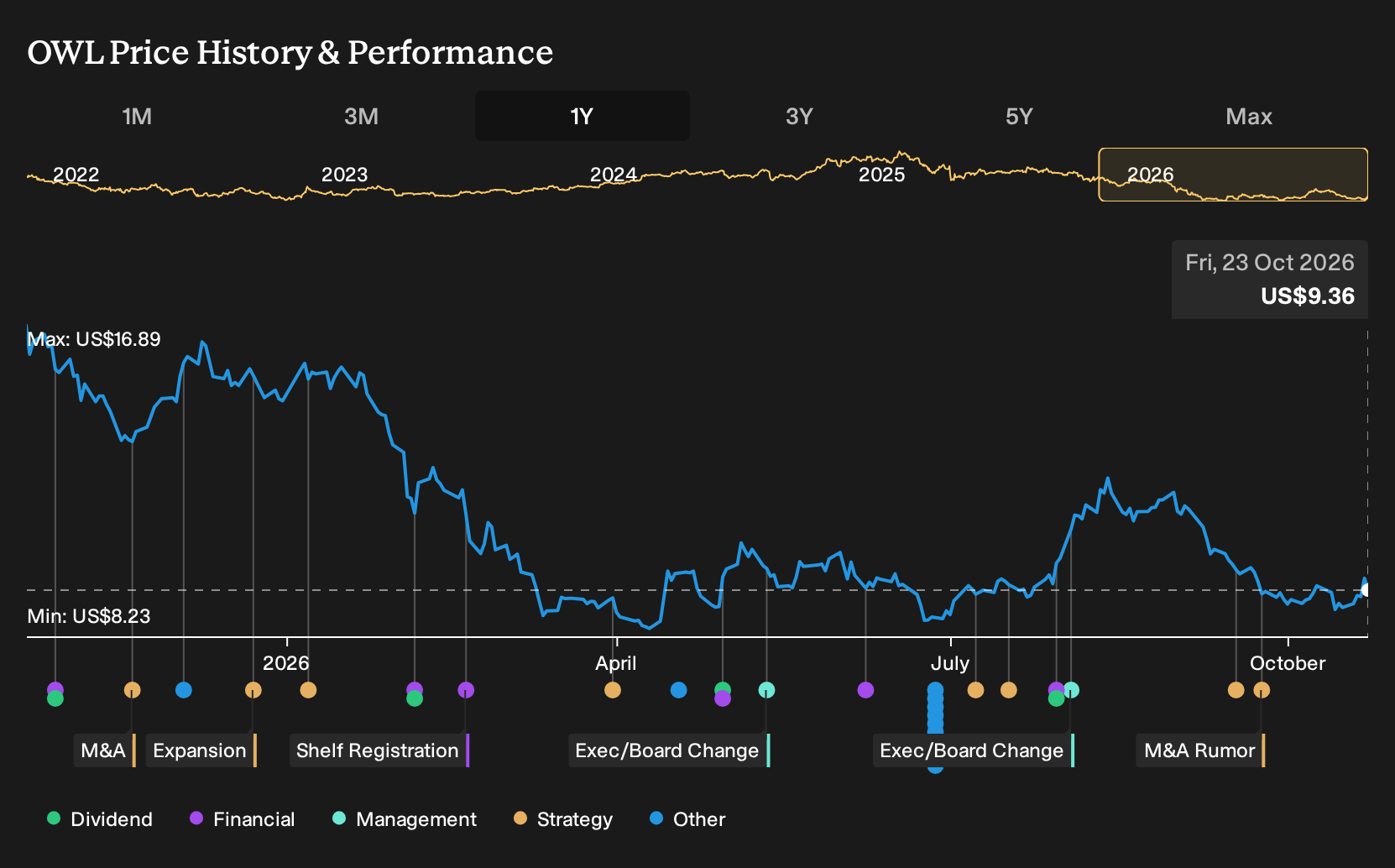
- Blue Owl Capital Corporation reset its base dividend to US$0.31 per share, which management aligned with recent earnings, after reporting second quarter adjusted net investment income of US$0.34 per share and noting some yield pressure on new lending commitments.
- The revised dividend framework, which leaves room for supplemental payouts while a Moody’s investment grade rating and low leverage support the balance sheet, puts more focus on how efficiently Blue Owl Capital converts its private credit portfolio into recurring cash generation.
- We will look at how Blue Owl Capital's recalibrated base dividend framework shapes the broader investment narrative around its fee engines.
Blue Owl Capital Investment Narrative Recap
To own Blue Owl Capital you need to be comfortable with a story built on fee based cash flows from permanent capital vehicles and private credit, real assets and GP stakes. The base dividend reset closer to earnings suggests management is trying to line up cash out with what the lending book is producing. This makes the current payout look more closely tied to operations.
The most important near term swing factor is still whether Blue Owl Capital can keep growing fee paying AUM while dealing with slower fundraising, capped withdrawals in some funds and yield pressure on new loans. The biggest operational risk remains pressure on distributions if earnings or cash coverage of that high headline yield weaken further.
The recent adjustment of the base dividend to US$0.31 per share sits at the center of this discussion. It follows adjusted net investment income of US$0.34 per share, which leaves a small cushion and keeps room for supplemental dividends rather than locking everything into the regular payout.
For you as a shareholder, that reset matters because dividend sustainability has been flagged as a weakness, with payouts not well covered by earnings or free cash flow. How consistently Blue Owl Capital converts its lending and fee engines into cash distributions, while managing a high level of debt and some fund redemption pressure, will likely drive how investors treat the stock around upcoming earnings prints.
Blue Owl Capital's current analyst story points to forecast revenues of US$3.5b and expected earnings of US$847.0 million by 2029, based on projected annual revenue growth of 5.8% and an earnings increase of roughly US$766.1 million from US$80.9 million today.
Uncover why Blue Owl Capital's fair value indicates a 34% potential upside to its current price, a discount that could narrow quickly.
Exploring Other Perspectives
One alternate view on Blue Owl Capital focuses on execution risk in digital infrastructure. Bears argue that delays such as the Jupiter project could make prior revenue expectations of about US$3.4b and earnings of roughly US$984.0 million by 2029 look optimistic. Those lower analysts already saw the stock as fairly valued. You can treat this dividend reset and earnings setup as a fresh signal, then compare how both narratives might shift from here.
Explore 7 other Blue Owl Capital fair value estimates, including one that suggests as much as 88% downside from the current price.
Form Your Own Verdict
Disagree with existing narratives? Extraordinary investment returns rarely come from following the herd, so go with your instincts.
- A great starting point for your Blue Owl Capital research is our analysis highlighting 2 key rewards and 3 important warning signs that could impact your investment decision.
- See our latest analysis for Blue Owl Capital. The report includes a comprehensive fundamental analysis summarized in a single visual, the Snowflake, making it easy to evaluate Blue Owl Capital's overall financial health at a glance.
Looking For More Ideas Beyond Blue Owl Capital?
If the Blue Owl Capital story has sharpened your thinking around income, risk and balance sheet quality, it can be useful to put those same filters to work on a wider watchlist. Use the Simply Wall St Screener to scan for other businesses that match the profile you are looking for, then compare how their cash generation, payout policies and financial strength stack up.
- For investors who care most about resilient balance sheets, start with a list of solid balance sheet and fundamentals (24 results) and see which businesses pair financial strength with consistent fundamentals.
- If capital preservation comes first for you, filter for defensiveness using a 30 resilient stocks with low risk scores that highlights companies with more resilient risk profiles.
- When you want something less crowded, search beyond the usual tickers with a 21 high quality undiscovered gems that surfaces financially strong stocks that are not yet widely followed.
Have feedback on this article? Concerned about the content? Get in touch with us directly. Alternatively, email editorial-team@simplywallst.com