
Goldman Sachs linked a $210 billion financing order in a single day! AI's “financial relay” boosts confidence, adding momentum to the semiconductor bull market narrative
The Zhitong Finance App learned that as Wall Street financial giant Goldman Sachs won a large financing order of 210 billion US dollars, the US semiconductor sector continued the rebound trajectory last Friday and the market began trading the “financial relay” logic — with the release of three critical AI financing news, Wall Street institutional investors' concerns about the AI computing infrastructure financing crisis have clearly abated.
The sharp sell-off of semiconductors and a wide range of technology stocks in the US stock market that occurred last week is because market participants are generally constantly questioning “who will bear the huge costs associated with the construction of trillion-dollar AI computing power infrastructure.” These three pieces of news on Monday answered Wall Street questions to a certain extent: Meta equity financing, SpaceX leases large-scale AI computing power equipment resources, and Anthropic is an IPO financing, and AI capital expenditure is expected to continue to receive strong market capital support.
Goldman Sachs is turning the huge financing needs of the AI computing power industry chain into multiple revenue growth opportunities for underwriting, transaction structure design, and asset management. Among the three deals announced on October 26, Goldman Sachs co-led Meta's approximately US$95 billion share financing plan, acted as the sole structured agent for SpaceX's US$40 billion chip financing, and obtained the position of chief bookkeeping manager of Anthropic's initial public offering (IPO).
According to the proposed scale of participation, some institutions estimate that the total amount of related transactions is at least 210 billion US dollars, which may bring tens of millions or even hundreds of millions of dollars in fee revenue to the established Wall Street financial giant Goldman Sachs. The significance behind these developments is that Goldman Sachs can simultaneously connect issuers, open market investors, and private equity capital to continue to undertake financing operations during the AI computing infrastructure construction cycle — that is, Goldman Sachs also participated in the three large-scale AI financing transactions of Meta stock issuance, SpaceX chip financing, and Anthropic IPOs; these amounts represent the scale and expectations of the transaction, not Goldman Sachs revenue, and not all of them have been paid.
Three recent AI computing power industry chain news specifically answered the continuation path of capital during construction: Meta promotes equity financing, SpaceX supports chip procurement through equipment finance leases (Finance Lease), and Anthropic promotes initial public offerings (IPOs) to jointly broaden the funding sources of this unprecedented AI investment frenzy. It can be deduced from this that the market is re-evaluating the possibility that the procurement process of AI computing power resources will slow down and large-scale orders for core AI infrastructure hardware such as AI chips will be postponed due to financing pressure. This is the core mechanism of “financial relay” to support the semiconductor counterattack.
Furthermore, at a time when Meta Muse and OpenAI's GPT-6 Astra are fully detonating a wave of AI agents, “AI FOMO transactions” (meaning investors are worried about missing out on rising opportunities in AI-related assets, and are therefore chasing down or making up for previously lowered positions) can be described as making a comeback. Looking at the underlying architecture of AI computing power infrastructure, Muse and Astra are expected to further expand the scope of use of AI agents. The massive expansion of AI inference workloads brought by them will also increase the demand for model inference, tool execution, and state management, while deepening the competitive pressure on some software companies. According to the AI capital expenditure forecast and outlook of the J.P. Morgan strategist team, hyperscale cloud vendors will spend about 950 billion US dollars in 2026, 1.4 trillion US dollars in 2027, and 3 trillion US dollars in 2030.
With regard to AI trading and technology stock sell-off — that is, the memory chip sector, which has recently been hit hard, market bullish sentiment and fundamental optimism are still strong. According to KeyBanc's recent Asian research data, AI data centers are still absorbing the supply of AI computing power resources such as storage on a large scale, driving the price increase to 2027. The agency predicts that the HBM hybrid price is expected to rise sharply by 80% to 100% in the first quarter of 2027. At the DRAM memory price level, KeyBanc predicts that the fourth quarter of 2026 will rise 15% to 20% month-on-month under the strong price increase base in the third quarter, and 10% to 15% in the first quarter of 2027; in terms of future NAND pricing, it is predicted that the fourth quarter of 2026 will rise by about 20% month-on-month under the strong base in the third quarter, and another 10% to 15% in the first quarter of 2027.
From the perspective of AI inference system architecture, more complex AI tasks led by Meta Muse often include longer context, multiple rounds of model calls, tool execution, and result verification: prefill (prefill) requires processing input, decode (decode) continuously generates output, and key value cache (KV Cache) takes up more memory as context and concurrency scale expand, and computational throughput, memory bandwidth, and capacity need to be increased collaboratively. Therefore, as cutting-edge intelligence such as Meta Muse further detonates the demand for AI computing power, the core inference for the AI computing power industry is that GPUs, TPU/AI ASIC core AI computing chip components undertake model calculation, high-performance data center CPU execution and task orchestration, HBM, server DRAM, storage and high-performance network infrastructure, and data center optical interconnect devices all support efficient data transportation and state management; ultimately, it is necessary to deliver a complete set of AI computing power server clusters that will continue to operate continuously in the future service.
The semiconductor sector appears to have rebounded to begin trading “capital relay”
The semiconductor sector, which accounts for an important share of market capitalization in the long-term bull market curve of the US stock market, has stabilized partially from last Friday to a broader recovery and counterattack logic on Monday.
On October 23, the Philadelphia Semiconductor Index rose 0.44% and Micron rose 2.46%; on October 26, the Fee Half rose further by 2.82%, while the Nasdaq Composite Index and the Nasdaq 100 Index rose 0.83% and 1.09% respectively. Nvidia rose 2.39%, and the market's eye on the AI computing power theme — that is, the bullish sentiment in the field of memory chips seems to be making a comeback. Memory chips can be described as leading the semiconductor sector in the US market — SK Hynix's US stock ADR surged more than 4%, Micron's stock price rose 2.98%, and SanDisk rose 1.42%; the stock prices of the world's largest data center HDD manufacturers Western Digital and Seagate rose 3.63% and 2.18% respectively. Analysts generally listed Anthropic's public submission of IPO documents as an important factor in boosting AI sentiment, but the cumulative decline in October was still about 12.2%. The current market first reflects revisions to financing prospects related to AI computing power infrastructure and previous excessively pessimistic pricing, as well as the market's beginning to trade the “AI computing power infrastructure funding relay” logic.
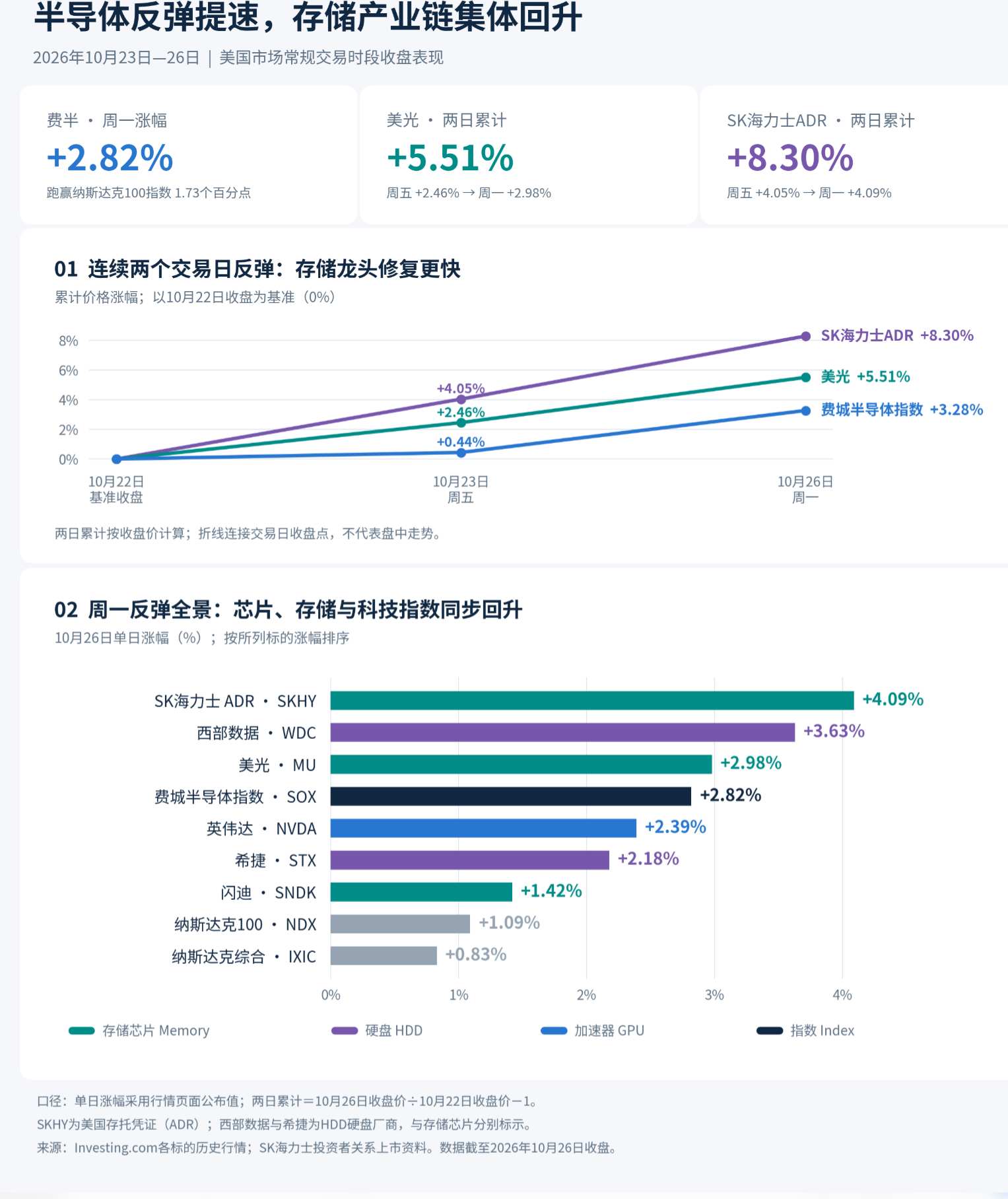
The key logical change in this round of AI computing power infrastructure financing themes is that equity capital and equipment financing are jointly supporting AI investment and reducing the construction cycle's dependence on a single corporate bond channel.
Among them, Facebook and Instagram parent company Meta have already initiated an underwriting distribution of about 35 billion US dollars, and plans to launch an At-the-Market Offering (ATM) plan (ATM) of about 60 billion US dollars; SpaceX has obtained a GPU financial lease promise of about 40 billion US dollars, which is expected to be settled by the end of 2026 and leased in the first half of 2027. Anthropic, on the other hand, has yet to determine the number and price of IPOs. It is deduced from this that if additional share capital is successfully raised, it will enhance the model company's ability to pay for computing power; equipment financing helps operators to bear upfront procurement expenses in installments, thereby increasing the possibility of chip supplier order fulfillment.
This kind of financial relay can be described as occurring at a time when the credit market continues to be pressured, and it can be said that it has brought a dose of super “strength” to the stock and bond market. CoreWeave (CRWV.US) 5-year credit default swap (CDS), which is at the core of the “AI computing power sell-off storm” and the “AI bubble bursting argument” — was about 1,148 basis points on the morning of October 26; based on a 40% recovery rate assumption, it corresponds to a 5-year cumulative implied default probability of about 62% — this figure includes a market risk premium and is not an actual bankruptcy forecast. Earlier, on October 22, the media reported that the yield on bonds due in 2031 was about 15.76%; SoftBank's five-year CDS reached 432 basis points on October 20, and the longest US dollar bond issued in September was an astonishing 9.75% — the 9.75% coupon is SoftBank's own record for issuing bonds, and it is also one of the largest issues in the history of high-yield bonds in the world.
High-rated tech giants' credit bond yield indicators are also facing repricing: according to the October 5 secondary market quotes, the yields of Microsoft's 2060 bonds, Google's parent Alphabet 2075 bonds, and Meta 2064 bonds are about 6.36%, 6.84%, and 7.48%, respectively; the quotes of these different term bonds reflect the surge in global credit bond yields and liquidity compensation in the context of the surge in AI financing benchmark costs driven by the benchmark 10-year US bond yield. This is not the actual negative pricing rate of all corporate debt.
Stock performance also shows that funds are being selected. From October 19 to 23, Meta, Alphabet A shares, and Microsoft fell by about 9.40%, 5.98%, and 0.86%, respectively, Nvidia fell by about 1.48%, and the Philadelphia Semiconductor Index fell by about 3.21%; as of October 26, CoreWeave fell more than 30% in the same month. As a result, Nvidia and Fivan both outperformed Meta and Alphabet each week, but Microsoft only fell 0.86%, which is more resistant to falling than Nvidia. This also clearly shows a sharp divergence in the performance of popular AI-related assets.
Goldman Sachs's ability to organize large amounts of financing shows that the capital market is still willing to fund some AI companies, but the ability to finance is increasingly dependent on customer quality, asset protection, and cash flow. For semiconductors, the most direct benefit is that customer procurement budgets receive financial support; for AI financing companies closely linked to AI computing power infrastructure, investors will still measure whether the additional capital can bring sufficient returns.
Judging from the investment logic of the AI computing power industry chain, the recent semiconductor counterattack market in Philadelphia reflects the resonance of order confirmation, repurchase support, and risk appetite restoration. It also echoes the continued surge in revenue generation associated with Meta and SpaceX's AI applications, further expanding investment in AI computing power resources, and the industrial background of KeyBanc and TrendForce optimistic about storage pricing — pressure on global semiconductors and broad technology stock valuations does not necessarily mean that AI demand is declining at the same time; those can transform overseas capital expenditure into actual delivery, profit, and cash flow Leaders in the fundamental AI computing power industry chain, such as Nvidia, the AI chip superleader, are getting an opportunity for the market to re-examine their value.
Nvidia, with a market capitalization of about 5.2 trillion US dollars, is still an important bullish pricing anchor for Zhongher Street in this round of intense market differences. Citi maintained a “buy” and target price of $315 in the Berlin GTC review on October 22, believing that the main factor limiting AI expansion is still the speed of manufacturing and deployment; Morgan Stanley resumed its “semiconductor first choice” status on October 2 and maintained a target price of $300. The Bank of America's August report also listed it as the first choice, with a target price of $350. Jefferies reiterated a “buy” of $300 at the end of August. These judgments are supported by the volume of Rubin and Vera CPUs, the expansion of the customer range, and Nvidia's ability to increase the computational output and system value that can be delivered per unit of electricity.
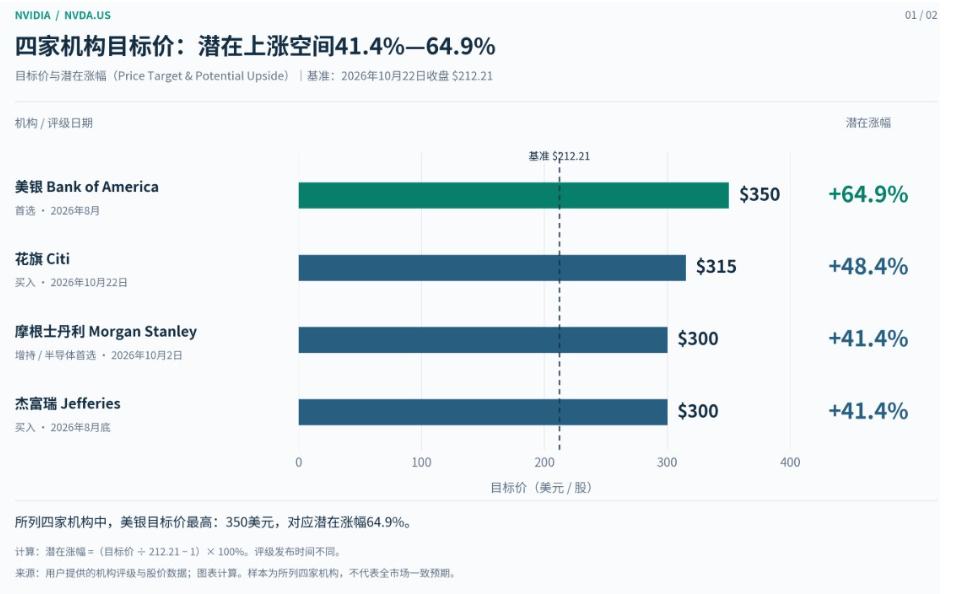
Based on Nvidia's closing price of $212.21 on October 22, $300, $315, and $350 correspond to potential growth potential of about 41.4%, 48.4%, and 64.9%, respectively; based on a total share capital of about 24.1 billion shares, it is estimated that the total share capital remains unchanged, corresponding to a market capitalization of about 7.23 trillion yuan, 7.59 trillion US dollars, and 8.44 trillion US dollars. This set of pricing expresses a judgment on future profit expansion. The fulfillment path still revolves around the delivery of the next-generation AI computing power cluster superplatform, the launch of customer computing power, and continuous procurement.
An unprecedented AI financing frenzy pushes Goldman Sachs to participate in at least $210 billion a day
According to information, the three huge artificial intelligence financing deals announced during the US stock trading session on Monday morning EST all appeared under the same name: Goldman Sachs Group.
The Wall Street bank co-led Meta Platforms' $95 billion stock offering, was SpaceX's sole structured agent for a $40 billion chip financing deal, and was designated as the chief bookkeeping manager of Anthropic's large-scale initial public offering — an IPO that is expected to be at least as large as SpaceX's June listing financing.
These large-scale deals, totaling at least US$210 billion, will bring rich revenue to Goldman Sachs. Goldman Sachs is likely to be paid at least tens of millions of dollars, or even hundreds of millions of dollars for related work.
Goldman Sachs's important position in Anthropic's IPO came as a surprise to some, as Morgan Stanley had previously taken the lead in expanding the AI company's revolving credit line. A person familiar with the matter said that the customer relationship between Goldman Sachs and Anthropic is handled by San Francisco-based bankers Nick Giovanni and Zheng Min, who are also important bankers serving Nvidia.
A Goldman Sachs representative declined to comment.
Wall Street has always competed to finance the AI boom, including meeting the rapid growth in demand for chips and data centers to provide the computing power necessary to support this technology. However, the continuous influx of debt and equity capital into this field, combined with the cash consumption of cutting-edge AI laboratories, has also raised concerns that some of the financing may be difficult to sustain.
These growing concerns are being reflected in the bond and stock market performance of companies such as CoreWeave. Over the past month, the stock prices of some new cloud vendors have dropped sharply. These companies provide computing power to companies that develop and run artificial intelligence models.
Although Wall Street banks have yet to disclose in detail the fee revenue directly derived from the AI boom, the surge in capital demand has fueled the growth of their investment banking business. In the first nine months of this year, the total underwriting revenue of the five largest institutions was about US$19 billion. Among them, equity capital market business revenue increased 48% and bond underwriting revenue increased 13%.
Goldman Sachs has been actively seeking to participate in this boom, including becoming the only bank in a partnership. The partnership promised in August to finance Nvidia customers' chip transactions with $500 billion.
In the SpaceX deal announced on Monday, Elon Musk's company will purchase Nvidia chips through a lease arrangement with Apollo Global Management. Goldman Sachs acted as a structural agent, and funds managed by its asset management department also promised to invest in the transaction. Another person familiar with the matter said that the deal was separate from Nvidia's cooperation plan and was gradually brokered after Goldman Sachs received a call from SpaceX a few months ago. Since non-public information was being discussed, the person also requested anonymity.
In June of this year, Goldman Sachs became the lead bookkeeping manager for SpaceX's record IPO, and received $100 million in fees as a result. This achievement is based on years of operating customer relationships between veteran bankers Dan Dees, Kim Posnett, David Ludwig, and Susie Schell.
Some media recently reported earlier this month that Goldman Sachs also received hundreds of millions of dollars in additional revenue through performance rewards related to the early investments it helped high-net-worth clients arrange.
Goldman Sachs is also one of the advisors for Google's parent company Alphabet's more than $80 billion series of shares. The issuance plan is one of the largest share financings in history. The main bankers responsible for the deal, Posnett and Yasmin Kupal, also promoted the Meta deal announced on Monday.
Last year, Goldman Sachs set up a capital solutions division led by Pete Leon and Mahesh Seredi to collaboratively use the capabilities of different departments such as asset management, investment banking, and even trading business when designing large-scale financing solutions for enterprises.
“We think we're at the center of this investment supercycle.” Goldman Sachs President John Waldron said this earlier in May of this year.
Significant improvements in Anthropic's operations meet historical undervaluation of memory chips: two important support lines for semiconductor counterattacks
Anthropic's IPO filing provides a more explanatory operating signal than the “net loss of US$80.7 billion”: revenue for the first half of the year was US$16.286 billion, and operating losses narrowed to US$693 million; of the net loss of US$80.748 billion, losses due to changes in fair value of financing instruments such as convertible notes alone reached US$72.388 billion. Therefore, a huge net loss cannot be equated with the consumption of cash. Computing power and infrastructure spending during the same period was US$8.945 billion, accounting for about 55% of revenue, and fell further to about 48% in the second quarter, indicating that revenue expansion is faster than this major cost project.
Anthropic has more than 1,900 customers contributing one million dollars in annual revenue, and a net revenue retention rate (Net Revenue Retention) of about 900%, which indicates that the revenue of the same customer group that meets the statistics has increased rapidly; the latter indicates that the revenue of the same customer group that meets the statistics has increased about nine times, not nine times the average consumption of each customer.
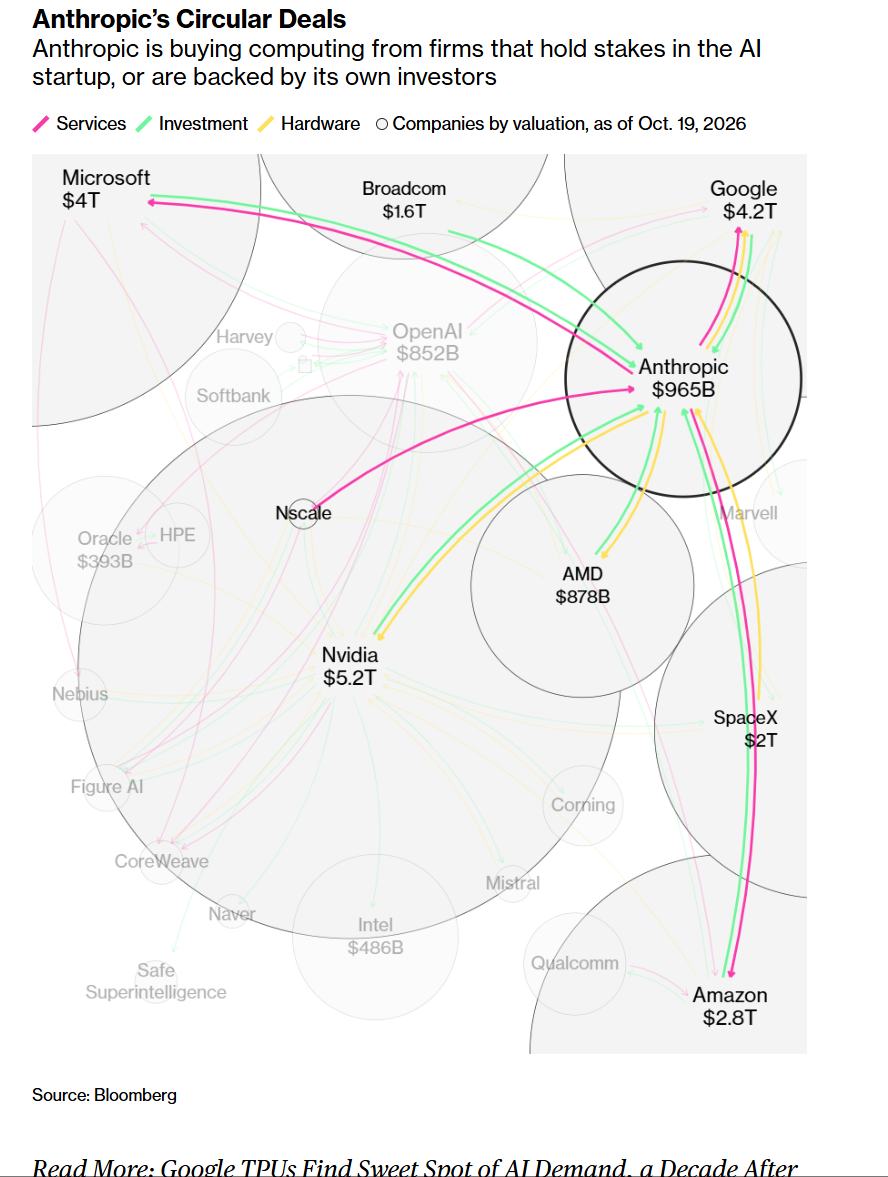
Combining management improvement with equity financing is the core mechanism for IPOs to support the computing power industry chain. Anthropic has disclosed that Broadcom-related equipment leases are about US$161.2 billion, SpaceX AI's arrangement to provide Nvidia's computing power is up to US$120.5 billion, and Nscale services are up to US$44.6 billion, corresponding to different terms and conditions of contract. If additional capital is added to the company, the IPO can improve the ability to fulfill these future payment arrangements, thereby supporting the needs of the entire AI computing power industry chain, such as AI GPU/TPU/ASIC accelerators, memory/memory chips, network infrastructure, data center optical interconnection, CPU, and 2.5D/3D cutting-edge advanced packaging and testing. At the same time, the final issuance valuation will still reflect long-term computing power obligations, security responsibilities, and governance arrangements; currently, public reporting means that the financing window has entered the inspection stage, which does not yet indicate that the fund-raising has been completed.
The Korean memory chip sector, which has two of the world's largest memory chip giants — SK Hynix and Samsung Electronics — provided another bullish basis: the stock price has taken into account a pessimistic downward scenario far more stringent than current profit expectations.
Goldman Sachs recently lowered the 12-month target for the KOSPI Index, the benchmark stock index of the Korean stock market, from 12,000 points to 9,000 points, mainly using more conservative valuation assumptions. At the same time, it believes that the current Korean stock market semiconductor valuation implies a sharp drop in profit in 2027 by 65%. The consistent market expectations can be described as too pessimistic. KOSPI's forward price-earnings ratio is about 4 times, and the non-storage sector is about 7.6 times, reflecting the market's strong discount on profit sustainability. Although Goldman Sachs was lowered to 9,000 points, the 9,000 point target still corresponds to a potential increase of about 64.5% based on the closing of 5,469.47 points on October 26. If AI procurement continues and profits do not experience the implicit collapse in stock prices, there is a fundamental basis for valuation repair.
Funding actions are providing the conditions for this repair. According to Goldman Sachs tracking data, technology-related stocks were net sold for about 20 billion US dollars in the past two weeks, and the Nasdaq 100's volatility premium against the S&P 500 rose to the 98th percentile of the five-year range, indicating that defensive transactions are already highly concentrated. On the other hand, from October 1 to 23, Korean individual investors made net purchases of leveraged products related to Samsung and SK Hynix, about 315.4 billion won; from October 1 to 22, Korean investors made net purchases of SOXL (that is, tracking three times the Philadelphia Semiconductor Index and looking at multi-leveraged ETFs — the US stock code “SOXL”), accounting for about 73.9% of the net purchase amount of US stocks during the same period. These buys show that expectations of a rebound are accumulating, but their leveraged nature also means that the market may continue to fluctuate sharply.
The semiconductor counterattack market, and even the most persuasive combination of optimistic signs that it has entered a new round of “main upward wave” super bull market trajectory, can be described as the active implementation of financing linked to AI computing power infrastructure, and the growth in application revenue, and the cashing out of supplier profits. Goldman Sachs undertook financing, Anthropic showed operational improvements, and Korea Storage showed extremely undervaluation, corresponding to the three aspects of capital supply, terminal monetization, and asset price support, respectively. If the tech giants' earnings report further confirms order conversion and cash flow improvements, the market has reason to lower its bets on a sharp drop in computing power purchases, extending the current rebound from position repair to profit-driven revaluation.