
How AI Factory Expansion At Dell Technologies (DELL) Has Changed Its Investment Story
- Dell Technologies has rolled out a wide range of AI Factory hardware, deskside agentic AI systems and modular data center designs with NVIDIA, while Honeywell has begun deploying Dell backed AI platforms like Forge Cognition and Forge Plant Cognition into real world facilities.
- These AI infrastructure launches and customer deployments highlight that Dell Technologies is not just selling components but supplying end to end platforms that support complex workloads from industrial plants to telecom networks.
- We will now look at how Dell Technologies' expanded AI Factory with NVIDIA product stack could influence its broader investment narrative.
Scan Dell Technologies' AI build out against a curated list of peers by jumping into 55 AI infrastructure stocks that are already geared for heavy agentic and data center workloads.
Dell Technologies Investment Narrative Recap
To own Dell Technologies, you need to believe the AI infrastructure cycle and broader data center demand eventually convert that US$95b AI backlog into shipped systems and cash, while storage and services keep supporting margins. The near term swing factor remains how much of that order book shows up in free cash flow and earnings over the next few quarters.
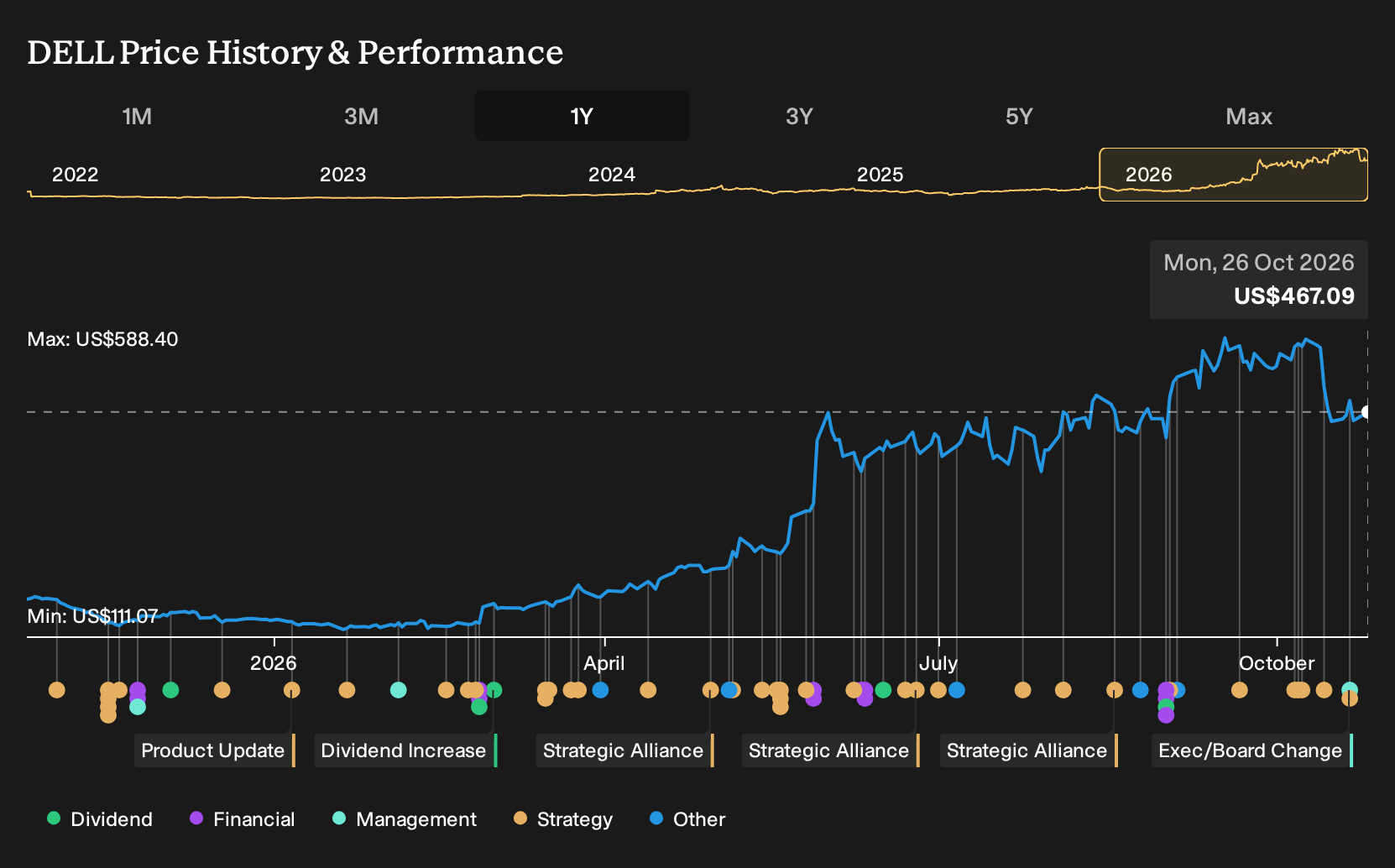
The biggest operational risk is that rate dilutive AI servers, tight component supply and pressure in more commoditized PCs and traditional servers stop overall margin progress. The recent stock pullback after the Barclays downgrade reflects those concerns, but the latest AI Factory launches do not materially change that central risk reward balance yet.
The most relevant update is Dell Technologies expanding the Dell AI Factory with NVIDIA into full agentic AI platforms, including deskside reference designs and modular data center blueprints. That points directly at the backlog conversion question, because these are the types of integrated systems enterprises would deploy as they shift from pilots to production AI workloads.
Real world rollouts like Honeywell’s Forge Cognition and Forge Plant Cognition, both running on Dell AI Factory infrastructure, give investors concrete examples of that thesis being tested on factory floors, campuses and refineries. Execution risk stays real, especially around component supply and lower AI server margins, but each deployment gives more evidence that Dell’s pipeline is tied to operational projects rather than just early stage experimentation.
Dell Technologies Consensus AI Assumptions
Dell Technologies sits on an AI story that analysts have already put numbers around, and those figures matter if you are weighing how much of the AI Factory narrative is already baked into the price. The consensus view assumes revenue can compound at 20.8% a year for the next three years, with profit margins edging from 7.5% today to 7.8% over that period. That is not a moonshot margin expansion; it is a small lift that leans heavily on mix, particularly higher contribution from storage, software and services that sit around those NVIDIA powered AI systems.
Current earnings sit at US$11.4b, and the analyst group expects that to move to US$20.8b by 2029, with a spread that runs from US$16.7b on the cautious side to US$24.4b on the optimistic side. That implies earnings need to increase by roughly US$9.4b from today’s level for the consensus to play out, which is a sizeable jump for a hardware heavy business. For context, consensus also calls for a gradual drop in the P/E multiple from about 32.0x today to 20.6x on those 2029 earnings. That lower future multiple is below the current 27.4x P/E used for the wider US tech sector in the same report.
These projections line up with a forecast that total revenue could reach about US$266.7b and earnings US$20.8b in 2029, which is the year analysts are anchoring their long term AI scenarios. Part of the bridge from here to there relies on share count drifting lower, with expectations that Dell Technologies reduces shares outstanding by roughly 4.06% a year for the next three years. That buyback path does not change the operating performance required, but it concentrates those forecast earnings per share, including the US$34.51 EPS estimate for 2029 that sits inside the consensus model.
Dell Technologies' narrative projects US$266.7b revenue and US$20.8b earnings by 2029. This leans on 20.8% yearly revenue growth and an earnings increase of about US$9.4b from US$11.4b today.
Uncover why Dell Technologies' fair value indicates a 27% potential upside to its current price, which could narrow quickly.
Exploring Other Perspectives
One alternate angle to watch is execution risk around Dell Technologies’ leadership shift as its AI Factory rollout accelerates. The most optimistic analysts already penciled in revenue of roughly US$308.9b and earnings of US$24.4b by 2029 before this news. Those forecasts reflect a much stronger AI conversion story. Use this as a cue to compare several viewpoints, then decide which narrative feels more realistic to you.
Explore 4 other Dell Technologies fair value estimates, including one that suggests as much as 57% upside from the current price!
Form Your Own Verdict
Disagree with existing narratives? Extraordinary investment returns rarely come from following the herd, so go with your instincts.
- A great starting point for your Dell Technologies research is our analysis highlighting 4 key rewards and 3 important warning signs that could impact your investment decision.
- See our latest analysis for Dell Technologies. The report includes a comprehensive fundamental analysis summarized in a single visual, the Snowflake, making it easy to evaluate Dell Technologies' overall financial health at a glance.
Looking For More Ideas Beyond Dell Technologies?
If Dell Technologies has sharpened your focus on AI infrastructure and cash flow quality, you can use that same lens on a wider watchlist. The Simply Wall St Screener lets you scan hundreds of listed businesses using the same fundamentals-first filter and quickly spot candidates that fit your own return and risk preferences.
- For investors who want potential upside with tighter risk controls, start by checking companies that show resilient balance sheets and cleaner fundamentals through the list of solid balance sheet and fundamentals (24 results).
- If value is your main priority, you can shortlist candidates that look mispriced on core metrics by running a screen across 29 high quality undervalued stocks that may warrant a closer look.
- Readers hunting for ideas that the broader market may be overlooking can scan for quality businesses off the radar using the 21 high quality undiscovered gems.
Have feedback on this article? Concerned about the content? Get in touch with us directly. Alternatively, email editorial-team@simplywallst.com