
Meet the Stocks Yielding 65%, 45%, and 41% Annually for Warren Buffett's Berkshire Hathaway
Key Points
Dividend stocks have more than doubled the average annual return of non-payers over the previous 52 years.
Companies that pay a recurring dividend are almost always profitable, time-tested, and capable of providing transparent long-term outlooks.
Berkshire Hathaway’s three longest-tenured holdings sport minuscule cost bases and outsize yields on cost.
For the first time in well over half a century, Berkshire Hathaway (NYSE:BRKA)(NYSE:BRKB) is in uncharted waters. Its longtime CEO, Warren Buffett, retired from his post on Dec. 31 and stepped down as chairman of the board in mid-September. The conglomerate he helped build into a trillion-dollar business has been fully turned over to his protégé, Greg Abel.
But the Oracle of Omaha left Abel on some pretty solid footing. He has an enormous treasure chest of capital to work with and a $368 billion investment portfolio that features three time-tested companies generating annual yields of 65%, 45%, and 41% for Berkshire. The companies powering these jaw-dropping dividends are Coca-Cola (NYSE:KO), American Express (NYSE:AXP), and Moody's (NYSE:MCO) -- but there's a catch behind these impressive yields.
Missed AI’s "Act 1"? Act 2 Could Be 15x Bigger. Most investors think they missed the AI boat because they didn't buy Nvidia in 2005. But according to our analysts, we’re only at the end of "Act 1"—the R&D phase. "Act 2" is the global rollout. Continue »
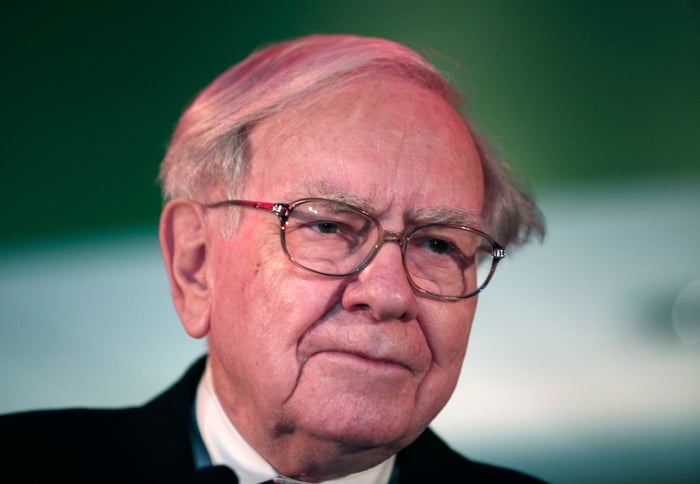
As an investor, Warren Buffett historically favored dividend stocks. Image source: Getty Images.
The Oracle of Omaha commonly gravitated toward dividend stocks
Warren Buffett has always been a stickler for value, favored companies with sustainable moats, and gravitated toward businesses that reward their investors. Typically, more than half of the companies held in Berkshire Hathaway's investment portfolio paid a dividend.
Dividend stocks are almost always profitable on a recurring basis, time-tested, and capable of providing transparent long-term outlooks for their investors. Perhaps most importantly, dividend stocks have a lengthy track record of outperforming.
In "The Power of the Dividends: Past, Present, and Future," analysts at Hartford Funds, in collaboration with Ned Davis Research, found that dividend payers averaged a 9.2% annual return from 1973 to 2025. By comparison, non-payers were more volatile and delivered an average annual return of just 4.21% over the same time frame.
With this long-term outperformance in mind, Buffett has used time to Berkshire Hathaway's advantage.

Image source: Coca-Cola.
Patience has paid off handsomely for Warren Buffett and Berkshire's shareholders
The not-so-subtle secret to the outrageous annual yields Berkshire is generating is patience.
On the surface, the yields for Coca-Cola (2.22%), American Express (1.17%), and Moody's (0.84%), as of Oct. 22, aren't anything to write home about. However, these are the three longest-tenured holdings in Berkshire's investment portfolio, which greatly impacts their respective cost bases.
Coca-Cola and Amex have been continuously held since 1988 and 1991, respectively, while Moody's has been a pillar in Berkshire's portfolio since being spun off from Dun & Bradstreet in 2000. According to investment data from Buffett's 2021 letter to shareholders, Berkshire Hathaway's cost basis per share is $3.2475 in Coca-Cola, $8.489 in Amex, and $10.05 in Moody's.
Given Coca-Cola's global reach, top-tier marketing, and well-recognized brand, it's been able to raise its dividend for 64 consecutive years. The $2.12 per share it now doles out annually equates to a 65% yield relative to Berkshire's cost basis.
Although American Express hasn't raised its payout as frequently as Coca-Cola, the company is taking full advantage of its ability to generate fees from merchants and interest income/fees from its cardholders. Amex's $3.80-per-share annual payout works out to a roughly 45% yield on cost.
Lastly, credit-rating agency Moody's has seen long-term growth in demand for corporate/government credit ratings and business analytics. The $4.12 per share that Moody's pays annually to its shareholders translates into a 41% yield on cost for the trillion-dollar conglomerate that Warren Buffett built.
Suffice it to say, Coca-Cola, Amex, and Moody's aren't going anywhere anytime soon.
American Express is an advertising partner of Motley Fool Money. Sean Williams has no position in any of the stocks mentioned. The Motley Fool has positions in and recommends American Express, Berkshire Hathaway, and Moody's. The Motley Fool has a disclosure policy.