
US bond yields are booming, and the US banking industry is in a dilemma: cut the meat to sell or die and bear huge losses?
The Zhitong Finance App learned that as US bond yields soar, the US banking industry is facing a dilemma: should it sell its bonds at the cost of huge losses, or continue to be pressured to lose money on the books? Both options are expensive. A sell-off means an immediate financial blow; continuing to hold will cause losses on the balance sheet to accumulate, weakening some financial indicators and limiting dividends and repurchases to shareholders.
“If interest rates remain high, or if long-term interest rates become steeper, this drag will extend further and continue to put pressure on tangible net assets. Some banks will also face pressure on regulatory capital,” said Brian Mulberry, chief market strategist at Zacks Investment Management, who holds shares in several banks.
Banks usually use the “Accumulated Other Comprehensive Income (AOCI)” accounting indicator to record changes in the value of bonds they may sell before maturity. It reflects gains or losses that have not been realized through actual sales.
According to data from S&P Global Market Intelligence, in the second quarter of this year, the US banking sector's AOCI balance remained deeply negative, reaching US$156.64 billion, although it had improved significantly from the level of 2023.
The cumulative other comprehensive income (AOCI) of the US banking sector for recent quarters
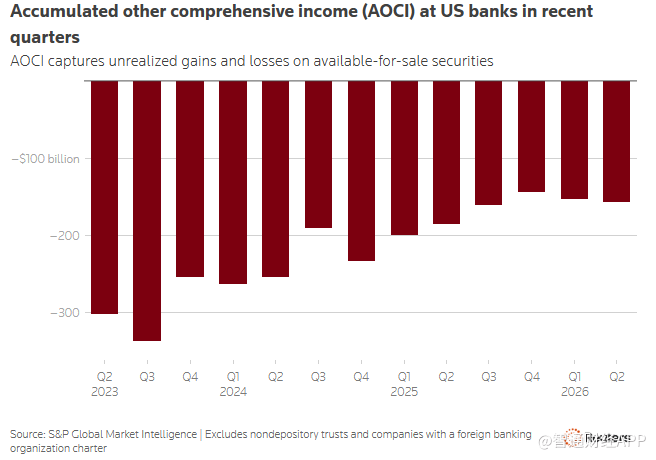
And that was only before the third quarter. The 10-year US Treasury yield, which is the benchmark for global borrowing costs, recorded the biggest quarterly increase since 1994 in the third quarter, which may lead to further deepening losses in the US banking industry.
In the three months ending September 30, Bank of America (BAC.US)'s cumulative other comprehensive losses increased by more than $3 billion from the end of June. By the end of September, the bank's bond portfolio had unrealized losses of US$109 billion, up from US$85 billion at the end of June. Most of these securities fall under the “hold-to-maturity” category, and the bank does not intend to sell them.
Sell it off or wait?
US bond yields and bond prices are trending in reverse. As yields rise, the price of existing bonds falls, thereby deepening the unrealized losses reflected in AOCI.
“Given changes in interest rates, it may be worthwhile to bear losses and reallocate funds to higher-yielding assets, which will benefit future cash flow and capital generation,” said Gabelli Funds portfolio manager McRae Sykes.
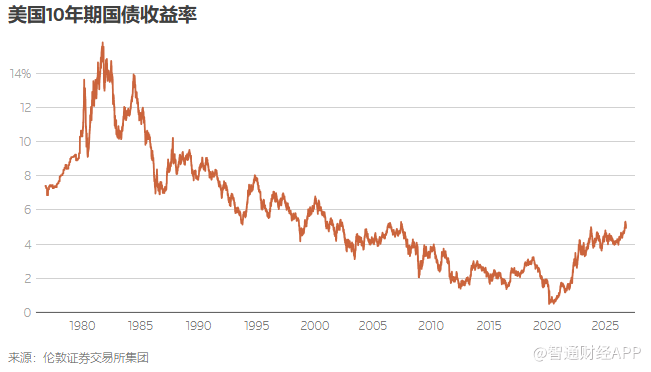
The risk of bond portfolios is not just hypothetical. In 2023, huge losses in bond investments combined with quick withdrawals of deposits from customers led to the bankruptcy of Silicon Valley Bank. Although the US banking sector has since cut its risk exposure, recent surges in yield suggest that decisions made years ago may continue to be a drag.
“If higher yields on alternative assets can cover this loss within a reasonable time frame, banks should be willing to bear this loss,” said Brian Jacobson, chief economic strategist at Annex Wealth Management.
Stock repurchases may stall
This impact is already reflected in banks' plans to return funds to shareholders. FITB.US (FITB.US) said that after the sharp rise in interest rates affected its AOCI, the bank delayed the stock repurchase plan originally scheduled for September. Wells Fargo Bank (WFC.US) also said that future repurchases may depend in part on the impact of interest rates on their investments.
“Looking ahead, we will continue to consider the interest rate environment and the impact on accumulating other comprehensive returns when deciding how many shares to buy back,” Wells Fargo Chief Financial Officer Mike Santomassimo said in a speech to analysts.
Meanwhile, Truist Financial (TFC.US) has been reorienting its securities portfolio. CFO Mike Maguire said the bank sees room for further sales, but the pool of operable bonds is limited. “With Basel III (Basel III) really in the spotlight and close at hand, we really feel it would be wise to take action on our securities portfolio.”
Basel III is an international regulatory framework that may affect how banks manage investments and how much money they can return to shareholders. These rules may add another layer of complexity to banks' decisions to manage bond portfolios.
PNC Financial Services Group (PNC.US) executives also said that when evaluating its AOCI holdings, the bank is taking into account the “upcoming” Basel III capital rules.