
Nio's Sales Surged 49%, but There's an Even Better Number Investors Should Know
Key Points
Nio delivered over 300,000 vehicles through September, a nearly 50% jump compared to the prior year.
Its "other sales" gross margins are finally contributing positively to consolidated gross margins.
The Chinese EV maker's second-quarter vehicle gross margins also jumped significantly
Chinese electric vehicle (EV) maker Nio (NYSE: NIO) has given investors plenty of reasons to be frustrated over the years. Between delayed profitability and net losses, a brutal Chinese automotive price war, and heavy capital expenditures for its battery-swap network, the road hasn't exactly been smooth.
But there's a potentially encouraging development investors shouldn't overlook. Through September, Nio delivered 300,301 vehicles, a whopping 49.2% increase compared with the prior year. That's impressive, and there's another number that might be even more important for long-term investors.
Missed Nvidia in 2009? This Rare Signal Is Flashing Again. In 2009, a "Double Down" signal flashed for a little-known chipmaker called Nvidia. For the first time in years, that same "Total Conviction" signal is flashing for a company 1/100th the size of Nvidia. Continue »
Bigger sales AND better margins
Nio's growth story has evolved beyond its premium namesake vehicles. The company now operates three brands: Nio, which targets premium buyers; Onvo, which focuses on family-oriented vehicles; and Firefly, which offers smaller, more affordable EVs. That broader lineup gives Nio opportunities to reach customers who might never have considered one of its higher-priced vehicles.Though Nio's sales can vary wildly month to month, the trend is clear and emphasizes that the company is expanding sales consistently over time and continuing to build scale.
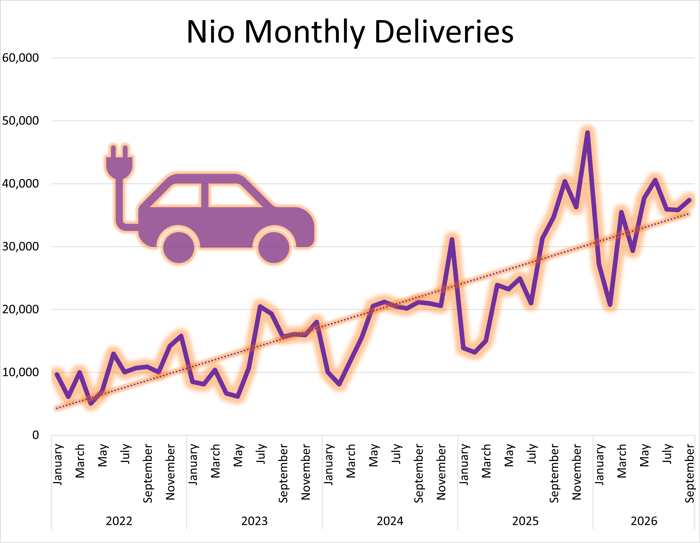
Data source: Nio sales releases. Chart by author.
Of course, there's a potential problem with this strategy. Expanding into lower-priced vehicles can put pressure on profit margins, particularly in China's brutally competitive EV market.
Here's where things get interesting. During the second quarter, Nio reported a vehicle gross margin of 18.5%, compared with just 10.3% during the prior-year period. That's an improvement of 8.2 percentage points, even as the company expanded its product portfolio to more affordable EVs. That's a meaningful improvement in the economics of selling vehicles, and something for investors to look for during its upcoming third-quarter results.
What it means for investors
There is an important caveat. Nio's improving margins aren't necessarily the direct result of its three-brand strategy. Management has pointed to a more favorable product mix (newer premium SUVs) and cost optimization, and the company hasn't established that every vehicle in its expanding lineup generates attractive margins.
Something else worth noting for investors is that Nio's "other sales" gross margins have reversed from negative 29% in 2022 to positive 6.6% in 2025. Part of this is the improved profitability of its growing battery-swap network, which should continue to scale as more and more Nio vehicles are on the road using it.

Image source: Nio.
Another thing to keep in mind is that vehicle gross margin slipped slightly from 18.8% in the first quarter to 18.5% in the second quarter. Investors shouldn't assume the improvement will continue uninterrupted. That said, the combination of rapidly growing deliveries and stronger vehicle margins is encouraging.
Nio has long needed to demonstrate that increasing sales can eventually translate into a sustainable business, rather than simply larger losses. Its latest results don't settle that question, although management believes the company will be net profitable next year. For investors willing to tolerate considerable risk, improved margins amid a price war and more affordable vehicle sales are arguably more important than the delivery growth alone.
Daniel Miller has no position in any of the stocks mentioned. The Motley Fool has no position in any of the stocks mentioned. The Motley Fool has a disclosure policy.