
How Rising Charge Offs Will Impact WaFd Stock Investors
- WaFd reported fourth quarter 2026 net interest income of US$182.35 million and net income of US$59.99 million, alongside full year net interest income of US$712.37 million and net income of US$255.87 million.
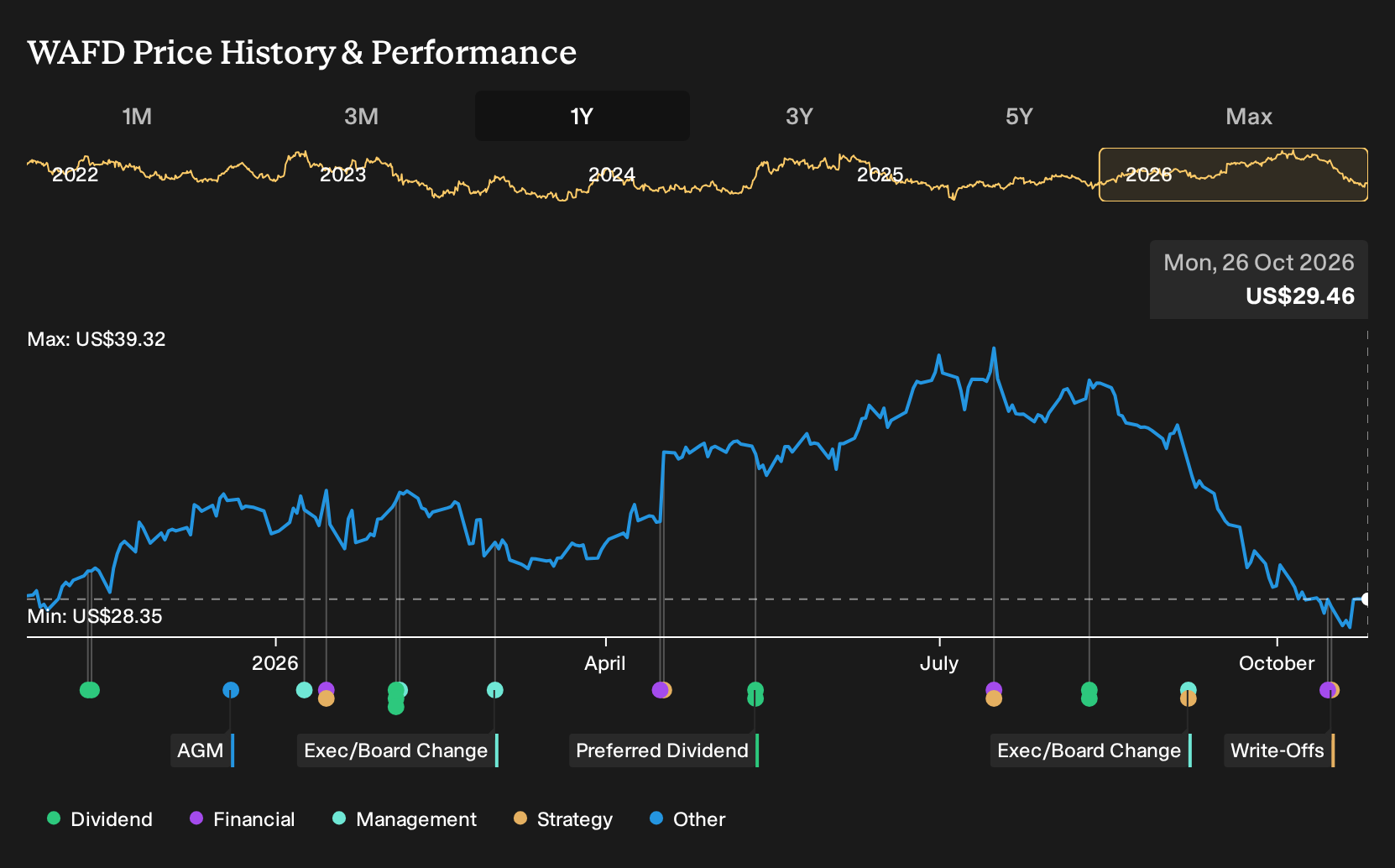
- The bank also recorded fourth quarter net charge offs of US$39.2 million compared with US$1.6 million in the prior quarter, highlighting rising credit costs alongside steady profitability metrics.
- This article will now examine how WaFd's investment narrative could be affected by this spike in quarterly net charge offs.
WaFd Investment Narrative Recap
To own WaFd, you need to be comfortable with a regional bank that is leaning harder into commercial and small business lending while managing through a bumpier credit cycle. The jump in quarterly net charge offs to US$39.2 million raises the near term question: can the loan book support Build 2030 growth targets without further credit strain?
For now, underlying profitability remains intact, with quarterly and full year net income still solidly positive. The key short term catalyst is whether credit costs settle or keep building, because that feeds directly into earnings and capital flexibility. The main risk is that credit pressure broadens beyond a few problem credits and starts to demand more aggressive reserve builds.
The recent earnings release is the clearest lens on this. WaFd reported fourth quarter net interest income of US$182.35 million and net income of US$59.99 million, alongside full year net interest income of US$712.37 million and net income of US$255.87 million. That backdrop shows a bank that is still generating healthy core earnings while absorbing higher write offs.
For you as a shareholder, the question is whether that earnings engine can keep funding WaFd’s Build 2030 ambitions while covering potentially higher loss content in the growing commercial book. If credit costs stabilize, the focus can swing back to loan mix, deposit quality and the contribution from digital and treasury platforms. If they stay elevated, the risk is more cautious balance sheet choices that slow those same catalysts.
What WaFd's Forecasts Assume About Growth And Credit Risk
WaFd's narrative projects US$3.3b revenue and US$1.1b earnings by 2029. That profile rests on analysts assuming 61.7% yearly revenue growth and an earnings increase of roughly US$858.8 million from US$241.2 million today.
The forecast framework behind WaFd is punchy. Analysts are effectively saying the bank today is a commercial and small business lender in transition, and that by 2029 it could be operating at a very different scale if everything in the Build 2030 playbook lines up.
On revenue, the 61.7% annual pace over the next three years is aggressive for a regional bank that has just reported a visible jump in quarterly net charge offs. That growth rate implies much heavier production across commercial and small business lines, continued runoff of lower yielding residential loans, and meaningful volume through fee based areas like treasury services and wealth management.
On earnings, the step up from US$241.2 million today to a projected US$1.1b by 2029 assumes the profit margin moves from 31.1% to 33.7% over the same period. For you, the key question is not just whether revenue can scale to US$3.3b. It is whether credit costs, including the kind of US$39.2 million quarterly net charge offs just reported, leave enough of that higher revenue to fall through to the bottom line.
The valuation overlay puts even more weight on those credit outcomes. To land at the US$31.75 analyst price target using these consensus numbers, the shares would need to trade on a P/E of 2.4x those 2029 earnings, compared with 8.7x today and 11.5x for the broader US banks peer group. That is a steep compression in the multiple for a bank that is also expected to scale earnings by more than four times, and it only looks reasonable if the profit profile is viewed as durable, not fragile.
Net charge offs are central to that durability test. If the recent US$39.2 million quarter represents an early sign of broader stress in the commercial portfolio, then the 33.7% margin assumption can quickly feel stretched because more of every incremental dollar of revenue would be consumed by provision expense. If instead the charge offs prove concentrated in a few credits and reserves were already built with this risk in mind, then the existing consensus path to US$1.1b in earnings looks less strained.
Balance sheet behavior matters just as much as the income statement here. Analysts are baking in a 3.5% annual decline in the share count over the next three years, implying ongoing buybacks. Sustaining that capital return rhythm while net charge offs are climbing requires confidence in both capital levels and the predictability of losses. If future quarters bring more volatile credit outcomes, management could choose to slow repurchases, which would in turn soften the per share earnings trajectory that underpins the current targets.
For your own process, the numbers in the consensus model give you a clean set of pressure points to test. The growth rate of 61.7% a year, the shift to a 33.7% margin, the US$3.3b revenue and US$1.1b earnings in 2029, and a P/E that compresses to 2.4x all rest on WaFd keeping credit contained while scaling higher yielding commercial exposure. The spike in net charge offs is the live data point that either challenges or supports those assumptions over the next few reporting periods.
Uncover why WaFd's fair value indicates an 8% potential upside to its current price that could narrow quickly.
Exploring Other Perspectives
Three fair value estimates from the Simply Wall St Community cluster in a tight band between US$31.75 and about US$35.81, so you are seeing different takes but no extreme outliers. Those views were formed before WaFd disclosed the US$39.2 million net charge offs, which could shift how community members weigh Build 2030 ambitions against credit risk. Consider this a prompt to review several alternative viewpoints before deciding where you sit on WaFd.
Explore 2 other WaFd fair value estimates, including one that suggests there may be as much as 22% upside from the current price.
Reach Your Own Conclusion
Do not just follow the ticker; dig into the data and build a conviction that is truly your own.
- A great starting point for your WaFd research is our analysis highlighting 5 key rewards that could impact your investment decision.
- See our latest analysis for WaFd. The report includes a comprehensive fundamental analysis summarized in a single visual, the Snowflake, making it easy to evaluate WaFd's overall financial health at a glance.
Looking For More Investment Ideas Beyond WaFd?
If WaFd has sharpened your sense for risk, reward and timing, it can be useful to line it up against a wider set of opportunities. Use the Simply Wall St Screener to filter for traits that match your own playbook, then compare how each stock stacks up on fundamentals before you commit capital.
- For investors who want quality and value to line up, take a look at our 29 high quality undervalued stocks that already combine strong fundamentals with attractive pricing.
- If resilience matters most to you, focus on businesses screened for stability, using our 30 resilient stocks with low risk scores to spot companies with lower risk scores.
- When you want staying power on the balance sheet, narrow your search to companies with robust finances by scanning our list of solid balance sheet and fundamentals (24 results).
Have feedback on this article? Concerned about the content? Get in touch with us directly. Alternatively, email editorial-team@simplywallst.com