
Levi Strauss (LEVI) Following Strong Earnings Faces A Fresh Valuation Test
Levi Strauss (LEVI) is back in focus after a class action lawsuit accused the apparel group of quietly raising prices to offset now unlawful tariffs, just months after reporting quarterly revenue of US$1.61b.
At a share price of US$21.78, Levi Strauss has seen a 30 day share price return of 10.39% and a 7 day gain of 4.46%, even though the 90 day move is down 11.71%. The 3 year total shareholder return of 73.17% contrasts with a softer 5 year total shareholder return that is down 5.61%. This hints that recent earnings strength and expectations around future growth are still exerting more influence on sentiment than the fresh legal risk.
Scan how investors are pricing Levi Strauss against other consumer names by checking the curated list of 29 high quality undervalued stocks that combine balance sheet strength with proven cash generation.
Levi Strauss appears to be a solid, global apparel business with fresh earnings momentum and a legal cloud forming in the background. After the recent share price rebound, is that mix already fully reflected in today’s valuation?
Most Popular Narrative: 16% Overvalued
The most followed valuation story on Simply Wall St puts Levi Strauss at a fair value of $18.72, below the recent $21.78 close, so the legal overhang is landing on a stock that this narrative already treats as rich.
The framing shift on the U.S. distribution network transition is the most consequential piece of this call, and it is worth sitting with the actual commitment before assessing how management now talks about it.
The plan had been specific: close the Hebron distribution center, consolidate into Groveport, and do it with urgency because “the fact that we have given the intent, given notice, is indicative that we’re serious about it.” A Bank of America analyst cites the number management itself had set: “an immediate $5 million in cost savings per quarter as soon as you shut these parallel DCs down.” Management confirms the Hebron closure happened, on schedule, at quarter’s end. The $5 million in quarterly savings that closure was supposed to trigger has been pushed to 2027, with no month specified.
See why 1 investors see Levi Strauss as 16% overvalued.
According to LunaRodas, that gap between earlier cost-saving promises and the revised 2027 timing sits at the center of the current thesis. The narrative ties together slower direct-to-consumer momentum, shifting capital return language, and the distribution hiccup as reasons why the market might be giving Levi Strauss too much credit at today’s price.
Result: Fair Value of $18.72 (OVERVALUED)
Still, Levi Strauss could see this overvalued tag challenged if direct to consumer trends improve or if U.S. distribution savings arrive sooner than expected.
Find out about the key risks to this Levi Strauss narrative.
Another View: Levi Strauss Through The P/E Lens
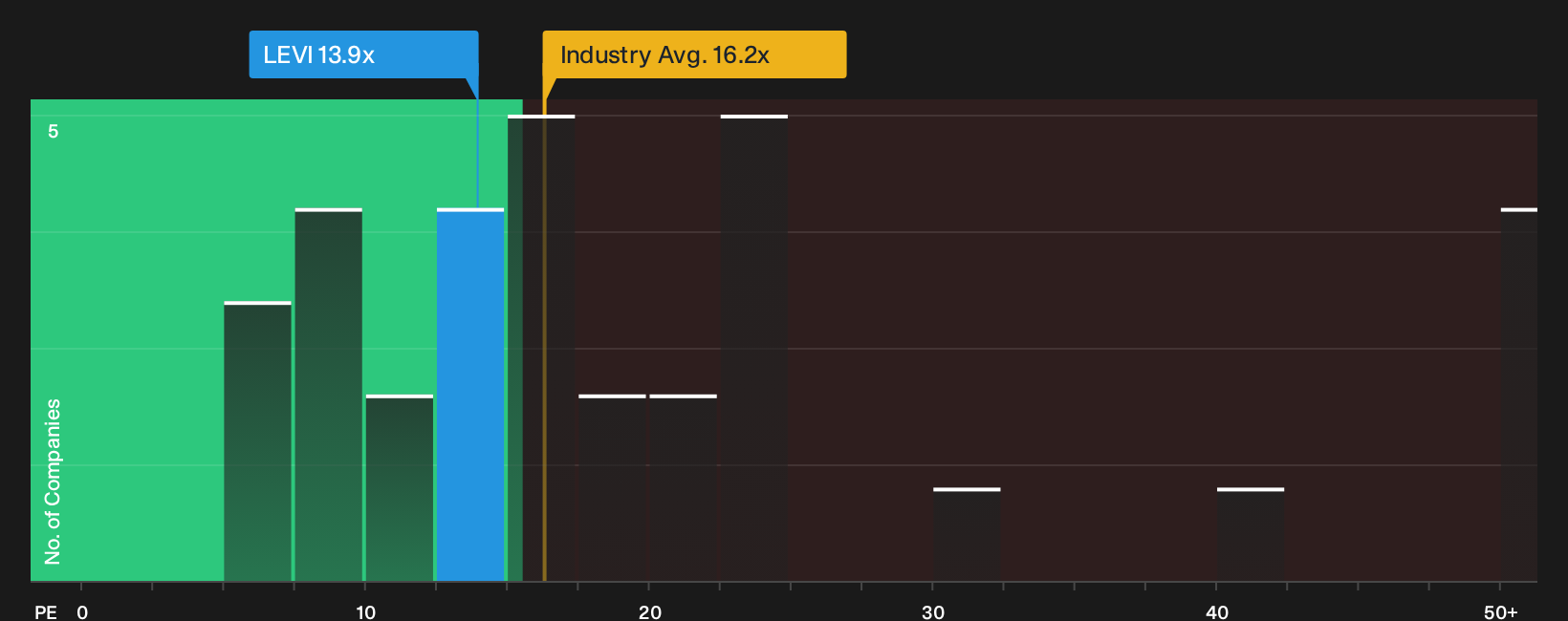
The DCF-driven fair value of $14.25 paints Levi Strauss as expensive at $21.78. Yet on a simple earnings yardstick the picture flips. The stock trades on a 13.9x P/E, below both the US market on 18.3x and the Luxury industry on 16.2x, and under its own 17.7x fair ratio. That gap cuts the other way, raising the question of whether the richer DCF assumptions or the cheaper earnings multiple are closer to how investors will treat Levi Strauss over time.
See what the numbers say about this price — find out in our valuation breakdown.
Next Steps
Mixed messages in the Levi Strauss story so far. If you want to move fast and ground your own view in the underlying data, start by weighing the 3 key rewards and 1 important warning sign
Looking For More Ideas Beyond Levi Strauss?
If Levi Strauss sharpened your thinking, do not stop here. Fresh ideas often come from scanning a wider field of opportunities with clear rules and filters.
- Target resilient income by reviewing a focused group of potential yield plays using the 5 dividend fortresses.
- Hunt for quality at a reasonable price by checking companies that appear mispriced on fundamentals through the 29 high quality undervalued stocks.
- Secure downside protection by filtering for businesses with strong finances and low leverage inside the list of solid balance sheet and fundamentals (24 results).
Have feedback on this article? Concerned about the content? Get in touch with us directly. Alternatively, email editorial-team@simplywallst.com