
Core inflation exceeds expectations, and officials collectively turn hawks. The Reserve Bank of Australia may raise interest rates for the fifth time in the year next week
The Zhitong Finance App noticed that the Australian inflation data released on Wednesday was higher than expected. Coupled with hawkish remarks by Australian Federal Reserve officials, the market is heating up expectations that policymakers will raise interest rates for the fifth time this year when they meet next week. CPI rose 1.3% in the last quarter compared to the previous three months, exceeding the expected increase of 1.2%; in September, CPI rose 4.3% year over year, higher than the 4.2% forecast.
Government data showed that consumer prices accelerated in the last quarter and exceeded market expectations. Just a few minutes before the data was released, RBA Chairman Michelle Bullock told lawmakers that the risk of inflation still exists.
In her opening statement to the Senate Committee, she said, “Some of the upward international and domestic risks of inflation have become or are becoming a reality. As a result, the inflation rate is likely to be higher than the benchmark we set in August.”
This series of hawkish signals raised expectations of the RBA's interest rate hike at next week's meeting to nearly 90%. At the same time, the Australian dollar once rose 0.4%, and the yield on policy-sensitive three-year treasury bonds once climbed 8 basis points.
Commonwealth Bank of Australia economist Belinda Allen said that the bank currently expects the Reserve Bank of Australia (Reserve Bank of Australia) to raise interest rates to 4.85% in November. Alan said, “At the dovish press conference after the September rate hike, recent communication from the Federal Reserve Bank of Australia corrected that information and became hawkish, focusing on the risk of rising inflation from overseas and concerns about pressure on domestic production capacity.”
Robert Thompson, head of economic and interest rate strategy at the Royal Bank of Canada in Sydney, said: “I think we can safely lock in this rate hike. Given the recent statement by the Federal Reserve Bank of Australia and the worrying details in this report, I would be shocked if the RBA did not raise interest rates. The core indicators are too high, and key segments such as market services, which exclude volatile items, have risen again.”
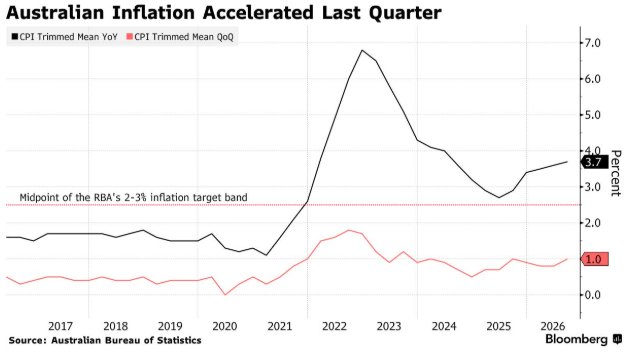
The Reserve Bank of Australia raised interest rates for the fourth time this year last month to deal with signs that the risk of accelerating upward inflation is beginning to show. The CPI report indicates that the central bank may need to tighten policy again at the November 2-3 policy meeting to try to pull inflation back to the target range of 2% to 3%.
According to data released by the Australian Bureau of Statistics on Wednesday, the RBA's preferred core inflation indicator, the annual truncated average of consumer prices, rose 3.7% in the last quarter, faster than in the previous three months, and also surpassed economists' expectations of 3.6%. On a quarterly basis, the core price rose 1%, in line with expectations.
Steven Smith, partner at the Deloitte Institute for Economic Research, said: “Today's data confirms the concerns expressed by the Reserve Bank of Australia in recent weeks. Progress in reducing inflation has stalled. The RBA has little will to allow inflation expectations to continue to rise.”
Last week, RBA Deputy Governor Andrew Hauser said that the inflation outlook looked “significantly worse” than the forecast in the RBA's August monetary policy statement. The central bank will release the latest economic outlook at the same time as next week's interest rate decision.
However, although RBA officials tend to be hawkish, the nine-member interest rate decision committee includes six independent directors, who may have different views.
Security Group economist My Bui detected signs of weakening economic conditions in the CPI report. She said, “I expect this meeting to have a divided vote rather than a unanimous vote. Despite this, I think their statement will still be quite hawkish because their primary concern is inflation.”
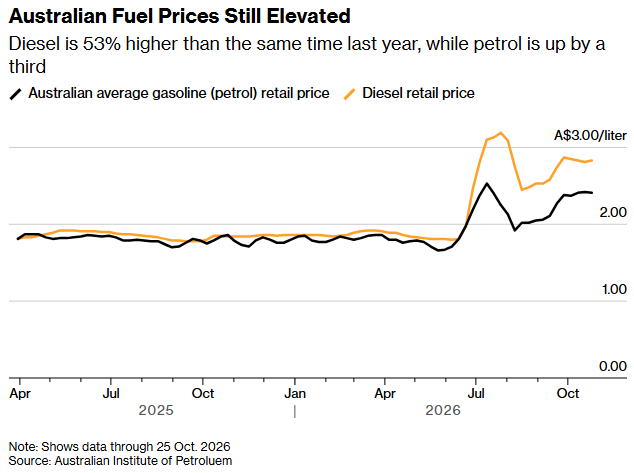
Fuel prices remain high in Australia
The global oil shock remains a continuing threat to the Reserve Bank of Australia's anti-inflation efforts, and the prospects for an end to the US-Iran war in the near future are still slim.
Economist James McIntyre said, “Higher fuel prices are driving overall inflation to soar, and as companies shift higher transportation costs, inflation is likely to spill out more and more into the wider basket of commodities. The potential inflation rate is significantly higher than the Federal Reserve's August forecast, which indicates that the outlook will be revised upward and that interest rates will be raised again by 25 basis points on November 3.”
Even so, the Federal Reserve and its Eurozone and Japanese peers are likely to remain on hold this week, choosing to wait and see until further rate hikes are possible. The three-day decision in Washington starting Wednesday is likely to confirm a hawkish position balanced with a careful pace, as policymakers face a range of inflationary risks, from soaring energy prices to a boom in artificial intelligence.
Recently, the Bank of New Zealand unexpectedly kept borrowing costs unchanged on Wednesday, which surprised the market.