
3 U.S. Consumer Discretionary Stocks Facing The Election Spending Test
Election season has turned into a live stress test for consumer stocks, as talk of a potential US$1.2b style stimulus collides with rising inflation worries and rate pressure. That mix could reshape where Americans choose to splurge or pull back. This article walks through three Consumer Discretionary stocks exposed to that story, and outlines how each could be affected if cash handouts, higher prices and jumpy sentiment all hit at once.
The three stocks highlighted next are only a starter set, drawn from a much wider group of consumer-facing businesses that fit this idea. The full screen surfaced 13 more companies with equally compelling narratives that are not covered below.
If you want to identify and analyze your own highest conviction angles on this theme, head straight into the U.S. Consumer Discretionary Stocks screener.
MarineMax (HZO)
MarineMax plugs directly into the screener’s consumer leisure theme, since it focuses on big-ticket recreational boats, marinas and related services that tend to move with household confidence and access to financing rather than everyday spending.
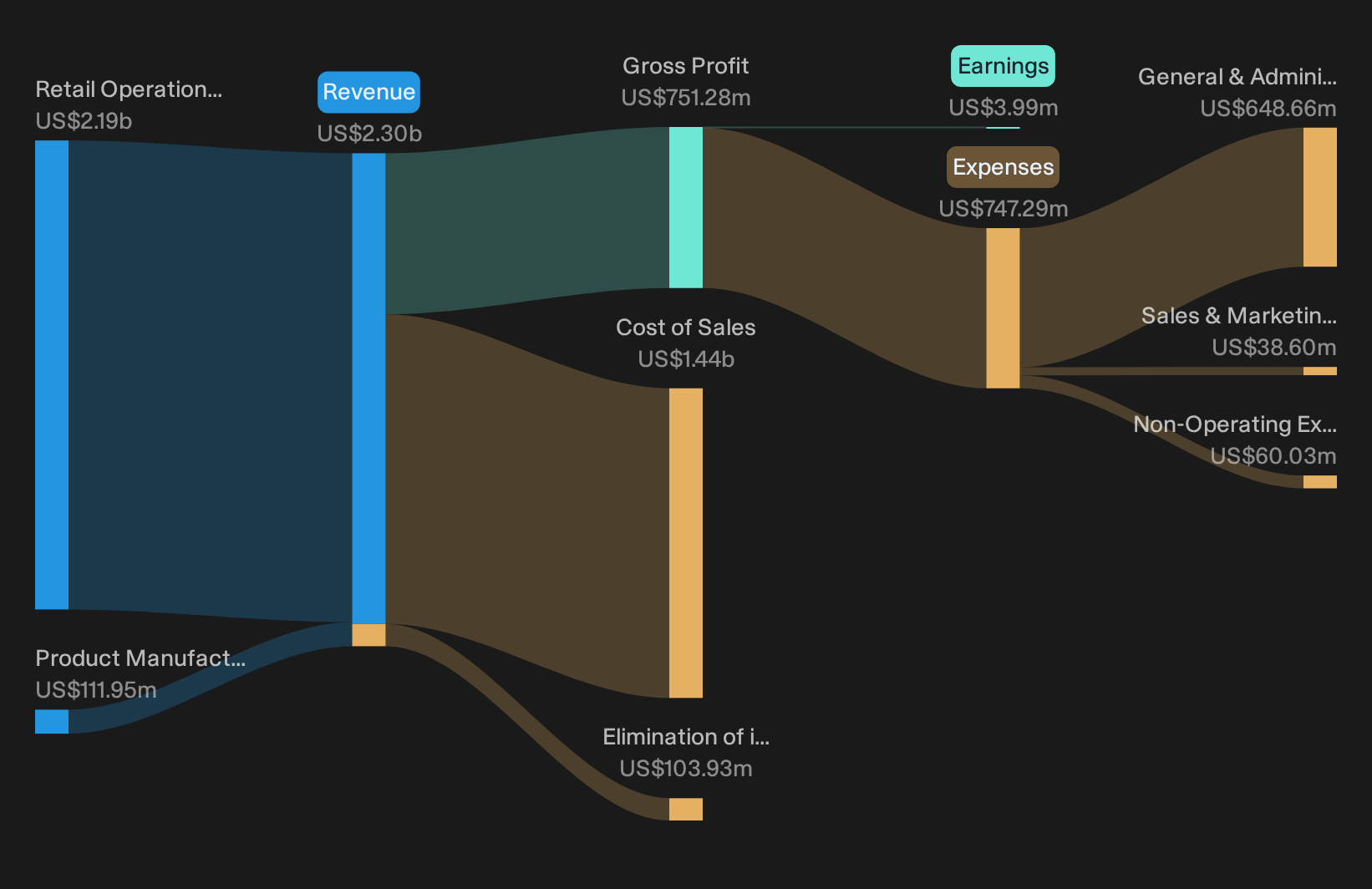
MarineMax is a recreational boat and yacht retailer and services group geared to discretionary leisure spending, generating about US$2.19b from Retail Operations and US$112 million from Product Manufacturing, with intersegment eliminations of US$104 million, and a market cap of about US$1.16b.
Expansion into higher margin service and marina activities, including parts and service, finance and insurance, marinas and superyacht services, which recently lifted consolidated gross margin into the mid 30% range, can continue to increase the share of recurring revenue and support more resilient net margins.
What happens if a single pressure point on high-end leisure demand shifts just as those higher margin activities become more important to the story?
If that pressure reverses, read the full narrative for MarineMax to see how MarineMax’s mix shift could accelerate, stall, or completely recast the investment case.
Chewy (CHWY)
Chewy is a pure play on U.S. consumer spending for pets, sitting in the sweet spot where everyday necessities blur into discretionary upgrades such as premium food, treats and services when households feel more comfortable with their budgets.
Chewy runs a U.S. e commerce platform for pet food, treats, supplies, medications and pet health services that aligns with the Consumer Discretionary theme. It generates about US$13.07b from the sale of pet products and services and has a market value of roughly US$8.8b.
Autoship customer sales of US$2.8b in Q2 FY26, which represent 84.6% of net sales and are growing faster than overall company sales, point to a further mix shift toward recurring orders that can support steadier revenue and provide a base for higher net margins as scale builds.
What happens to Chewy’s earnings power if that one lever on recurring pet spending shifts just as broader consumer cash flows are tested again?
If that pressure on pet spending is the real swing factor, read the full narrative for Chewy to see whether Chewy’s autoship engine is accelerating or masking new risks.

CarMax (KMX)
CarMax taps directly into the consumer discretionary theme as a nationwide used car retailer, where big-ticket vehicle purchases often hinge on household confidence and available credit rather than everyday budgeting, which puts its model front and center when cash windfalls or cost of living pressures collide.
CarMax runs a U.S. used vehicle retail and financing platform, generating about US$27.63b from CarMax Sales Operations and US$1.81b from CarMax Auto Finance, all in the United States, and carries a market value of roughly US$7.47b.
one apportionment nobody offered before. Enrique Mayor Mora says the “items we control directly” (in his list, “COGS efficiencies, the GPU decrease, pricing algorithm improvements, customer experience improvements”) account for “about half of the comp performance, while the other half is really coming from what we think is the FTC enforcement benefits that we are seeing.”
What happens to CarMax’s pricing power and demand if one quiet shift in customer behavior or policy support moves even slightly off script.
If that off script risk is on your mind, read the full narrative for CarMax to see whether CarMax’s earnings engine is quietly accelerating or starting to decouple.

Seeking Fresh Alternatives Before They Fly
New themes can break out quietly. Then momentum takes over and entry points start dropping away before the crowd reacts. Scan these fresh ideas while it matters and get in early.
- Capture potential turnarounds in smaller companies before they get widely covered by tracking the 21 high quality undiscovered gems curated for strong fundamentals hiding under the radar for now.
- Target possible resilient income ideas while prices still reflect caution by scanning a curated pool of 5 dividend fortresses that could keep paying even when sentiment swings.
- Position for the next leg of industrial and infrastructure demand by reviewing the hand picked 16 top copper producer stocks that align with long term consumption of essential metals.
Have feedback on this article? Concerned about the content? Get in touch with us directly. Alternatively, email editorial-team@simplywallst.com