
BNP Paribas Stock Puts European Bank Shares Back On Retail Investor Watchlists
European banking is back in focus after BNP Paribas reported a 14% jump in Q3 net income to €3.46b and announced a fresh €1.3b share buyback, and that kind of headline tends to reset expectations for the whole sector. When one heavyweight surprises the market, investors often reassess where risk and reward really sit. This article walks through 3 large European universal bank stocks exposed to the same news pulse, providing an overview to help you decide which stories you want in your portfolio and which you might prefer to watch from the sidelines.
The three banks in focus are just a sample from this theme, and the full screen on Simply Wall St surfaced 10 more large European universal banks with equally interesting stories that are not covered here. To identify and analyze your own highest conviction ideas in this space, go straight to the Large European Universal Banks screener.
Banco Santander (BME:SAN)
Banco Santander is one of the clearest fits for this large European universal banks theme, combining retail deposits, lending, investment services and payments into a single global platform that is already being reshaped by a multi year efficiency and technology program.
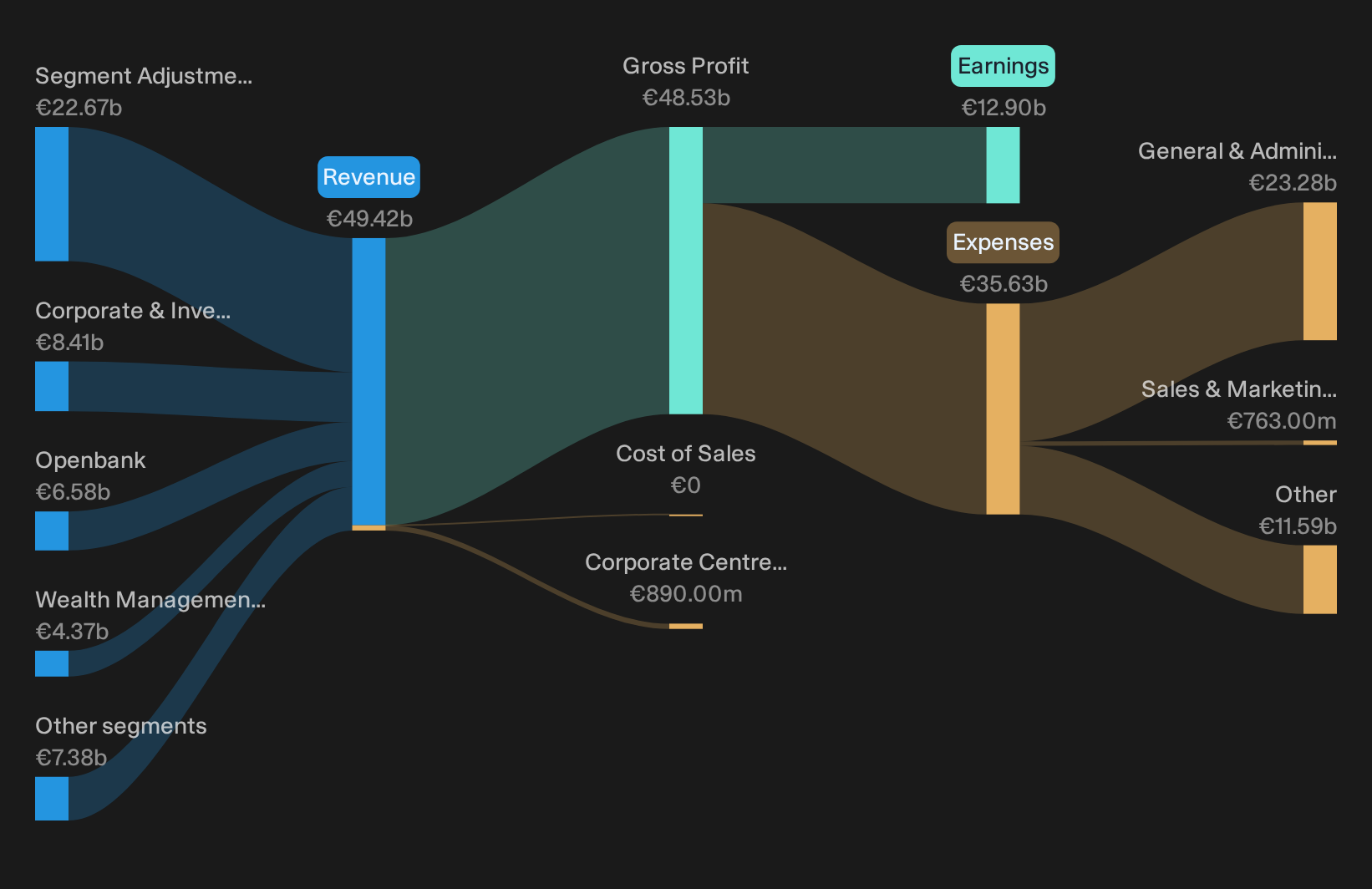
Banco Santander generates revenue across several lines, including Wealth Management & Insurance at €4.4b, Corporate & Investment Banking at €8.4b, Payment Solutions at €4.1b and its Openbank unit at €6.6b, and the bank’s market value is about €162.2b.
Expansion of Banco Santander’s ONE Transformation and global platform consolidation, with group costs in constant euros already declining while revenue rises and management targeting a move in the efficiency ratio from around 45% in 2025 to about 36% in 2028, could further widen operating jaws and support earnings growth.
What happens if one quiet pressure inside the loan book and capital allocation plan pulls those future margins away from today’s upbeat narrative?
If that pressure is what keeps you cautious on banks, read the full narrative for Banco Santander to see how those risks could interact with Santander’s efficiency push.
BNP Paribas (ENXTPA:BNP)
BNP Paribas is the textbook example of a large European universal bank in this screen, mixing everyday retail banking with corporate lending, markets activity and insurance so that earnings draw on several engines rather than a single interest rate story.
BNP Paribas generates most of its income from Corporate and Institutional Banking at about €19.1b, followed by Commercial and Personal Banking in the Eurozone at roughly €13.3b and Specialised Businesses at around €7.4b, with Investment and Protection Services contributing about €7.8b and a market value near €95.3b.
Execution of BNP Paribas’ efficiency and AI transformation program is expected to increase structural savings from €700m per year in 2022 to 2026 to around €1b per year in 2027 to 2030.
What really shapes outcomes for shareholders is how one less visible funding and credit constraint interacts with that cost saving ambition over time.
If you want to see how that constraint could either cap returns or accelerate them, go straight to the full narrative for BNP Paribas for the full funding story.

CaixaBank (BME:CABK)
CaixaBank brings a large cap Iberian retail and business franchise to this universal banks theme, with everyday banking, wealth, insurance and corporate services feeding into a broad earnings base.
CaixaBank runs a wide mix of services across Spain and Portugal, with around €12.1b from Banking, €2b from Insurance, €1.2b from Portuguese Investment Bank BPI and €0.1b from its Corporate Center, and the stock carries a market value near €80.2b.
The current outperformance in loan growth versus the wider market, including 5% loan book growth and double digit consumer lending growth, may be difficult to repeat if Spanish and Portuguese GDP growth returns to more typical levels. This could limit the pace of future revenue expansion and make it more challenging to maintain a return on tangible equity near 17%.
What really matters from here is how a quietly shifting capital and payout equation interacts with that loan heavy Iberian mix.
To see how that capital shift could either cap or accelerate CaixaBank’s next chapter, read the full narrative for CaixaBank and see what the market might be missing.

Curious About What You Might Be Missing Next
Fresh ideas move first. By the time every headline catches a breakout or a dropping outlier, the clean entry is gone. Scan under the radar while it matters and act now.
- Spot potential momentum before it looks obvious by checking out 195 high quality undervalued stocks built around strong cash flows and balance sheets that could support the next leg of a move.
- Track where real infrastructure money might be flying by using 42 power grid technology and infrastructure stocks focused on companies tied to grid upgrades and electrification while they are still under the radar for now.
- Explore the growth of smarter automation by reviewing 94 robotics and automation stocks featuring businesses plugged into robotics and factory intelligence before the crowd prices in that momentum.
Have feedback on this article? Concerned about the content? Get in touch with us directly. Alternatively, email editorial-team@simplywallst.com