
Terex (NYSE:TEX) surprises with Q3 2026 sales

Lifting and material handling equipment company Terex (NYSE:TEX) announced better-than-expected revenue in Q3 2026, with revenue up 58.4% year on year to $2.20 billion. On the other hand, the company’s full-year revenue guidance of $8.1 billion at the midpoint came in 0.6% below analysts’ consensus estimates. Its non-GAAP profit of $1.50 per share was 5.4% above analysts’ consensus estimates.
For more on Terex, read our free full research report.
Terex (TEX) Q3 2026 highlights:
- Revenue $2.20 billion vs S&P analysts’ consensus estimates of $2.17 billion (58.4% year-on-year growth, 1.1% beat)
- Adjusted EPS $1.50 vs S&P analysts’ consensus estimates of $1.42 (5.4% beat)
- Adjusted EBITDA $286 million vs analysts’ consensus estimates of $287.7 million (13% margin, 0.6% miss)
- Revenue guidance The company slightly lifted its revenue guidance for the full year to $8.1 billion at the midpoint from $8.05 billion
- Adjusted EPS guidance Management reiterated its full-year adjusted EPS guidance of $4.90 at the midpoint
- EBITDA guidance $945 million at the midpoint for the full year, below analysts’ consensus estimates of $996.2 million
- Operating margin 8.3%, down from 10.1% in the same quarter last year
- Free cash flow margin 9.5%, similar to the same quarter last year
- Market capitalization $5.68 billion
"Terex delivered higher sales, adjusted EBITDA and cash flow in the third quarter versus the prior year, with solid order activity increasing across all four segments, resulting in $7 billion backlog that provides meaningful forward visibility across the portfolio. We are also making progress integrating the expanded company, capturing synergies, and applying more consistent operating discipline to improve execution and returns," said Terex President and CEO Simon Meester.
Revenue growth
A company’s long-term performance is an indicator of its overall quality. Any business can post a good quarter or two, but the best consistently grow over the long haul. Over the last five years, Terex grew its revenue at a strong 15.2% compounded annual growth rate. Its growth beat the average industrials company and shows its offerings resonate with customers.
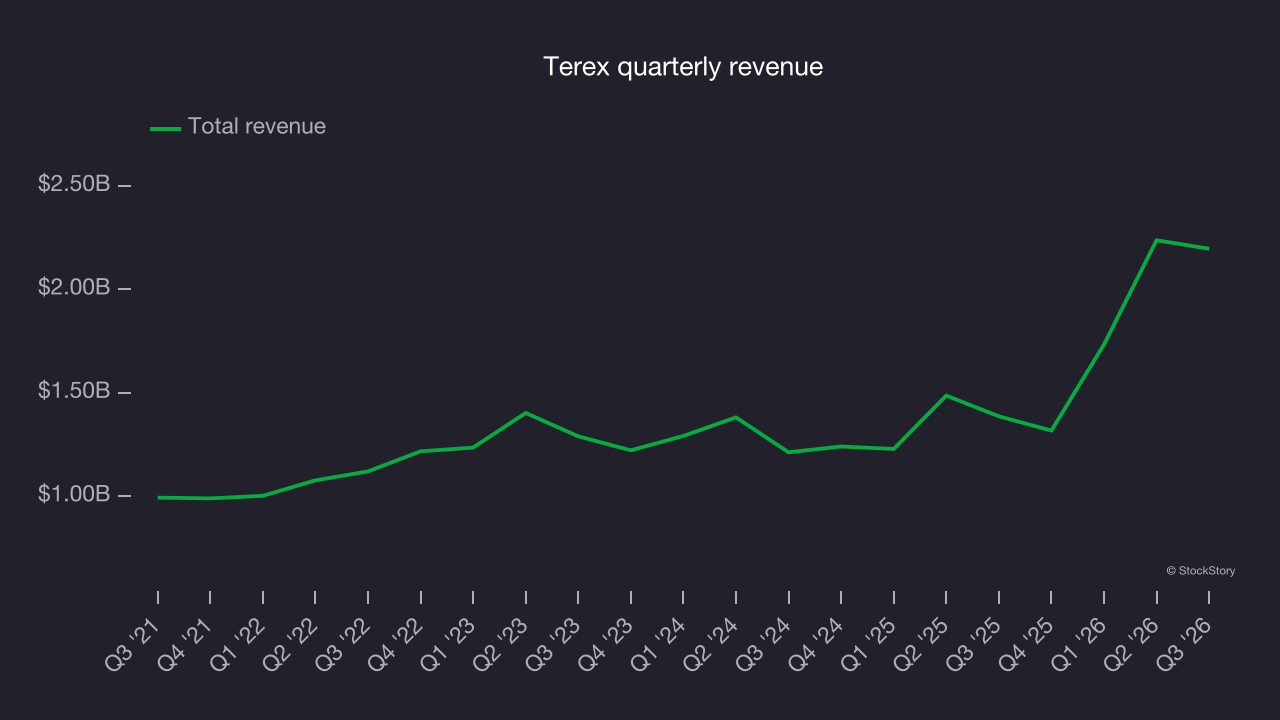
Long-term growth is the most important, but within industrials, a half-decade historical view may miss new industry trends or demand cycles. Terex’s annualized revenue growth of 21.1% over the last two years is above its five-year trend, suggesting its demand was strong and recently accelerated. 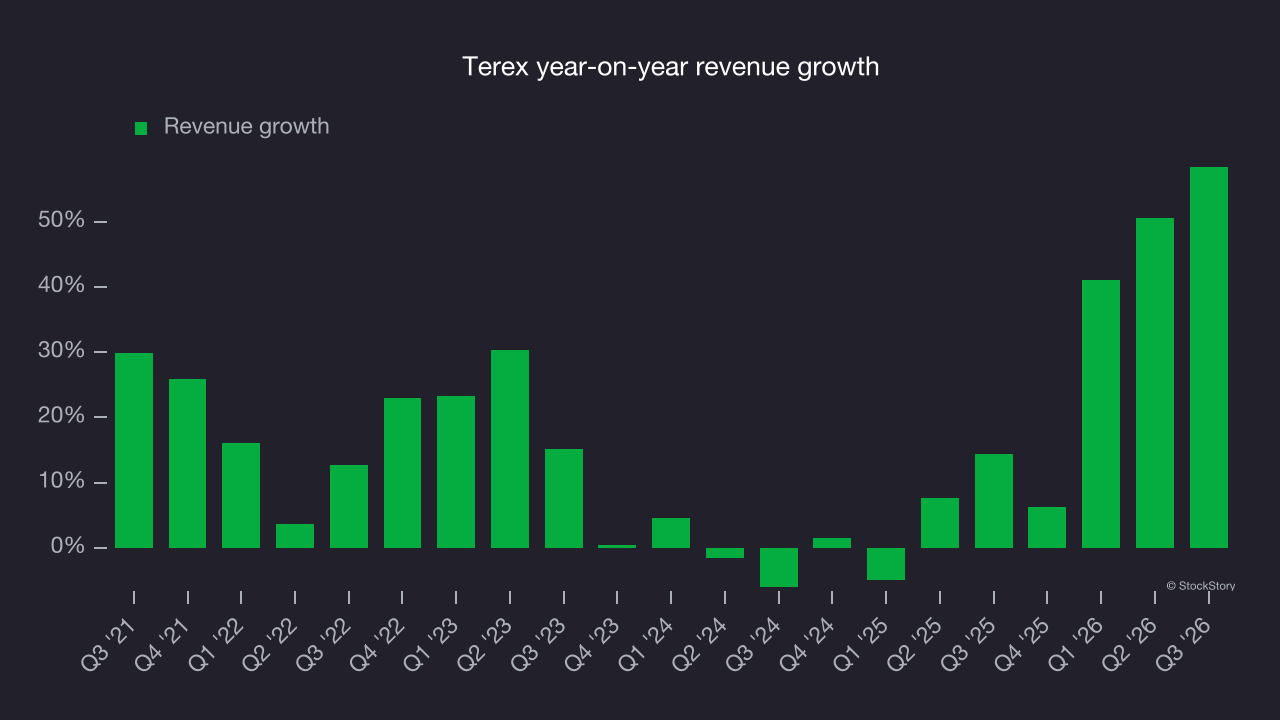
This quarter, Terex reported strong year-on-year revenue growth of 58.4%, and its $2.20 billion of revenue beat Wall Street’s consensus estimates by 1.1%.
Looking ahead, sell-side analysts expect revenue to grow 15.1% over the next 12 months, according to S&P, a deceleration versus the last two years. Still, this projection is healthy and implies the market is forecasting success for its products and services.
Operating margin
Operating margin is one of the best measures of profitability because it tells us how much money a company takes home after procuring and manufacturing its products, marketing and selling those products and, most importantly, keeping them relevant through research and development.
Terex has done a decent job managing its cost base over the last five years. The company has produced an average operating margin of 9.7%, higher than the broader industrials sector.
Looking at the trend in its profitability, Terex’s operating margin decreased by 4.8 percentage points over the last five years. This raises questions about the company’s expense base because its revenue growth should have given it leverage on its fixed costs, resulting in better economies of scale and profitability.
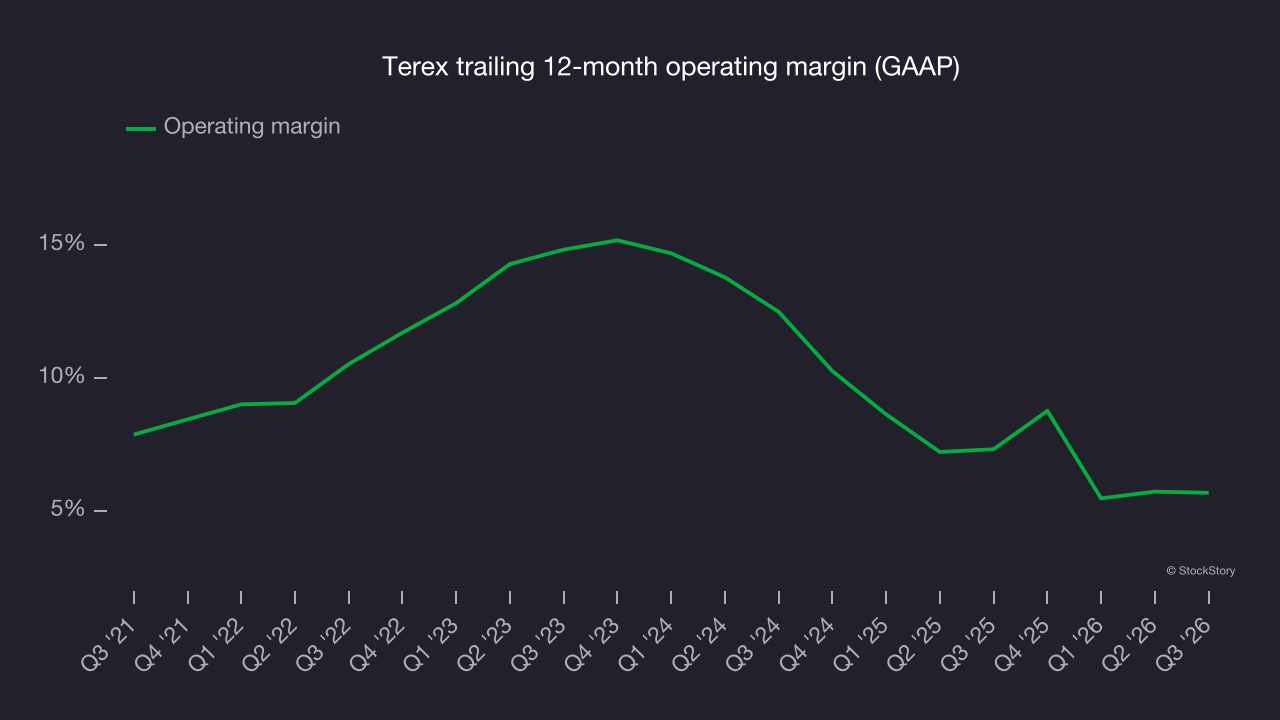
This quarter, Terex generated an operating margin of 8.3%, down 1.8 percentage points year on year. Terex’s operating margin decreased more than its gross margin, suggesting it was less efficient because expenses such as marketing, R&D and administrative overhead increased.
Earnings per share
We track the long-term change in earnings per share (EPS) for the same reason as long-term revenue growth. Compared to revenue, however, EPS highlights whether a company’s growth is profitable.
Terex’s EPS grew at a strong 12.3% compounded annual growth rate over the last five years. However, this performance was lower than its 15.2% annualized revenue growth, indicating the company became less profitable on a per-share basis as it expanded.
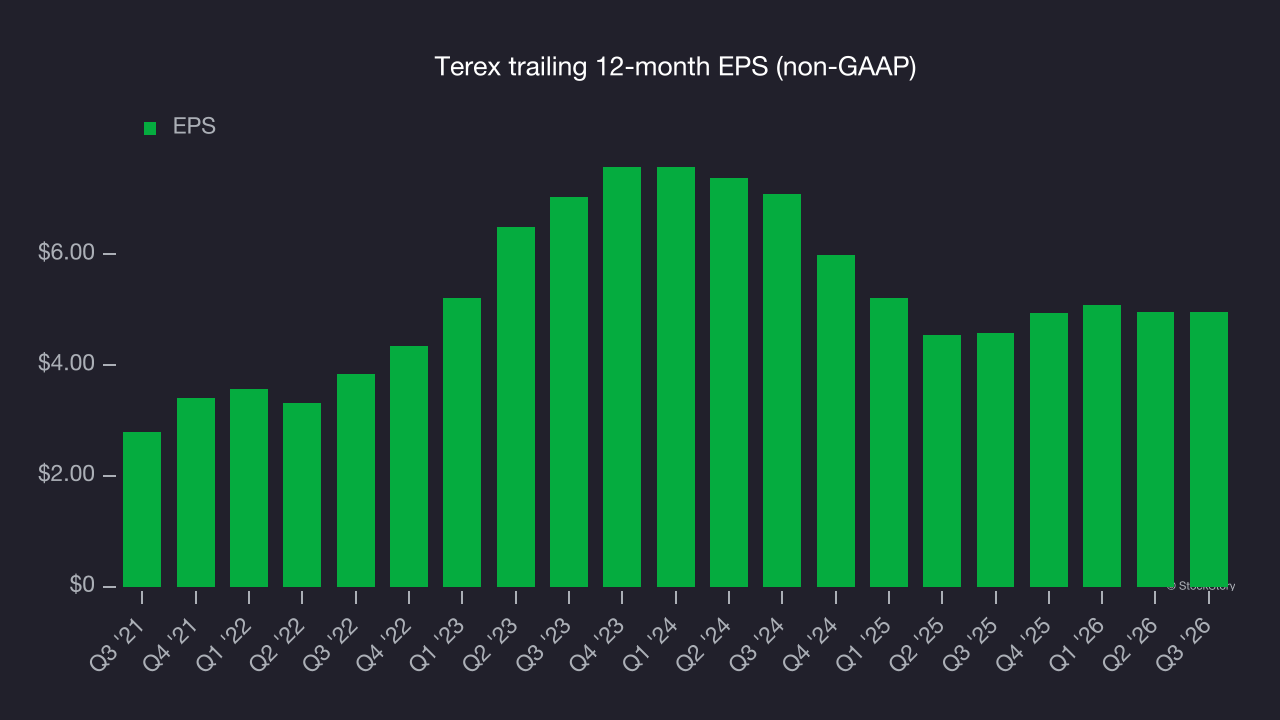
A closer look at Terex’s quality of earnings helps explain its performance. Terex’s operating margin declined by 4.8 percentage points over the last five years. Its share count also grew by 60.8%, meaning the company not only became less efficient with its operating expenses but also diluted its shareholders. 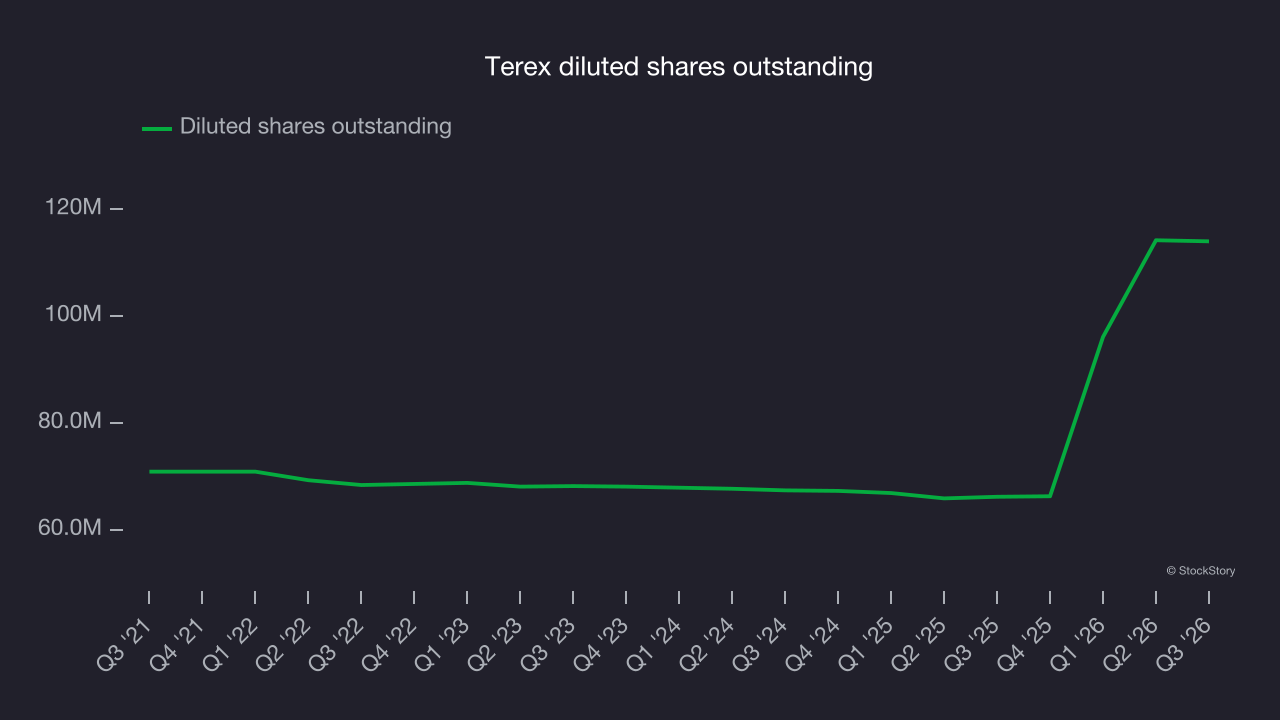
Like with revenue, we analyze EPS over a more recent period because it can provide insight into an emerging theme or development for the business.
For Terex, its two-year annual EPS declines of 16.3% mark a reversal from its seemingly healthy five-year trend. These shorter-term results weren’t ideal, but its success on other measures of financial health suggests it could return to earnings growth.
In Q3, Terex reported adjusted EPS of $1.50, in line with the same quarter last year. This result beat analysts’ consensus estimates by 5.4%. Over the next 12 months, Wall Street expects Terex’s full-year EPS to grow 13.4% from $4.97 to $5.63, according to S&P.
Key takeaways from Terex’s Q3 results
Terex’s full-year outlook fell short, with EBITDA guidance missing expectations and revenue guidance slightly below Wall Street’s consensus. Those shortfalls made for a weaker quarter overall, despite revenue narrowly topping analysts’ consensus estimates and EPS also beating Wall Street’s consensus. Shares fell 4.2% to $49.51 immediately after the report.
Terex’s latest earnings report disappointed. One quarter doesn’t define a company’s quality or determine whether the stock is a buy at the current price. That decision requires considering its valuation, business quality and latest quarterly results. For more on Terex, read our full research report here (it’s free).