
3 Regional Bank Stocks Built For Higher US Interest Rates
Fed policy is back in the spotlight as inflation holds near 3% and energy costs bite, and that combination can quietly reshape the outlook for big U.S. banks and insurance companies. Higher for longer rates can hurt some balance sheets and help others, so sitting on the sidelines risks missing important shifts. This article walks through three large-cap financial stocks exposed to this rate story and explains why their positioning matters now.
The three stocks highlighted below are just a starting sample, and the full screen surfaced 26 more large U.S. banks and insurers with equally compelling rate-resilience narratives that are not covered in this article.
To identify and analyze those additional candidates, head straight into the U.S. Rate-Resilient Large-Cap Banks and Insurance Companies screener.
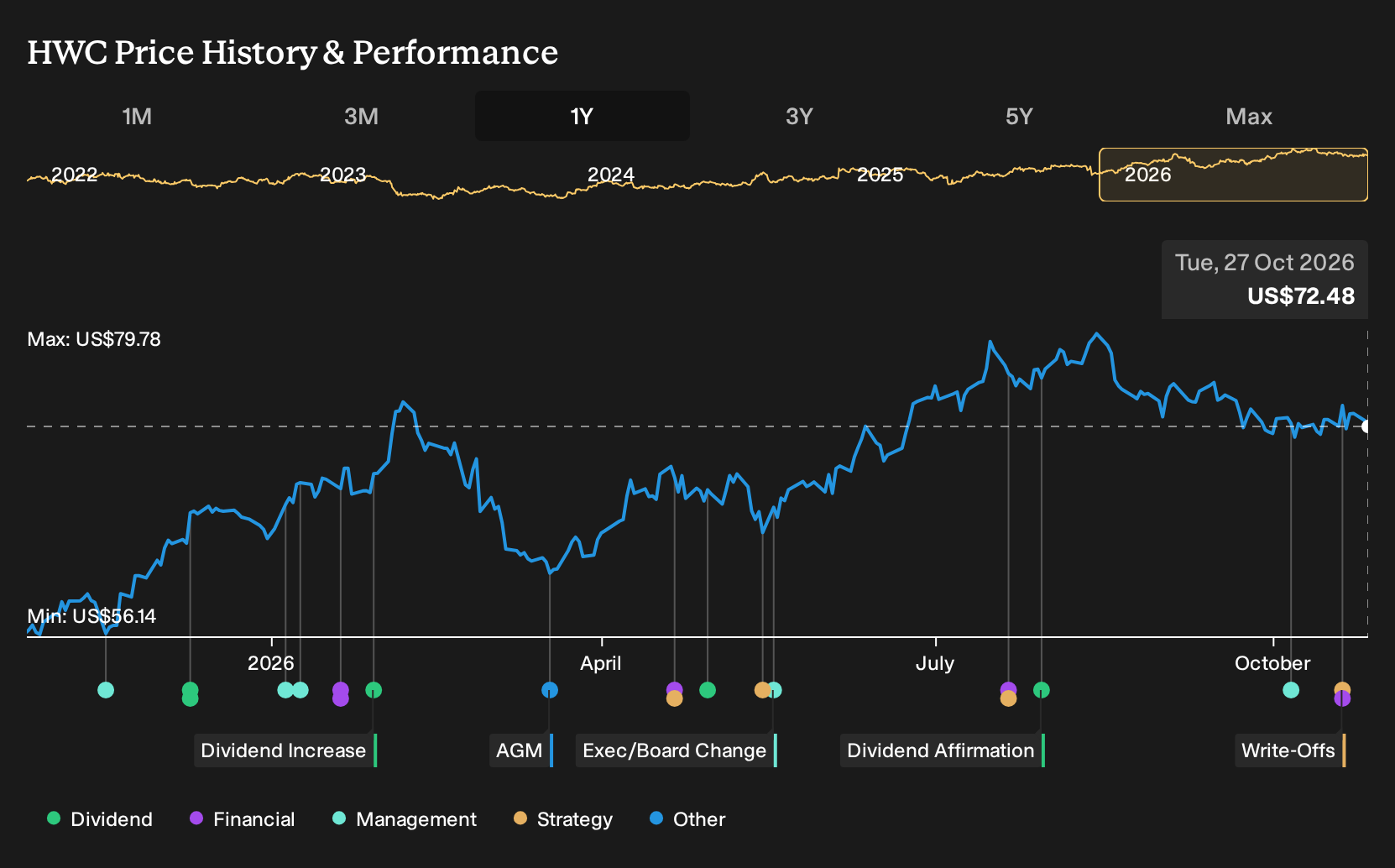
Hancock Whitney (HWC)
Hancock Whitney slots neatly into the rate resilient theme as a sizeable regional bank whose traditional and online lending and deposit engine is built to live on interest spreads. This makes its positioning in a higher for longer Fed cycle especially relevant.
Hancock Whitney generates essentially all of its US$1.4b in revenue from banking operations, including loans, deposits, and fee based financial services in the United States, and the stock sits in large cap territory with a market value around US$5.8b.
"Hancock Whitney plans to continue its program of hiring revenue producing bankers, with 42 net new hires already in place by the first half of 2026 toward a goal of 50 additions for the year. This is already contributing a material share of new loan production and can support revenue and fee growth."
What happens to that effort if one unseen pressure on funding costs and credit appetite shifts more sharply than management currently expects?
If that funding curve bends faster than expected, the full narrative for Hancock Whitney lays out how Hancock Whitney’s lending push could still accelerate or stall as the rate story evolves.
Five Star Bancorp (FSBC)
Five Star Bancorp is built around a straightforward community banking model in Northern California, serving small businesses, professionals, and households, with a market value of about US$1.1b that fits the screener’s focus on larger, profitable U.S. banks with stable dividends.
In a Fed cycle where higher rates could linger, Five Star Bancorp matters to this screen because its community banking focus ties funding closely to long term client relationships rather than wholesale markets. This becomes especially important when the cost of money keeps edging up.
"Continued build out of Five Star Bancorp's core deposit franchise, with management planning to fully exit brokered deposits by the end of 2026 after repeated quarterly reductions, can further reduce funding costs and support net interest margin and earnings."
What really tests that opportunity is how one subtle shift in customer behavior could ripple through both margins and future growth ambitions.
That ripple effect is exactly where the full narrative for Five Star Bancorp shows how Five Star Bancorp’s funding mix, margin path, and loan ambitions could accelerate rather than stall.

Equity Bancshares (EQBK)
Equity Bancshares fits the rate resilient screen as a regional lender built on spread income. Its broad deposit and loan franchise across several Midwestern states gives it several ways to turn a stickier Fed policy into steadier earnings.
Equity Bancshares runs a full service regional bank across Kansas, Arkansas, Missouri and Oklahoma, generating about US$313 million of revenue entirely in the United States. The stock is in roughly US$1 billion mid cap territory.
"The pending acquisition of Lincoln Bancorp, a $1.7b asset community bank with 16 Iowa branches, is expected to expand Equity Bancshares' Midwest footprint and add scale that management projects will be accretive to EPS in 2027, 2028 and 2029, which could support higher long-term earnings power."
The real swing factor is how one less visible shift in funding costs shapes the gap between that earnings ambition and what actually lands in margins.
That funding swing is where the full narrative for Equity Bancshares maps how funding costs, acquisition synergies and rate moves could be quietly accelerating Equity Bancshares’ earnings power.

Seeking Alternatives Before Momentum Flies
Fresh ideas move first, and the strongest stories often break out while most investors are still watching headlines. Scan under the radar for now, before momentum is fully caught, and act now.
- Spot cash generative businesses before the crowd by running the 29 high quality undervalued stocks while pricing still reflects hesitation rather than full conviction.
- Track emerging AI leaders with real profits, not just hype, by scanning the 39 profitable AI stocks that aren't just burning cash before sentiment sends valuations significantly higher.
- Target durable income while yields stay elevated by reviewing the curated 5 dividend fortresses before payout stories are fully reflected in prices.
Have feedback on this article? Concerned about the content? Get in touch with us directly. Alternatively, email editorial-team@simplywallst.com