
Should Digital Banking Revamp Require Action From Scotiabank Stock Investors?
- Bank of Nova Scotia recently upgraded its Canadian digital banking, rolling out a mobile first website, richer app self serve tools and a relationship based high interest savings account that ties rates to a client’s total balance across eligible products.
- The Scotia High Interest Savings Account links yield to a client’s combined deposits and investments, which could influence how customers consolidate cash and investment balances within Bank of Nova Scotia over time.
- This article examines how Bank of Nova Scotia’s investment narrative is shaped by this relationship based high interest savings push.
Scan how Bank of Nova Scotia’s relationship based savings push compares with other income focused plays by reviewing our curated list of 3 dividend fortresses in one place.
Bank of Nova Scotia Investment Narrative Recap
To own Bank of Nova Scotia, you need to be comfortable with a global retail and commercial lender that leans on Canadian banking, Pacific Alliance exposure and fee income to support earnings, while carrying typical credit and capital swings for a large bank. The key near term swing factor remains credit quality in Canada and Latin America, where higher loss provisioning or capital needs could pressure returns.
The new digital and relationship based savings push feels incremental to that core story. It supports the thesis if it improves deposit mix, cross sell and cost efficiency. The bigger immediate risk still sits in loan performance and regulatory capital rather than website or app features.
The relationship based Scotia High Interest Savings Account, surfaced more clearly through the redesigned mobile first Scotiabank site and app, links directly to the catalyst around digital usage and deeper client relationships. Rate tiers tied to a Total Relationship Balance aim to pull more cash and investments onto the platform and keep households within the Bank of Nova Scotia ecosystem.
Execution risk sits in complexity and client perception. Variable daily rate tiers, changing balances across chequing, savings, GICs and mutual funds and exclusions for certain accounts can confuse users if communication is not clear. If customers embrace the structure, it could support fee lines and primary relationships. If they do not, the catalyst impact is limited.
What The Current Bank Of Nova Scotia Forecasts Assume
Analysts currently factor in Bank of Nova Scotia growing revenue by 11.2% a year over the next few years, while profit margins ease from 27.0% today to 25.5% by 2029. Consensus earnings are projected at CA$12.3b by that point compared with CA$9.5b today, which reflects a higher profit base even with some margin pressure. Those numbers sit behind a 2029 P/E of 15.6x in the models, slightly below both the 16.1x multiple applied to the bank today and the 17.1x level referenced for the broader US banks industry.
Forecasts also assume the share count declines by about 1.39% per year over the next three years. Fewer shares mean any given earnings pool spreads across a smaller base, which can support earnings per share even if operating trends are mixed. A discount rate of 7.27% is used in the Simply Wall St report to translate those future cash flows back into today’s value, so your own view on risk and required return will matter if you adjust that hurdle rate.
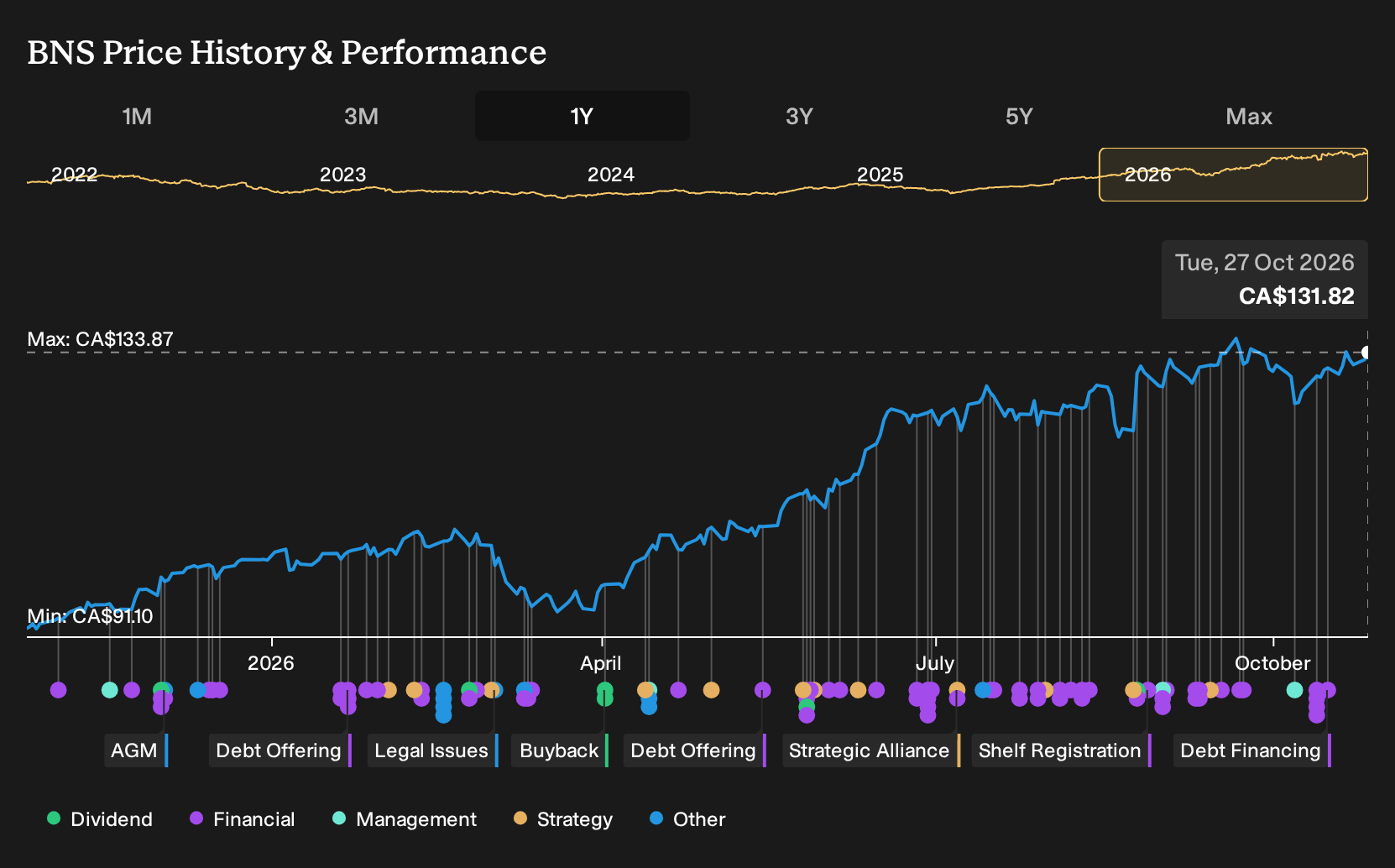
On the valuation side, the analyst group centres on a consensus target of CA$132.86 for Bank of Nova Scotia, with CA$152.00 at the top end and CA$109.00 at the low. With the shares quoted at CA$126.03 in the analysis, the gap to the central target is 5.1%. That narrow range suggests these forecasts describe a bank that many analysts currently see as roughly in line with their fair value work rather than deeply mispriced.
Underpinning those targets is a forecast that Bank of Nova Scotia could deliver CA$48.4b of revenue and CA$12.3b of earnings by 2029 while trading on a 15.6x P/E, using a 7.3% discount rate in that part of the work. For any investor sanity checking these numbers, a key judgment is whether the mix of international operations, digital banking and wealth relationships can support that revenue and profit base while also absorbing credit and capital swings along the way.
Bank of Nova Scotia's narrative projects CA$48.4b revenue and CA$12.3b earnings by 2029. This requires 11.2% yearly revenue growth and about a CA$2.8b earnings increase from CA$9.5b today.
Discover why Bank of Nova Scotia's fair value points to a valuation gap that aligns with its current price.
Exploring Other Perspectives
Three fair value views from the Simply Wall St Community cluster between CA$132.86 and about CA$177.56, so some retail investors see Bank of Nova Scotia as close to consensus while others pencil in a far richer outcome. Consider this in light of fresh digital banking upgrades and recent debt issuance, then assess how these moves might influence long term earnings power. Opinions clearly vary, so explore several alternative viewpoints before forming your own stance.
Explore 2 other Bank of Nova Scotia fair value estimates, including one that suggests it could be worth just CA$132.86.
Reach Your Own Conclusion
Don't just follow the ticker. Dig into the data and build a conviction that's truly your own.
- A great starting point for your Bank of Nova Scotia research is our analysis highlighting 4 key rewards and 1 important warning sign that could impact your investment decision.
- See our latest analysis for Bank of Nova Scotia. The report includes a comprehensive fundamental analysis summarized in a single visual, the Snowflake, making it easy to evaluate Bank of Nova Scotia's overall financial health at a glance.
Looking For More Investment Ideas Beyond Bank of Nova Scotia?
If you want to cross check Bank of Nova Scotia against other opportunities, it can help to scan a wider universe and see which companies line up with the income profile, balance sheet strength or risk level that suits you best.
- For investors who want income without ignoring quality filters, review a curated set of higher yield opportunities through our 3 dividend fortresses.
- If capital preservation and resilience matter most to you, focus on businesses that score well on stability and financial strength by using our 8 resilient stocks with low risk scores.
- When you are hunting for lesser known opportunities with solid fundamentals, widen the search to a broader group of under the radar ideas with our 9 high quality undiscovered gems.
Have feedback on this article? Concerned about the content? Get in touch with us directly. Alternatively, email editorial-team@simplywallst.com