
Wondering Why Kanzhun Fell? Here's What The Bears Saw
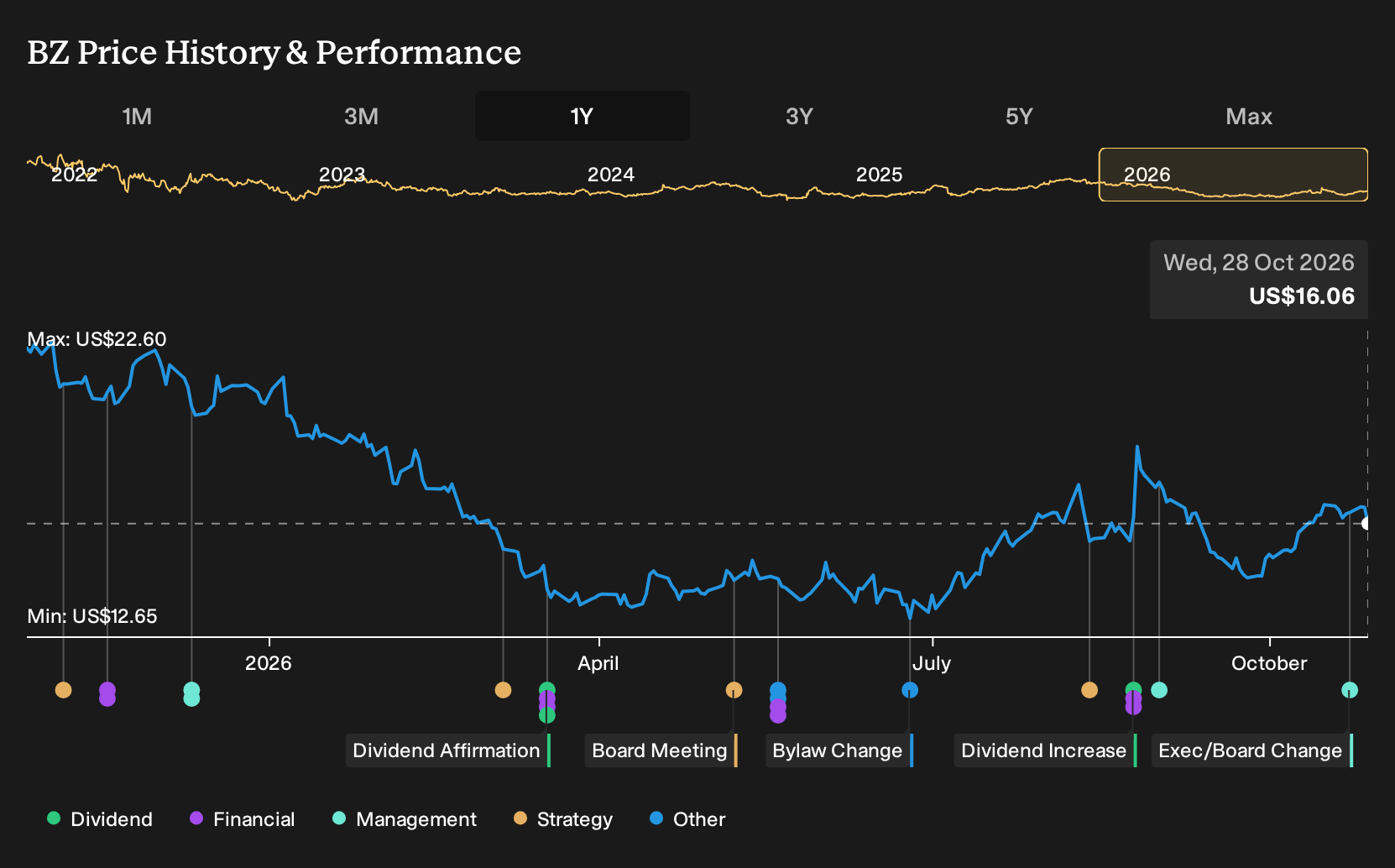
If you had backed Kanzhun for a three year story built on AI, user expansion, and rising profitability, the first twelve months would have stung. For Kanzhun shareholders, the loss over the past year was 25.9%, including dividends. That sits awkwardly beside starting expectations of 13.2% annual revenue growth, margin expansion toward 32.8%, and a much lower future P/E. Which of those moving parts did the original thesis fail to stress test properly?
On Simply Wall St, a Narrative is an investor's thesis written down: the reasoning, plus the numbers it rests on. Run those numbers and you get an estimated Fair Value.
If the move has made Kanzhun harder to judge, start where the gap is still open and scan 29 high quality undervalued stocks.
The Argument Kanzhun Investors Were Weighing Up
The shares cost US$22.23 at the start of the period, and Kanzhun sat between two sharply different but credible stories about its future.
On the optimistic side, the bull narrative put Fair Value at US$24.4, about 10% above the start price. That view leaned on assumptions of 13.2% annual revenue growth, profit margins reaching 32.8%, and a future P/E of 3.6x over a 3 year horizon.
The bearish case saw Fair Value closer to US$14.01, or 37% below the start price. That perspective focused on China’s aging population, heavier regulation, and the risk that user growth and monetisation would slow despite ongoing AI investment.
What The Results Changed For Kanzhun
The clearest new fact for Kanzhun was the Q2 2026 report, with revenue at RMB 2,398.6m and net income at RMB 1,945.1m. Net margin moved from 34.1% in Q2 2025 to 81.1% in Q2 2026, which leaned toward the optimistic case on profitability, even if that margin level may not represent a steady state. Overall, the evidence cut both ways.
The key assumption investors can carry to other stocks is margin expansion. When a thesis rests on higher profitability, track reported net margin and operating margin over several periods and compare those figures directly with the forecast narrative instead of relying on top-line growth alone.
What Kanzhun’s Current Price Asks You To Believe
Kanzhun now trades at US$16.06, after the share price declined 25.9% over the past year. The selected narrative places fair value above that level and focuses on AI-driven matching, blue-collar exposure, and early overseas expansion as the core of the present case.
Under this view, a buyer today would be assuming Kanzhun can keep turning its large user base into more paying enterprises and higher ARPPU through AI-supported services.
"Key takeaways: Analysts expect Kanzhun to keep using AI-driven matching, user growth, and higher-value hiring services to support further increases in revenue and engagement that are not yet fully reflected in current earnings reports. The main thing that has to go right is that Kanzhun continues to turn its large and growing user base into more paying enterprise customers and higher ARPPU through AI-powered services, disciplined spending, and measured pricing increases across both white-collar and blue-collar segments."
The price and this Narrative do not agree. → Uncover what this Narrative says Kanzhun is actually worth
Looking One Step Beyond Kanzhun
Kanzhun leans heavily on data and AI to match workers with roles. You could look one move sideways.
Employers using richer hiring tools still need help judging risk, compliance, and identity. Another business focuses on that layer.
It turns vast pools of information into decision tools that plug into workflows. Clients use those products to assess counterparties, spot fraud, and manage exposure.
As AI spreads through hiring and workplace software, trusted data and analytics may matter even more. That is where this quieter opportunity starts to get interesting.
The case is on the record, with the assumptions it rests on. → See the Narrative that values this company 19% above its price
Have feedback on this article? Concerned about the content? Get in touch with us directly. Alternatively, email editorial-team@simplywallst.com