
Can “AI Faith” Really Conquer Everything? Alphabet and Microsoft's cloud business explode, AI accelerates monetization and awakens the “semiconductor bull market narrative”
The latest results and future prospects announced by Google's parent company Alphabet (GOOGL.US) and Microsoft (MSFT.US) on Thursday morning Beijing time — in particular, the strong growth trajectory of the two major cloud computing businesses, Google Cloud Computing Platform and Microsoft Azure Cloud — can be described as providing important data verification for the semiconductor and data center power equipment chain leaders closely linked to the AI computing power infrastructure construction process to continue to explode under the AI intelligence frenzy.
The Federal Reserve maintained interest rates at 3.75% to 4.00% at 10-2 local time. More importantly, at the press conference, Federal Reserve Chairman Walsh did not directly equate strong growth with economic overheating, and emphasized that improved productivity may increase the economy's ability to carry growth. Recent developments in the Federal Reserve and monetary policy can be said to have greatly mitigated the market's macroeconomic concerns about additional hawkish shocks and the continued rise in AI financing costs driven by US bond yields. Against the backdrop of the Federal Reserve standing still, US stocks ended trading on Wednesday in the early hours of Thursday morning Beijing time. US technology stocks continued their rebound trajectory. The NASDAQ 100 index rose 0.55%, and the Philadelphia Semiconductor Index, which has the title of “AI computing power trading weather vane,” rose 1.75%.
As of the morning of October 29, Beijing time, Microsoft's strong performance and the strong future outlook shown during the performance conference call can be described as having received unanimous bullish approval from the market. After the market, the stock price rose and once surged about 7% — a record high if the 7% increase continued until the opening of the market; Alphabet experienced a clear post-market decline due to lower than expectations in advertising revenue and free cash flow, which at one point plummeted by more than 11%.
Alphabet and Microsoft's cloud business both showed a strong growth trend, but the overall fundamentals trajectory and post-market differentiation of stock prices are fully highlighted — the commercialization process of AI applications led by AI agents is accelerating, thereby strengthening the long-term bull market logic of AI computing power — the AI infrastructure process, which is currently in full swing around the world, is expected to continue to expand AI computing power capacity and demand, but global capital is beginning to more strictly differentiate between “revenue growth”, “profit/profit growth” and “cash growth that can be used for debt repayment and reinvestment.”
With strong performance data from a series of AI computing power industry leaders, including Facebook and Instagram parent companies Meta, SK Hynix, and Amphenol, Seagate, Western Digital, and Vertiv, as well as major disclosures of the performance of Google's parent companies Alphabet and Microsoft, the main story that makes more investment sense in terms of global AI computing power topics, as well as the semiconductor sector of the stock market and the investment logic of technology stocks in a broad sense — the strong performance of social media giant Meta and the two major cloud computing giants It is providing stronger verification for AI commercialization; that is, cloud business growth continues to be transformed into profit and operating cash flow, which will enhance the ability of enterprises to support computing power procurement and meet financing obligations, and increase the certainty of fulfillment of semiconductor orders and profit growth. As a result, the market is actively gaining a key basis for re-bullish AI computing power industry chain—improved commercial returns can support the next round of investment, making the semiconductor rebound more solid fundamental support.
The doubling of Google Cloud's revenue and the acceleration of Microsoft Azure's growth are complementing the most critical demand verification for semiconductor counterattacks: AI investment by tech giants has continued to translate into impressive cloud service revenue. Google Cloud's revenue reached US$30.709 billion, up 102.6% year on year, exceeding market expectations of US$29.57 billion. This set of data echoes SK Hynix's 80% operating profit margin and Vertiv's organic order growth of over 100%, enhancing the demand transmission logic from model usage and cloud service charges to storage, chip and power cooling equipment procurement.
The basis for Wall Street's bullish outlook on semiconductors and year-end prices is extending from clearing positions and seasonal smooth winds to the combined support of profit fulfillment, supply constraints, and long-term order visibility. Goldman Sachs believes that the 65% decline in 2027 profit implied by the valuation of the Korean storage sector is too pessimistic; at the time of its report, Samsung Electronics and SK Hynix's forward price-earnings ratio was about 3 times higher, which deviated from the high point of KOSPI, Korea's benchmark stock index, which fell by about 40%, and the profit forecast for the next 12 months increased by about 22% during the same period, forming an important basis for valuation repair.
SK Hynix management said that DRAM and HBM production capacity will be “substantially sold out” until 2029; Goldman Sachs storage experts expect that the DRAM price increase may continue until the first half of 2028, and the average HBM hybrid price will rise by about 122% in 2027. Of the 23 midterm election years according to Deutsche Bank statistics, 21 rose three months after the beginning of October, providing a smooth wind in historical probability. As the cloud business grows and supplier profits continue to be realized, and financing costs and credit spreads gradually improve, the semiconductor rebound has a more solid foundation for moving from emotional recovery to a profit-driven market.
The two major cloud giants are growing strongly, so why are their earnings reports coming out of different markets? Cloud revenue strengthens AI computing power demand expectations, and cash flow and capital expenditure influence short-term market pricing
Strong cloud business growth, as reflected in Alphabet and Microsoft's latest financial reports, and strong demand for enterprise-side AI-related computing resources is being rapidly transformed into revenue and profit data for these two major cloud giants. There is no doubt that the strong growth trajectory related to the cloud computing business of the two major cloud computing giants supports the overall computing power demand dominated by the AI computing power industry chain. The market is further differentiated. How much additional investment is required and when larger amounts of cash can be left behind.
The rebound of semiconductors was significantly stronger than the general stock market trajectory — this was evident in global stock markets, including the Japanese and Korean stock markets, as well as the Chinese stock market. The Philadelphia Semiconductor Index rebounded for four consecutive trading days after falling about 6.72% on October 22, with a cumulative rebound of about 8.87% from the closing low of the day, but still about 20% lower than the June high; after falling about 6.24% in the two weeks ending on the 23rd, the NASDAQ 100 rebounded about 2.95% on the 28th, still about 4.52% lower than the closing high on October 6. Broadcom closed up 2.77% on the 28th, but the after-market price at 06:12 Beijing time on the 29th fell 2.16% from the closing. Reuters post-market snapshots show that Microsoft once rose by about 7% after the market, while Google's parent company Alphabet once fell by more than 11% after the market — the industrial chain counterattack before the earnings report has not yet turned into a full resonance after the earnings report.
The credit market, on the other hand, can be described as revealing in depth this fragmentation. The recent financial market situation can be described as showing the tension of a major rebound in semiconductor-led technology stocks and the financial fragmentation and division shown by the corporate credit bond market. The recent worsening geopolitical conflict between the Middle East, Russia, and Ukraine has led to a surge in energy costs and a surge in US bond yields, which in turn has catalyzed a surge in AI financing costs. This has also made the credit market more fearful about the AI credit storm and potential crises related to the “bursting of the AI bubble.”
From September 25 to October 26, the five-year credit default swap (CDS) interest rate spread for CoreWeave (CRWV.US), which is the core stock sell-off in the “AI computing power sell-off storm” and the “AI bubble bursting argument”, rose from 835 to 1,148 basis points. Under the assumption of a 40% recovery rate, the model estimate corresponds to a 5-year cumulative implied default probability of about 62% — this indicator also focuses on the credit risk premium, which is not directly equivalent to the company's actual default probability for the next five years; furthermore, Meta's CDS spread rose from 98 to 121 during the same period, while Microsoft only increased from 52 to 55. CoreWeave then narrowed to 1041.4 basis points on the 27th, indicating that the pressure began to ease, but it was still at a high level. The data also highlights that high treasury yields raise the overall financing benchmark, and credit spreads are stratified according to cash flow, leverage, and reliance on refinancing.
Cloud computing giants and a series of positive developments in the AI computing power industry chain made Wall Street financial giant Goldman Sachs's selective dips buying and allocation strategy, Daimo senior strategist Wilson's positive judgment on the “end of market adjustment,” and Deutsche Bank's year-end seasonal downturn bullish observations obtained a new basis for profit: capital began to re-evaluate previously excessively pessimistic AI computing power and semiconductor pricing, and the upward trajectory of AI computing power and semiconductors is critical to the bullish trend of the global stock market. However, what really enhances the multi-pronged logic is that profits related to cloud service revenue, storage orders, and data center core equipment chains continue to be realized at an accelerated pace; seasonal and position rebates mainly provide conditions for upward market expansion.
Alphabet: Cloud business doubles, but advertising business and cash flow values seem to dominate the valuation level
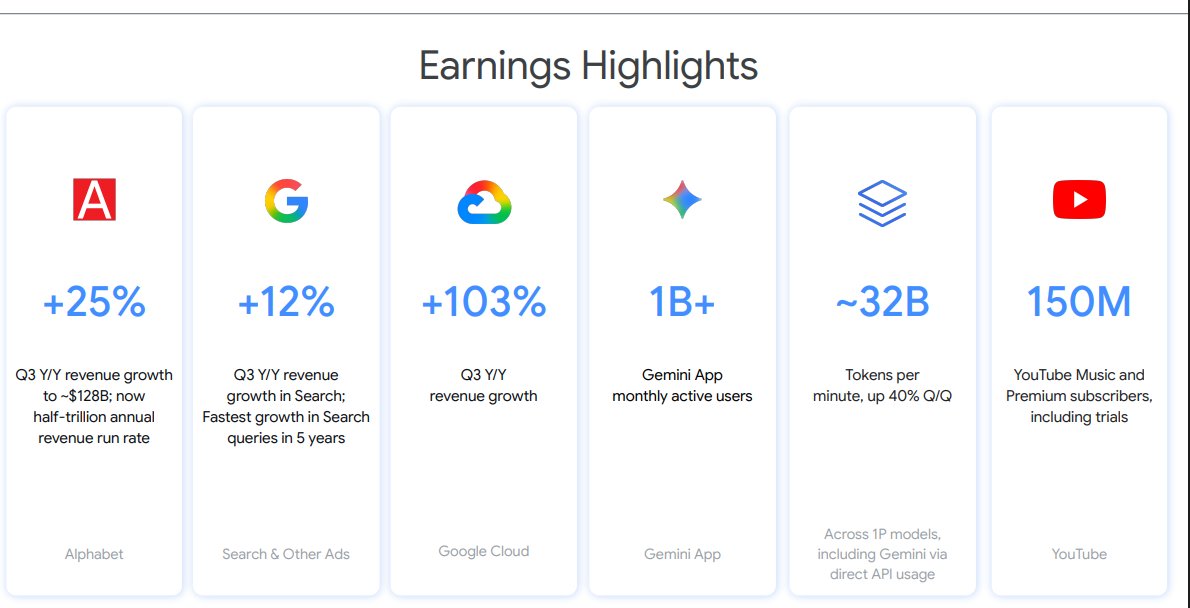
Alphabet's third-quarter revenue was US$127.577 billion, or US$102,346 billion in the same period last year, up 24.7% year-on-year, slightly lower than the agreed expectations of about US$128.2 billion by Reuters/LSEG. Operating profit was US$45.76 billion, up 29.9% year on year, and the operating margin rose from 30.5% to 31.8%; however, Wall Street analysts according to Market Alert expected operating profit of about US$43.16 billion, and there is still a gap in reality. Net profit of US$26.468 billion, a year-on-year decrease of 24.3%; earnings per share of US$2.12 were lower than the previous year's agreed expectations of US$2.87 and the agency's consolidated estimate of US$3.01. The decline in profit includes losses of 8.7 billion US dollars in equity securities, mainly involving changes in SpaceX's investment valuation, and cannot all be attributed to the deterioration of the main business.
The details of digital advertising are particularly noteworthy. Total advertising revenue was US$82,012 billion, up 10.6% year on year, lower than the estimate of US$83.42 billion; among them, search and other revenue was US$63.50 billion, up 12.0% from the previous year, up 12.0%, lower than the estimate of US$64.85 billion; YouTube advertising revenue was US$11.257 billion, up 9.2% from the previous year, up 9.2%, lower than the forecast of US$11.43 billion. Google Network revenue was $7.455 billion, up 1.4% year over year; subscription, platform and device revenue was $14.290 billion, up 11.0% year over year.
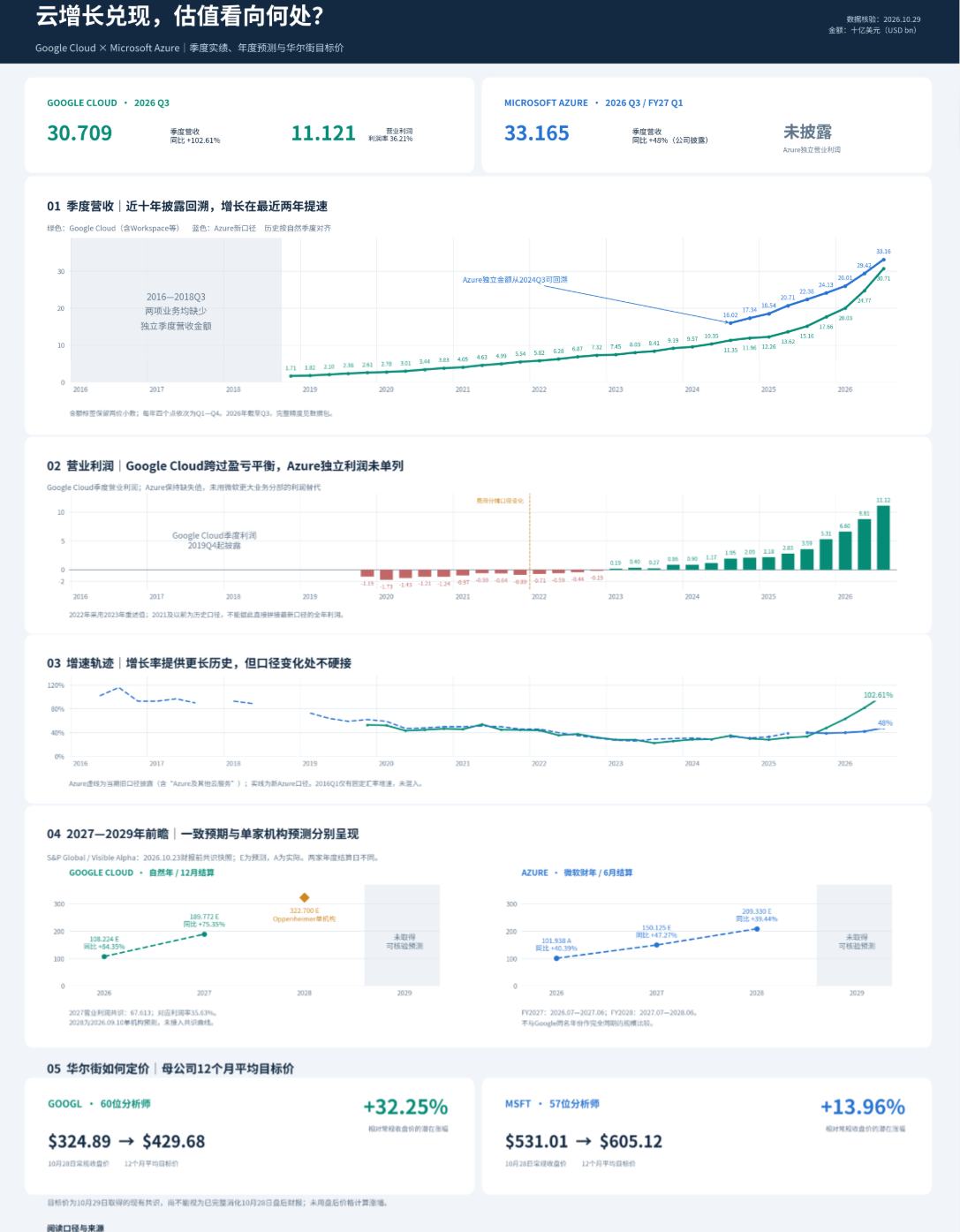
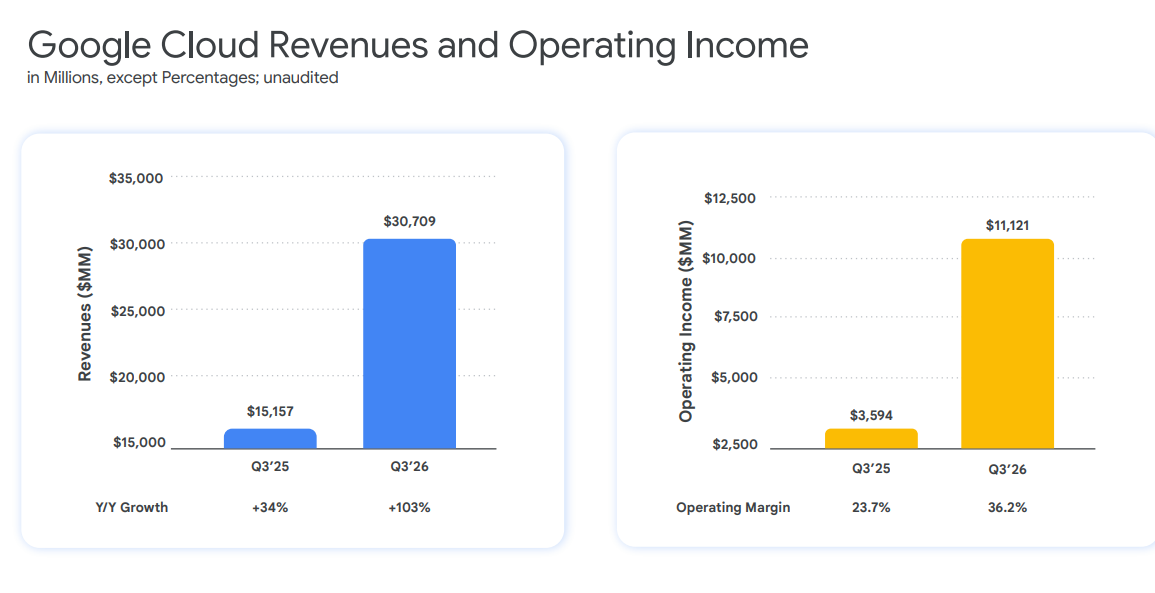
Alphabet's strongest business is still Google's cloud computing business — Google Cloud: revenue of US$30.709 billion, a year-on-year increase of 102.6%, higher than LSEG's estimate of US$29.57 billion by about 3.9%; operating profit rose from US$3,594 billion to US$11.121 billion, up 209.4%, and profit margin rose from 23.7% to 36.2%. Based on the Group's revenue growth, the cloud business contributed more than 60%, indicating that AI infrastructure and enterprise cloud demand have become a real growth engine. However, the division profits associated with cloud computing of Google's parent company Alphabet do not bear all of the Group's shared AI R&D expenses, and are not directly equivalent to Alphabet's overall return on AI investment.
The core growth of Google's performance call focused on usage, contract fulfillment, and TPU commercialization: the cloud backlog reached US$561 billion, up about 9.1% from month to month, and management expected slightly more than 55% to confirm revenue over the next 24 months; Gemini first-party API processes close to 32 billion tokens per minute, an increase of 40% over the previous year, and more than four times the previous year; the Gemini app users reached 1 billion, but the disclosure wording cannot be directly rewritten as monthly active users. The company also disclosed that 18 cloud product lines had annual revenue of more than 1 billion US dollars and sold more than 100 million AI seats for intellectual work. Sales of TPU external systems will expand in the fourth quarter and increase significantly in 2027, but the company has no separate AI or TPU revenue and profit.
This model has direct positive significance for Broadcom, HBM, advanced packaging and network equipment in the TPU industry chain: TPU's expansion from Google's internal resources to external sales and cloud service delivery capabilities will expand the serviceable market for related hardware. At the same time, TPU inventory procurement first takes up working capital, and only generates revenue and repayment after delivery. This is not the same accounting path as the capital expenditure of Google's self-built data center. Doubling Google Cloud's revenue can enhance the credibility of procurement demand, but it does not guarantee that the Group's current free cash flow will improve simultaneously.
Cash flow is Alphabet's main pressure point this time: capital expenditure of US$51,355 billion, up 114.4% year on year; operating cash flow of US$42.290 billion, down 12.7% year on year; free cash flow of US$9.065 billion, which is significantly weaker than expected to be close to breakeven. In addition to construction expenses, cash payments of $5.2 billion in EU fines and increased TPU inventories also had an impact. The company maintains capital expenditure of US$195 billion to US$205 billion in 2026, and is expected to increase significantly in 2027; the conference call also suggested that third-party computing power investment in the fourth quarter will suppress cloud profit margins, and AI Mode's low monetization rate is already affecting search growth. As a result, Google Outlook strengthened demand for computing power, but did not provide a basis for “overall revenue, profit, and cash returns exceeding expectations.”
However, according to some analysts, Google's strong cloud computing business is enough to dispel negative market concerns about Google's future. Ethan Ferrer, a strategist at Zacks Investment Research, stated in a report: “This is just a small episode in the path of artificial intelligence prosperity and development, not a complete interruption in the growth of AI applications. The market demand is clear; the 103% increase in cloud services is proof of that.”
Microsoft: Azure accelerates and operating leverage are realized together, and the surprise of capital expenditure needs to be unraveled and understood
Microsoft's revenue for the first quarter of fiscal year 2027 was about US$92.277 billion, up 18.8% year on year, higher than the agreed market expectations of about US$90.63 billion to US$90.66 billion; operating profit was US$45.915 billion, up 21.0% year on year, and the calculated operating margin reached 49.76%, an increase of about 0.88 percentage points over the previous year. Adjusted earnings per share of $4.89, or $4.13 last year, increased 18.4% year over year, exceeding agreed market expectations of approximately $4.73; GAAP earnings per share were $4.92, up 32% year over year, including changes in OpenAI's investment profit and loss base.
Microsoft's cloud computing business — that is, Azure cloud computing achieved revenue of about US$33.165 billion, with a reported and fixed exchange rate growth rate of 48%, an increase of 6 percentage points over the previous quarter's 42% growth rate under the stated caliber, and also surpassed the company's previous 44% to 45% guideline. Visible Alpha, adopted by Reuters, is expected to be US$32.84 billion; another snapshot before earnings reports was US$33.06 billion, an increase of 47.7%. As a result, Azure surpassed sellers' forecasts across the board, and also crossed the highest expected growth threshold of around 47% discussed by some agencies. For analysts who are optimistic about Microsoft's stock price and basic outlook, a more weighty bullish view is being formed — that is, the cloud computing business continues to expand at an accelerated pace on a continued high revenue base and is occurring at the same time as the Group's profit growth.
Microsoft's overall cloud computing-related business revenue was US$63.9 billion, up 30% year on year; Microsoft 365 cloud revenue was US$27.778 billion, up 17.2% year on year; commercial cloud reported a growth rate of 17% and a fixed exchange rate of 18%, respectively, after excluding revenue confirmation factors for the previous year; consumer cloud grew 17%, and industry solution cloud increased 10%. Remaining commercial performance obligations were US$677 billion, up 73% year on year, but slightly lower than the previous quarter's US$678 billion, and the commercial order index fell 12% year on year.
The improvement in cash flow was particularly prominent compared to expectations: operating cash flow of US$58 billion, up 28.7% year on year; cash capital expenditure of US$39.367 billion, up 103% year on year; free cash flow of US$18.633 billion, far higher than the agreed market expectations of US$8.54 billion and Wall Street's most optimistic expectations, but it still fell 27.4% year on year. Capital expenditure, including financial leases, was 45.2 billion US dollars, lower than previous corporate guidelines of more than 50 billion US dollars. The company's explanation involved delays in the delivery of production capacity by a third party, so the full difference cannot be directly explained as an increase in investment efficiency.
Microsoft Cloud's gross margin was 66%, up from 65% in the previous quarter and down from 68% last year. It also shows that “improving the group's operating leverage” and “the cloud business still bears pressure on infrastructure costs” can be established at the same time. Therefore, for Wall Street analysts who are optimistic about Microsoft, the more prudent judgment is that Microsoft has proven that high-intensity AI investment can coexist with the group's operating profit margin of close to 50%, and the phased delay in cash spending further mitigated current financing concerns.
From memory to liquid cooling, AI infrastructure demand is being fulfilled at an accelerated pace: orders and profits together reinforce the story of strong AI computing power growth
The strong growth of the two major cloud giants is providing revenue side verification for AI infrastructure investments. However, as can be seen from a series of positive growth trends among leaders in the AI computing power industry chain in the recent past, from memory carrying models and inference tasks to power supply and liquid cooling systems that guarantee the operation of high-density racks, industry chain financial reports are providing mutually confirming demand signals. Among them, storage manufacturers' profits and long-term supply arrangements are particularly representative.
HBM and SK Hynix, a leader in server DRAM, provided the strongest evidence of storage profit: third-quarter revenue of 104.62 trillion won, up 328% year over year; operating profit of 83.33 trillion won, up 632% year on year, or 7.32 times the previous year, and operating margin reached 80%. The call showed that long-term agreements for 14 core customers have covered more than half of production capacity from 2027 to 2028; in addition to the demand currently being negotiated, management determined that DRAM and HBM production capacity would be “substantially sold out” by 2029, and customer demand would exceed the current supply by more than double. For investors focusing on AI computing power and semiconductors, the most valuable change is undoubtedly that customer procurement plans increase the probability of fulfillment through longer term agreements, pricing arrangements, and advance payments.
Seagate, the leader in near-line high-capacity HDDs, had revenue of US$4.233 billion in the first quarter of fiscal year 2027, up 61% year on year; adjusted earnings per share of US$7.68, compared with US$2.61 in the previous year; free cash flow of US$1.5 billion; and most of its near-line capacity has been allocated to 2028, and some customer agreements have been extended to 2030, but specific configurations and price locks were mainly covered until 2027. Data center HDD giant Western Digital's revenue for the same period was US$4.381 billion, up 55% year on year; adjusted earnings per share were US$4.64, with revenue guidance for the next quarter of US$5.1 billion and earnings per share of US$5.80. AI agents are rapidly gaining popularity around the world to respond to the demand for expanding the capacity of logs, retrieval data, and persistent data generated at an accelerated rate, while HDDs undertake long-term storage at a lower cost per unit capacity, complementing SSDs that serve hot data.
Data center power supply, thermal management and liquid cooling system giant Vertiv's results further validate the “keep the chip running after buying it” investment chain: third-quarter revenue of US$4.313 billion, up 61% year over year, up about 14.7% above US$3.76 billion; adjusted earnings per share of US$2.21, up 78% year over year, up 78% year on year, higher than US$1.82; organic orders increased by more than 100%, and adjusted operating margin reached 25.2%. The company raised its annual revenue guidance to US$14.45 billion to US$14.85 billion, adjusted earnings per share of US$710-7.20, and free cash flow of US$2.6 billion to US$2.8 billion. High-density racks increase heat flow density, power supply, and cooling requirements, so Vertiv's profitability elasticity comes not only from an increase in the number of data centers, but also from an increase in the value of infrastructure per rack.
On the power side, demand for AI computing power expansion is also being realized at an accelerated pace. Gas turbine and grid equipment giant GE Vernova's third-quarter revenue was US$12.6 billion, up 27% year on year, with orders of US$29 billion, organic growth of 96%, with backlog orders reaching US$19.7 billion; free cash flow guidelines were raised to US$16 billion to US$17 billion. Solid oxide fuel cell and field power supplier Bloom Energy's revenue was US$1,236 million, up 138% year over year, and raised its annual revenue guidance to US$4.4-4.6 billion. The former reflects the expansion of power grids and large-scale power generation equipment, while the latter provides power supply routes for some projects to bypass long waiting times to be connected to the grid; both benefit from computing power construction competition over available electricity.
As demand for AI computing power expands more and more, demand for AI related to semiconductor equipment, chip manufacturing and design is also growing at an accelerated pace. The “king of global chip foundry” TSMC's third-quarter US dollar revenue was 46.72 billion US dollars, up 41.2% year on year, with a gross profit margin of 66.4%. The total investment from 2026 to 2028 is expected to significantly exceed the previous three years. EUV lithography giant Asmack's revenue for the third quarter was 11.662 billion euros, and the fourth quarter guide was 14.2 billion to 15.2 billion euros; management said that the current planned supply for 2027-2028 is still insufficient to meet demand, and some customers have already discussed orders for 2029 and even 2030. Etching and deposition equipment giant Fanlin Group's quarterly revenue was US$8.219 billion, up about 54% year-on-year, and the next quarter will fluctuate between US$8.6 billion and US$400 million.
ASM International, a leader in atomic layer deposition equipment, had third-quarter revenue of 1,159 million euros, up 45% year on year, and adjusted operating profit increased 56%. Revenue is expected to exceed 5.7 billion euros in 2027; EDA design software and verification platform giant Keng Teng Electronics had revenue of US$1,633 billion, an increase of 22% year over year, a backlog of US$8.2 billion, and raised annual revenue to US$6.387 billion to US$6.387 billion. Advanced manufacturing processes increase deposition and etching steps, and custom ASICs increase design, verification, and system simulation requirements, which means that competition between GPU and TPU can expand common upstream business rather than just redistribute shares among chip manufacturers.
Connectivity, analog chip, and system manufacturing formed another set of verifications: analog and embedded chip giant Texas Instruments's third-quarter revenue was 6.055 billion US dollars, up 28% year on year; data center terminal business increased 95%, up 20% from month to month, and fourth quarter revenue was 5.8 billion to 6.3 billion US dollars; high-speed connector and cable giant Amphenol's revenue was 10.230 billion US dollars, up 65% year on year and 37% year on year, leading to 10.3 billion US dollars to 10.5 billion US dollars in the fourth quarter; optical fiber and optical connection materials giant Corning's core revenue was 5.81 billion US dollars, up 19% year on year, light Communications increased by 44%, and related generative AI products grew by more than 100%; AI computing and network equipment manufacturer Tianhong Technology (Celestica) had revenue of US$5.83 billion, a sharp increase of 83% year over year, and gave a preliminary forecast of US$40 billion in revenue in 2027, an increase of 90% year on year.
A stronger basis for the semiconductor bull market: demand visibility is significantly extended, and profits are concentrated on scarce links
AI applications, including Google's parent company Alphabet and Microsoft, Meta, and Oracle, have also provided positive signals about AI computing power requirements. Social advertising and AI application giant Meta's third-quarter revenue was US$64.601 billion, up 26% year on year, ad impressions increased 10% and unit price increased 14%; the number of daily active users of its apps was 3.64 billion. Muse has more than 10 million registered accounts in the US and Canada, and about a quarter of them are used every day; enterprise database and cloud infrastructure giant Oracle clearly stated that free cash flow was positive in the second half of fiscal year 2028, surpassed 30 billion US dollars in fiscal year 2029, and revenue of at least 225 billion US dollars in fiscal year 2030. The former shows that application growth coexists with capital consumption, while the latter provides a verifiable timeline for cash recovery after a peak in capital expenditure.
As Meta Muse and OpenAI's GPT-6 Astra fully set off a wave of AI agents, “AI FOMO transactions” (meaning investors are worried about missing out on rising opportunities in AI-related assets, and are therefore chasing down or making up for previously lowered positions) are expected to make a comeback. Looking at the underlying architecture of AI computing power infrastructure, Muse and Astra are expected to further expand the scope of use of AI agents. The massive expansion of AI inference workloads brought by them will also increase the demand for model inference, tool execution, and state management, while deepening the competitive pressure on some software companies. According to the AI capital expenditure forecast and outlook of the J.P. Morgan strategist team, hyperscale cloud vendors will spend about 950 billion US dollars in 2026, 1.4 trillion US dollars in 2027, and 3 trillion US dollars in 2030.
However, the next phase of the global AI computing power theme and the strong upward trajectory of the semiconductor sector, which is more supported, should be driven by improved profit forecasts, repayment payments, and improved credit spreads, especially scarce production capacity and scarce technology.
Judging from the technical mechanism, AI agents expand one answer to repeated reasoning, retrieval, tool execution, and state saving. The GPU and TPU are responsible for model calculation, and the CPU is responsible for tools and task orchestration. HBM holds high-bandwidth access data, server DRAM hosts the operating environment, and SSD and HDD respectively provide high-performance access and high-capacity storage. At the same time, network infrastructure, data center high-speed optical interconnection, power supply, and cooling determine the actual utilization rate of expensive accelerators. Therefore, cloud revenue acceleration can support multiple hardware links at the same time; how much profit a specific company obtains still depends on performance advantages, supply bottlenecks, and bargaining power.
Industry forecasts show that growth comes not only from the number of devices, but also from configuration upgrades and prices. TrendForce expects the capital expenditure of the nine major CSP's to reach 957 billion US dollars in 2026, an increase of 106% year on year, and more than 1.5 trillion US dollars in 2027, a further increase of about 60%; AI server shipments are expected to increase by 32.2% and close to 36%, respectively, and the revenue scale will rise from 479 billion US dollars to close to 92 billion US dollars. The agency's research tracking NVL72 shows that shipments of related racks are expected to increase by more than 50% in 2027, and the combined output value of the GB300, VR200 and VR300 will exceed 710 billion US dollars, an increase of 214% over the previous year.
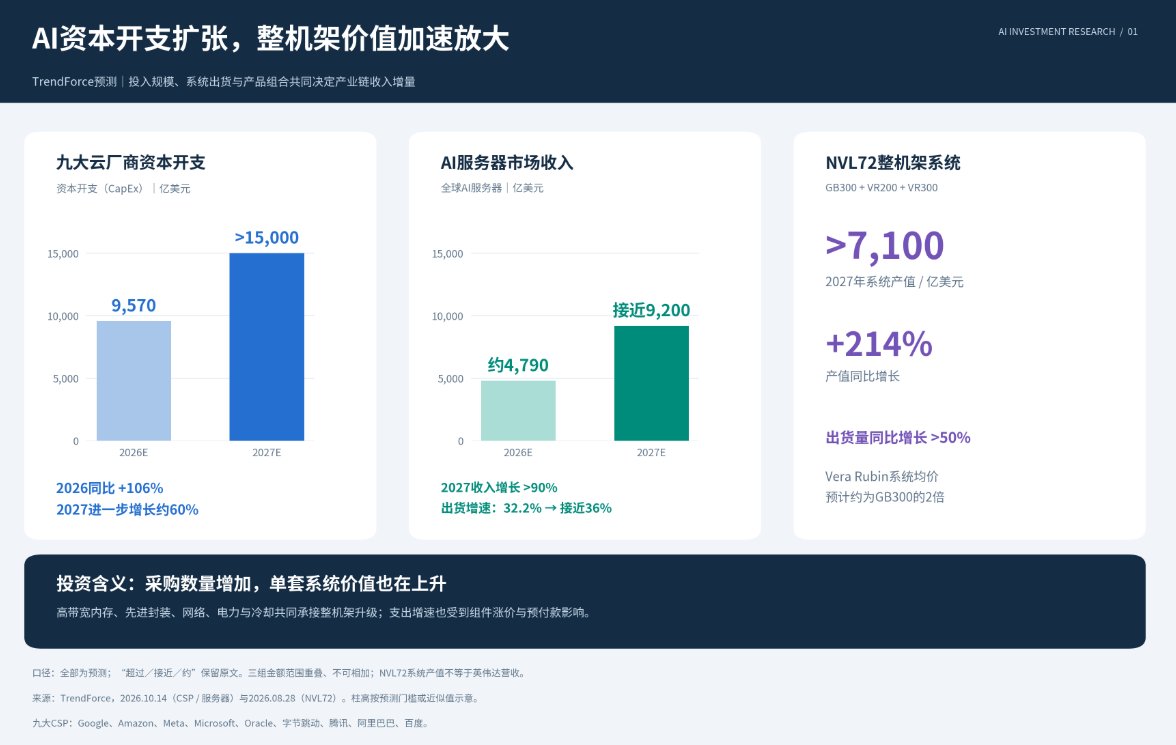
Storage prices reinforce vendor profit elasticity. TrendForce publicly predicts that traditional DRAM contract prices will rise 10% to 15% month-on-month and NAND will rise 15% to 20% in the fourth quarter; previously, in September, the agency also predicted a 121% increase in HBM mixed average price in 2027; the agency also previously estimated that DRAM and NAND may account for 68% of major CSP capital expenses from 47% in 2026 to 68% in 2027. This is a revenue and profit opportunity for storage vendors, and a cost constraint for cloud vendors; whether Microsoft and Google can increase revenue per unit of computing power determines whether the two sides can continue to prosper.
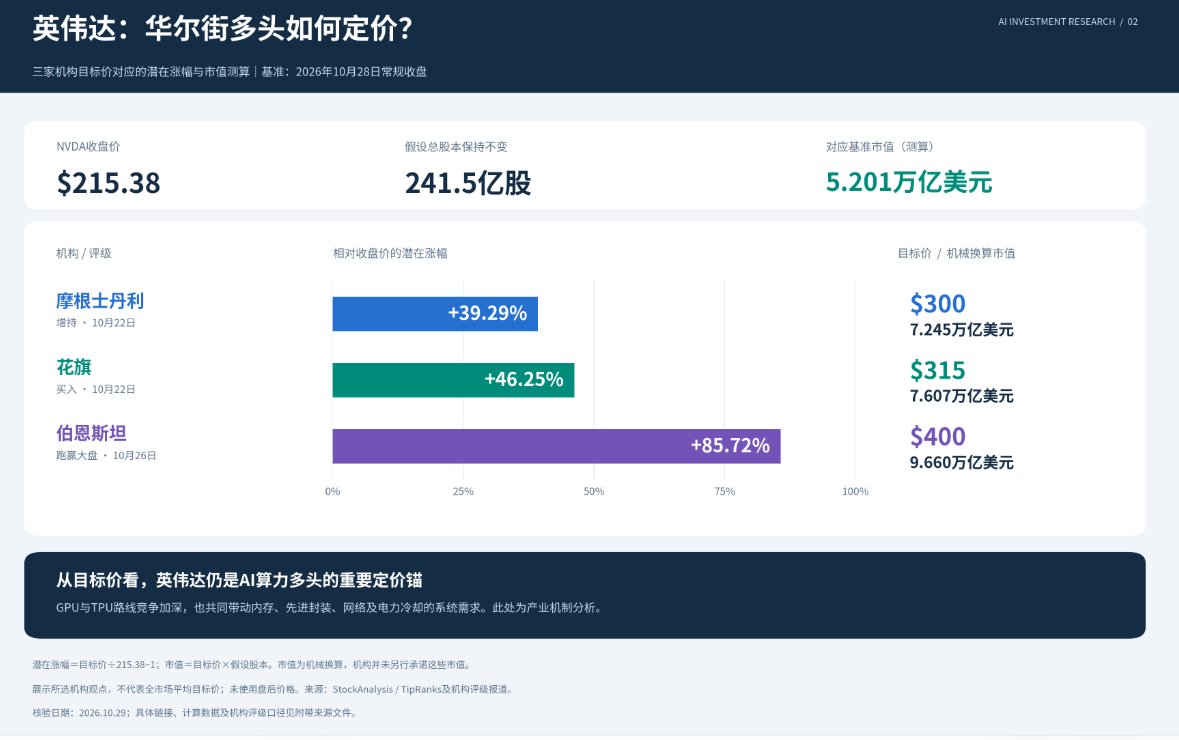
Nvidia, with a market capitalization of about 5.2 trillion US dollars, is still an important bullish pricing anchor for Zhongher Street in this round of intense market differences. Based on the closing price of $215.38 on October 28, Morgan Stanley's latest target prices of $300, Citi $315, and Bernstein's $400 correspond to an increase of about 39.3%, 46.3%, and 85.7%, respectively; assuming that the share capital of about 24.15 billion dollars remains unchanged, the market capitalization of machinery is about 7.25 trillion dollars, 7.61 trillion dollars, and 9.66 trillion US dollars. Wall Street analysts' latest consistent average price targets for Alphabet and Microsoft are $429.68 and $605.12, respectively, which is a potential increase of 32.25% and 13.96% compared to the regular closing price of October 28.
As the two major cloud computing giants verify that demand for AI computing power continues to blowout and demand for AI applications dominated by AI agents is rapidly penetrating into various industries, investment opportunities for AI infrastructure expansion are simultaneously covering memory bandwidth, large data storage, and high-speed optical interconnection of data centers. In the storage sector, Goldman Sachs maintained a “buy” rating of HBM and DRAM leader SK Hynix and a target price of 3.5 million won; Morgan Stanley maintained a “overrated” rating for near-line hard drives and Seagate, a leader in heat-assisted magnetic recording (HAMR), adjusted the target price from $1,200 to $1,148, and raised the target price of data center hard drive giant Western Digital from $643 to $668. Based on the regular closing prices of 1,487,000 won, 697.97 US dollars, and 396.42 US dollars for the three companies on October 28, the corresponding potential upside was 135.37%, 64.48%, and 68.51%, respectively.
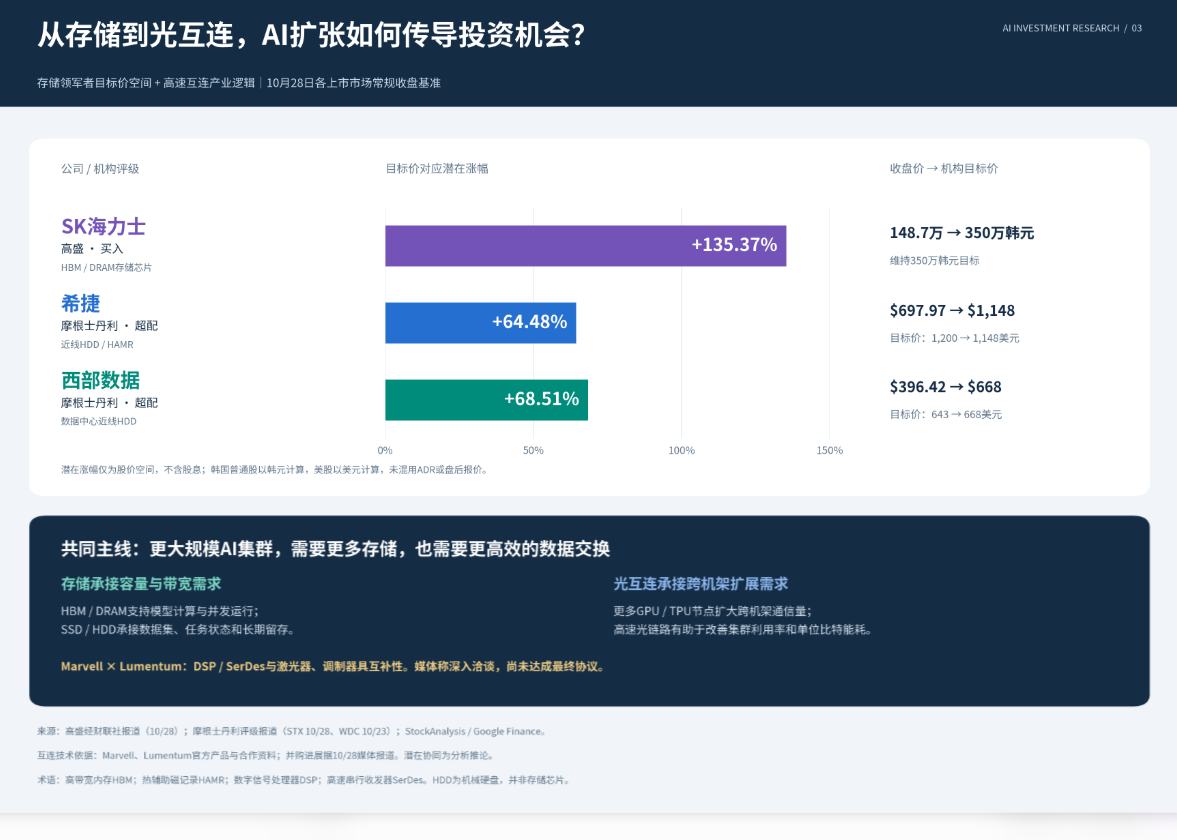
The same round of AI cluster expansion will also extend investment requirements from “storing more data” to “enabling more computing nodes to efficiently exchange data.” HBM and DRAM support model calculation and concurrent operation, and enterprise-grade SSDs and near-line HDDs undertake data and long-term storage at different access frequencies; as the scale of GPU and TPU deployment and the degree of parallelism across racks increase, high-speed optical interconnection has become an important part of alleviating communication bottlenecks and improving cluster utilization. Recent developments in optical interconnection show that market reports that Maywell is in in-depth negotiations to acquire Lumentum, but no final agreement has yet been reached, reflecting that chip giants and even businesses are seeking to further integrate network silicon and optical device capabilities.
Mywell's digital signal processor (DSP), high-speed serial transceiver (SerDes) and network chip capabilities are technically complementary to Lumentum's lasers, modulators, and optical devices, and the two sides also already have a foundation for high-speed electro-optical interface cooperation. Derived from industrial mechanisms, potential integration is expected to enhance the collaborative design of high-speed links, support bandwidth upgrades and energy consumption improvements per bit, making it more scarce in the AI computing power industry chain and further covering “computing, storage, and interconnection” within the scope of benefits for AI capital expenditure.