
How Investors May Respond To Bread Financial Holdings (BFH) Preferred Share Offering
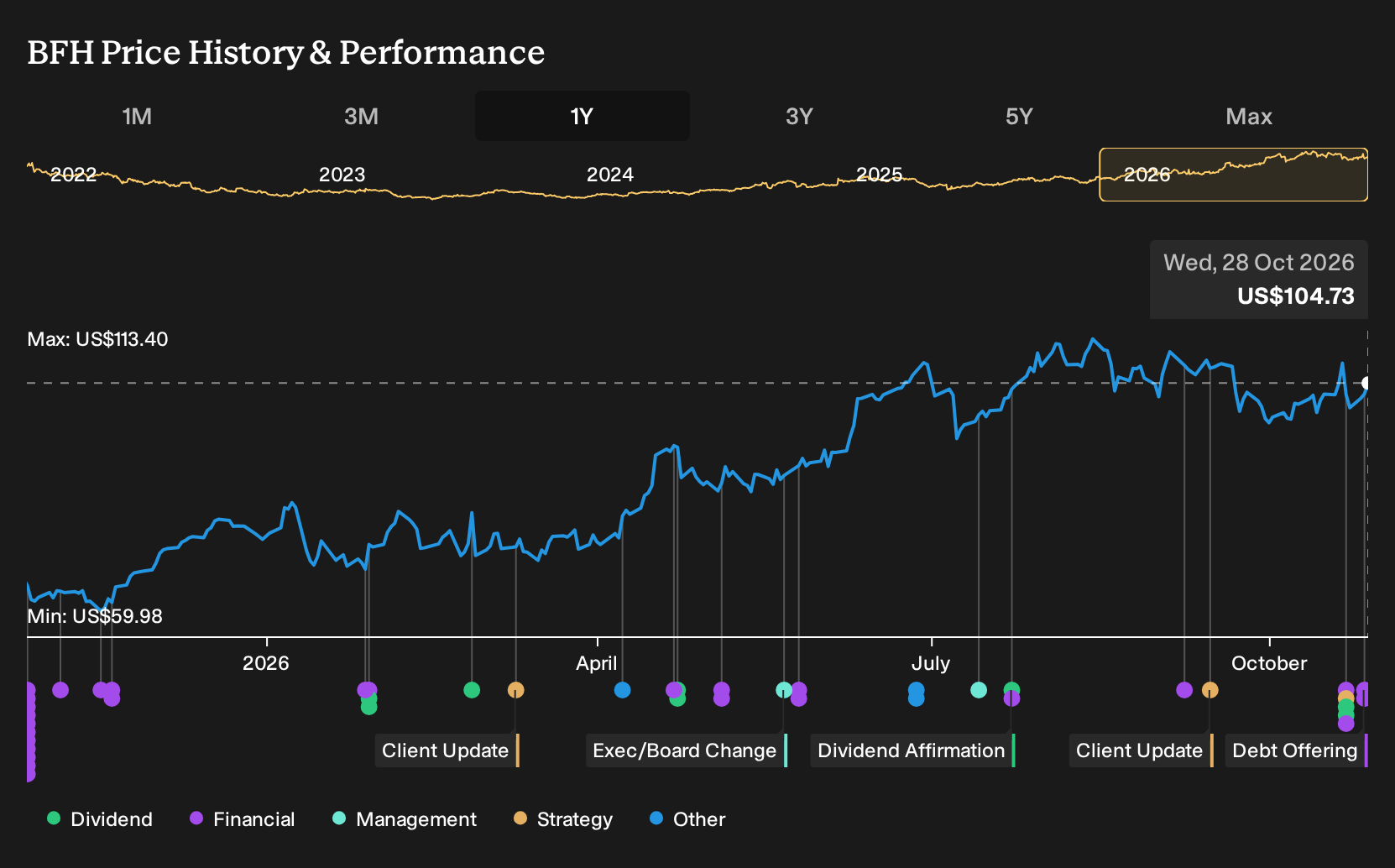
- Bread Financial Holdings completed a US$125 million fixed income offering of 5,000,000 non convertible, non cumulative, perpetual Series C preferred depositary shares at US$25 each, with callable and junior features.
- The preferred issuance adds an extra capital lever for Bread Financial Holdings as it balances loan growth, loss rate guidance, and growing partner profit sharing obligations.
- This article examines how Bread Financial Holdings' new preferred capital layer interacts with its earnings narrative and capital return plans.
Scan how Bread Financial Holdings’ latest preferred issuance compares with peers by lining it up against a curated group of 26 high quality undervalued stocks with similar balance sheet and earnings stories.
Bread Financial Holdings Investment Narrative Recap
To own Bread Financial Holdings, you need to be comfortable with a lender that leans into consumer credit while working to keep loss rates contained and funding flexible. The recent preferred issuance adds another capital tool around a business that is guiding to about 5% total revenue growth in 2026, driven mainly by average loan balances.
The key short term swing factor is credit performance versus the improved full year net loss rate outlook of 6.9% to 7.0%. Rising partner profit sharing and rewards costs, plus a 5% bad loan ratio, remain the biggest operational pressure points. The new preferred layer does not radically change those near term risks.
Among the recent announcements, the long term renewal with Sephora looks most relevant next to the new preferred capital. This partnership supports Bread Financial Holdings’ focus on co brand and private label programs, and links closely to its push into more data driven, personalized credit and loyalty offers for higher quality customers.
For investors watching catalysts, that Sephora extension ties directly into credit sales and loan mix, which feed the revenue outlook and loss rate profile that management is trying to defend. Execution risk sits in balancing richer rewards and partner profit sharing with disciplined underwriting so that earnings and returns do not get squeezed over time.
What The New Preferred Capital Layer Is Being Asked To Support
Bread Financial Holdings' latest preferred capital layer is being positioned against a set of analyst assumptions that lean heavily on revenue expansion while accepting lower profitability. Analysts are building in revenue growth of 18.0% a year over the next three years, a material step up for any consumer credit focused lender that still needs to keep loss rates in check and funding costs under control.
On earnings, the consensus framework is more cautious. Analysts expect net income to move from US$565.0 million today to US$519.1 million by 2029. That is a decline of about US$46 million, even as the same group is assuming profit margins step down from 21.2% to 11.8% over roughly the same period. Preferred capital that is perpetual, non cumulative and junior to deposits and senior debt has to be serviceable in that context, which makes the interaction between loss rates, partner sharing and common equity payouts important to monitor.
That earnings profile sits inside a balance sheet that analysts think can get leaner on the common side. Expectations for a 7.0% yearly reduction in shares outstanding over the next three years imply more buybacks or lower issuance, which can amplify per share earnings if the absolute profit pool does not contract too sharply. The perpetual preferred shares slot in as a fixed cost layer, so the trade off for common holders sits between lower share count, potential P/E expansion to 9.0x by 2029 from 6.7x today, and the claim that preferred dividends have on future cash flows.
Bread Financial Holdings' narrative projects US$4.4 billion revenue and US$519.1 million earnings by 2029. This is built on 18.0% yearly revenue growth and an earnings decline of about US$46 million from US$565.0 million.
Uncover how Bread Financial Holdings' fair value indicates a 10% potential upside to its current price before that valuation gap starts to close.
Exploring Other Perspectives
The lowest analysts focus less on revenue growth and more on pressure on Bread Financial Holdings’ margins. They were penciling in earnings of about US$390.2 million by 2029 on roughly US$4.5b of revenue before this preferred deal. That is a much harsher story than consensus, and the new capital layer could easily nudge those views in either direction.
Explore another Bread Financial Holdings fair value estimate, including one that suggests it could be worth just $115.06.
The Verdict Is Yours
Disagree with existing narratives? Extraordinary investment returns rarely come from following the herd, so go with your instincts.
- A great starting point for your Bread Financial Holdings research is our analysis highlighting 2 key rewards and 2 important warning signs that could impact your investment decision.
- See our latest analysis for Bread Financial Holdings. The report includes a comprehensive fundamental analysis summarized in a single visual, the Snowflake, making it easy to evaluate Bread Financial Holdings' overall financial health at a glance.
Looking for more Bread Financial Holdings style ideas?
If the Bread Financial Holdings story has you thinking about portfolio tweaks, it can help to line it up against other companies with similar strengths or different risk profiles so you are not relying on a single case study.
- Target resilience first by scanning a 32 resilient stocks with low risk scores that screens for businesses with sturdier risk scores when you want calmer swings in your holdings.
- If balance sheet strength matters most to you, compare Bread Financial Holdings with a broader list of solid balance sheet and fundamentals (24 results) that filters for companies pairing financial stability with sound fundamentals.
- For investors hunting for potential mispricing, broaden the watchlist with a 19 high quality undiscovered gems that highlights high quality businesses the market may not be fully paying attention to yet.
Have feedback on this article? Concerned about the content? Get in touch with us directly. Alternatively, email editorial-team@simplywallst.com