
As Philadelphia Semiconductors rebounded, Bernstein lowered NXP (NXPI.US) target price: AI infrastructure exposure is difficult to leverage valuation premiums
The Zhitong Finance App learned that the latest performance report and future outlook of NXP Semiconductor (NXPI.US), a leader in analog chips and smart car MCU chips headquartered in the Netherlands, can be described as revealing an important differentiation in the semiconductor rebound — the resumption of growth trajectory in performance and outlook does not mean being able to receive valuation treatment at the level of an AI computing power leader. On October 28, after NXP's earnings report, it fell about 7.7% before the market, but the closing decline narrowed to 0.71% to $251.69. In the same period, the Philadelphia Semiconductor Index rose significantly for four consecutive trading days, with a cumulative rebound of about 8.87% from the close of the 22nd. Compared with NXP's increase of only 3%, a sharp loss; the NASDAQ 100 Index had a cumulative increase of about 2.95% from the 26th to the 28th. This divergence means that capital is comparing the overall growth rate of various chip companies, exceeding expectations, and the share of revenue associated with AI computing power infrastructure, rather than indiscriminately buying stocks in the semiconductor sector.
The Bernstein analysts' team's latest judgment on NXP's stock outlook is that NXP's business execution is steady, valuations are not expensive, and repurchase capacity is enhanced, but the automotive business accounts for a relatively high share, and the data center business is not enough to significantly boost overall growth, so there is currently no strong catalyst to drive valuation revaluation.
According to NXP's earnings data, third-quarter revenue, adjusted gross margin, and earnings per share all slightly exceeded expectations, but the fourth quarter guidance did not provide significant room for improvement; normalization of channel inventory, improved capacity utilization, and future falling manufacturing costs supported profit recovery, but the main gross margin gains still need to be realized around 2028.
The Bernstein Semiconductor analyst team led by Stacy Rasgon raised the profit forecast slightly, but reduced the valuation multiplier from about 16 times to 14 times, while the target price was lowered from $290 to $270, maintaining the neutral rating of “market-perform” (Market-Perform). Compared to the share price of 253.50 US dollars used in the report, the room for growth was only about 6.5%, and the report rounded to 7%; compared to the closing price on the 28th, the room for increase was about 7.3%. This is a Wall Street study acknowledging improvements in fundamentals but questioning relative investment attractiveness. It is not a “buy” or an optimistic rating recommendation of the same level.
The profit repair report card was handed over, but the stock price is waiting for stronger growth surprises
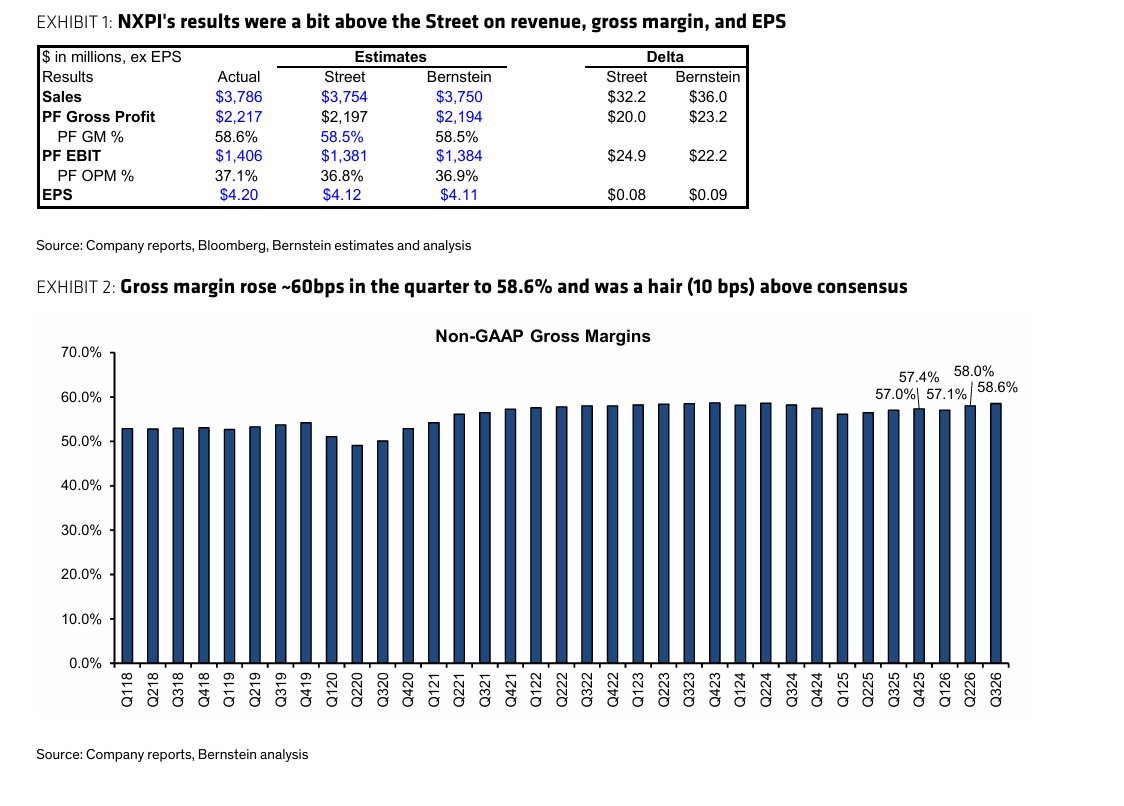
NXP's third-quarter revenue of US$3.786 billion was up 19.3% year over year, about 0.9% higher than Bloomberg's unanimous estimate of US$3.754 billion quoted by Bernstein; adjusted earnings per share of US$4.20 were US$4.20, up about 35% from US$3.11 in the same period of the previous year, and about 1.9% higher than the forecast of US$4.12. The adjusted gross profit margin was 58.6%, up from 57.0% in the same period last year and the forecast of 58.5%; the adjusted operating profit margin was 37.1%, higher than 33.8% in the same period of the previous year and 36.8% forecast. Growth has been converted into profit, and profit is growing faster than revenue, but the margin above expectations is still moderate. The company's operating cash flow for the quarter was US$1,256 million, net capital expenditure of US$50 million, and free cash flow reached US$1.26 billion, accounting for 31.9% of revenue, showing good cash conversion capacity.
The business structure explains why overall growth is good, but it has not sufficiently ignited market sentiment. The automotive business revenue was US$2,070 million, up 12.7% year on year, slightly higher than the market's agreed forecast of about US$2,058 million, accounting for about 54.7% of total revenue, and is still the main determinant of the Group's growth; industrial and IoT revenue of US$802 million, up 38.5% year on year, slightly lower than the forecast of US$806 million; revenue from mobile business was US$411 million, down 4.4% year on year but slightly higher than expected US$406 million; communication infrastructure and other revenue of US$503 million, up 53.8% year on year, exceeding expectations of US$493 million.
NXP's long-term competitiveness focuses on automotive and industrial embedded processing, connectivity, security, and analog mixed-signal technology, while software-defined automotive, industrial intelligence, and data center control systems form NXP's fastest recent growth direction. However, communications infrastructure and other business revenues have yet to be included in NXP's undisclosed AI data center revenue, and the fastest-growing business has yet to replace automobiles as the main determinant of the Group's growth.
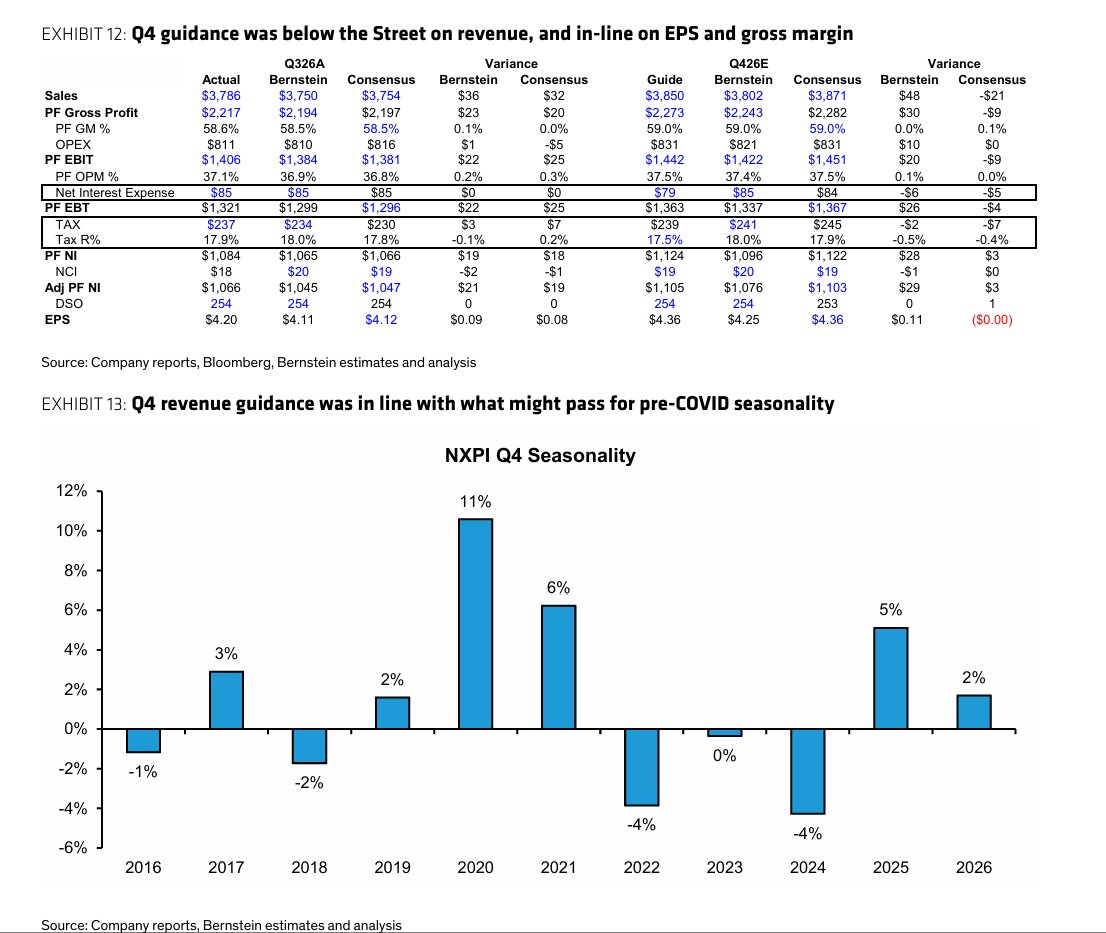
The fourth quarter guidance further highlighted this “growth realized, and the forecast gap was insufficient”: the revenue range was 3.75 billion US dollars, with a median value of 3.85 billion US dollars, up about 15.4% from the same period last year, but slightly lower than the agreed estimate of US$3,871 billion quoted in the report; adjusted median earnings per share of US$4.36, up about 30.1% from US$3.35 in the same period last year, in line with expectations; the median adjusted gross margin was 59.0%, which was also in line with expectations. By business, automotive, industrial, Internet of Things, and mobile business guidelines are all slightly weaker than market expectations, while communication infrastructure and other businesses are stronger. Management expects double-digit revenue growth in 2027, and Bernstein judged that it is more likely to fall in the low double digit range, and the market has already taken into account similar growth. The catalyst that NXP's stock price now urgently needs is to guide growth beyond existing benchmark predictions, and not just that growth continues to occur.
The AI control plane opens up new space, why is the target price of $270 still being lowered?
NXP's main path of participation in AI infrastructure is to enable expensive computing systems to run reliably.
At the performance conference call, NXP management predicted that data center revenue in 2026 will exceed the previously stated target of $500 million and reach about $1 billion in 2028; Bernstein estimates that it will still account for only about 6% of revenue at that time, and is expected to be around 4% in 2026. The growth of this business is impressive, but customer introduction, mass production of new products, and software adaptation determine the speed at which revenue is realized, and cannot be extrapolated based on GPU purchases or additional power added to data centers.
At the same time, the company's internal inventory amount increased by about 39 million US dollars month-on-month to 2,596 billion US dollars, but the number of inventory days fell from 156 days to 148 days, indicating that the expansion of revenue and cost scales was improving turnover; channel inventory remained at the target level for about 11 weeks, and distribution accounted for 59.3% of revenue. According to customer headquarters locations, the share of revenue in the Chinese market fell from 18% to 17%, the Americas rose to 31%, Europe, the Middle East and Africa fell to 24%, and the rest of the Asia-Pacific region remained at 28%. These metrics support cyclical restoration, but they have yet to show an outbreak of inventory replenishment sufficient to significantly raise revenue forecasts associated with AI infrastructure.
When Bernstein lowered his target price, the key was a decline in the valuation multiples he was willing to pay, rather than a worsening profit forecast. Its revenue forecast for 2026-2028 was raised to about $14.315 billion, $15.772 billion, and $17.059 billion, respectively, and the adjusted earnings per share forecast was raised to $15.22, 17.48, and $21.06; the average earnings per share for 2027-2028 was multiplied by about 14 times, to obtain a target price of $270. The improvement in profit margins comes from increased capacity utilization and the gradual release of cost advantages in VSMC's manufacturing layout: management expects gross margin to reach 60% in 2027, and VSMC is expected to contribute about 200 basis points of improvement after fully climbing the slope, but not all of them can be included in 2027 in advance.
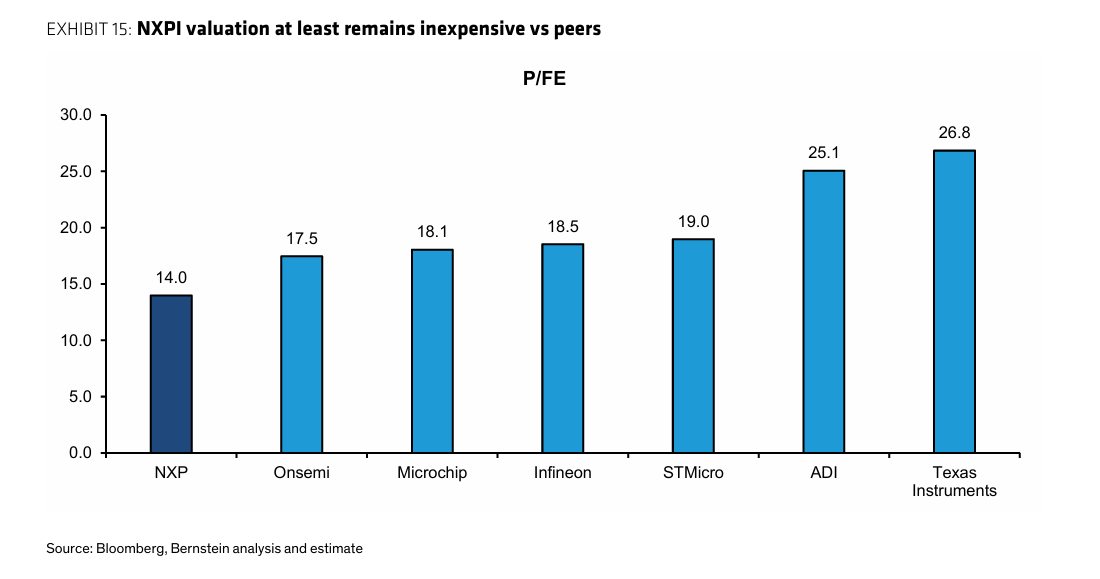
Balance sheets and repurchases provide another layer of support: net debt of about US$7 billion, net leverage of about 1.3 times, below the company's target of 2 times; after adding US$5 billion in repurchase authorizations, the total number of available authorizations was US$6.3 billion. The Bernstein model predicts free cash flow of approximately $4,060 billion and $5.51 billion in 2028, respectively, and assumes a significant increase in buyback strength. Therefore, the main line of investment is automobile and industrial recovery, manufacturing efficiency improvements, and repurchases to jointly increase earnings per share; the AI business needs to be further scaled up to change the overall valuation framework. NXP's valuation in the picture is about 14 times lower than that of Ansemi, Microchip, Infineon, ST, Adderall, and Texas Instruments shown. The company “is not expensive, but it still lacks a catalyst for revaluation.”
Bernstein said that follow-up observations on NXP include Analyst Day next March, the number of new products released, and whether demand, share, and gross margin can exceed the model; conversely, re-inventory removal or loss of design shares from key customers will weaken this path.
Wall Street disagreements focus on the speed of order fulfillment, and AI opportunities fall on “control and trusted operation”
After the earnings report, Wall Street did not form a unanimous bearish judgment. Based on the unified calculation of the closing price of $251.69 on October 28, Morgan Stanley maintained an overallocation, with an implied increase of 24.4%; KeyBanc remained overallocated and the target price dropped from 345 to $330, implying an increase of 31.1%; Jefferies maintained the purchase, and the target price dropped from 370 to 350 US dollars, implying an increase of 39.1%; Needham maintained the purchase, and the target price was 300 dollars, an implied increase of 19.2%; Cantor remained overallocated and the target price was 400 dollars, which implied an increase of 19.2%; Cantor remained overallocated and the target price was 400 dollars, implying an increase of 19.2%; Cantor remained overallocated and the target price was 400 dollars, implying an increase of 19.2%; Cantor remained overallocated and the target price was 400 dollars, implying an increase of 19.2%; Cantor remained overallocated and the target price was 400 dollars, implying an increase of 19.2%; Cantor remained overallocated and the target price was 400 dollars, implying an increase of 19.2% 58.9%
The more cautious Bank of America remains “neutral” and reduces the target price from 300 to $280. The main concerns include weak car growth compared to some peers, the data center is still small, and the new generation of automotive processors is late in contributing. The essence of the Wall Street rating disagreement is that investors are willing to pay for how much future growth in advance; maintaining purchases but lowering target prices also means that bullish institutions are lowering valuation requirements.
Looking at technical mechanisms, NXP's data center products mainly include control plane processors, board-level management-related microcontrollers, security devices and interface products, which undertake equipment management, communication, safe and reliable operation tasks; it does not rely on GPU training computing power or HBM capacity to directly charge. The more complex the AI cluster, the higher the investment in a single frame, and the greater the losses caused by downtime, firmware failure, and security failure, the more customers need stronger control and management capabilities.
NXP has become a founding participant in the Open Computing Project Security Control and Management Plane Working Group, which is in line with its accumulation of processing, connectivity, and security technology. However, the revenue growth of such products depends on the design introduction and mass production cycle: increasing the importance of technology can increase customer stickiness, but it will not automatically lead to the same revenue growth rate or valuation multiples as AI accelerators.
The “AI data center control-plane processor (control-plane processor)” that NXP focuses on — it is responsible for managing the hardware system that hosts the AI inference and training cluster. It itself does not necessarily perform AI model calculations, nor is it a single chip category. It is mainly a digital processing chip. It can be a microcontroller (MCU), microprocessor (MPU), or system-on-chip (SoC) with integrated networking and security functions.
Intel and AMD server CPUs can also execute management software, and actually take on some control tasks; however, they cannot rely on the main CPU for all management functions. For example, when the server operating system crashes, the main CPU has not started, or even when the main computing power is turned off, the operation and maintenance system still needs to read fault information, update firmware, or reboot remotely. Therefore, servers are usually set up with management subsystems that can operate independently with standby power and remain in control through out-of-band management (Out-of-band Management). Additionally, low-power embedded processors are more suitable for continuous operation of these management tasks in terms of interface integration, real-time response, and cost.
NXP's opportunity lies in this — the increase in the number of large AI servers and even AI computing power racks, and the increase in system complexity, driving the demand for independent management, connectivity, and security chips. It mainly forms a division of labor and collaboration with the Intel and AMD main CPUs in the system; it is not because the main CPU is “not good at control,” but rather that reliable systems must maintain independent control capabilities when the main computing system fails.