
Oracle Stock Outlook Has The Bull Case Changed After Investor Day
- Oracle used its recent Investor Day and AI World event to lay out long term revenue and free cash flow targets, reaffirm capital spending discipline, and showcase a broad AI roadmap that includes new infrastructure, agentic software tools, and expanded partnerships with OpenAI, Google, Nvidia, Intel, Cerebras, Snowflake and others.
- The combination of multicloud AI database expansion, large contracted AI infrastructure commitments with structured funding, and a stated path back to positive free cash flow directly addresses earlier worries about Oracle’s heavy AI CapEx and balance sheet pressure.
- We will now look at how Oracle’s long term AI driven cash flow plan, highlighted at Investor Day, shapes the investment narrative.
Oracle Investment Narrative Recap
To own Oracle, you need to believe its huge AI and multicloud buildout turns a US$638b backlog and heavy infrastructure usage into durable, cash generative subscriptions rather than stranded data centers and higher dilution. The key near term catalyst remains evidence that contracted AI capacity keeps filling and renewing at solid economics as spending stays high.
The biggest risk is still execution on that AI CapEx and the funding plan, not the headline partnerships themselves. The recent news around Oracle’s security and AI collaborations supports the core thesis but does not yet change the fact that free cash flow and balance sheet pressure are the main swing factors.
The planned F5 collaboration to bring next generation web application and API protection to Oracle Cloud Infrastructure is the most relevant announcement here. Oracle is trying to make OCI a place where customers can run AI heavy workloads and critical applications with familiar security tooling, not just raw compute and GPUs.
If Oracle and F5 execute, stronger, integrated security could help existing clients consolidate workloads on OCI rather than splitting them across providers. That supports the main catalyst, which is converting AI and cloud commitments into higher utilization and software pull through, while partially addressing the risk that Oracle invests heavily in capacity customers do not fully use.
What The Current Oracle Forecasts Assume
Oracle's current consensus story leans heavily on very rapid top line expansion. Analysts are modeling revenue growth of 39.2% per year over the next three years, tied to the AI infrastructure buildout and multicloud database push highlighted at Investor Day.
On profitability, the sell side is not factoring in widening margins. Their models point to profit margins moving from 26.1% today to 24.4% in three years, so the earnings outlook leans more on scale than on richer economics per dollar of sales.
Forecasts also call for significant earnings growth in absolute terms. Earnings today sit at US$18.7b, with consensus looking for US$47.2b of earnings by 2029, and a range that runs from US$38.0b to US$52.4b depending on how confident each analyst is about AI demand and Oracle Cloud Infrastructure utilization.
The shift from US$18.7b to US$47.2b implies earnings would need to climb by roughly 2.5x over the period, even as margins compress modestly. This puts a lot of weight on the multicloud AI database and infrastructure backlog converting to revenue without major slippage.
By the analysts' math, all of this rolls up into a 2029 picture with forecast revenue of US$193.6b and earnings of US$47.2b. Those are the figures behind the current consensus assumptions and they are the same 2029 yardsticks used in the valuation models.
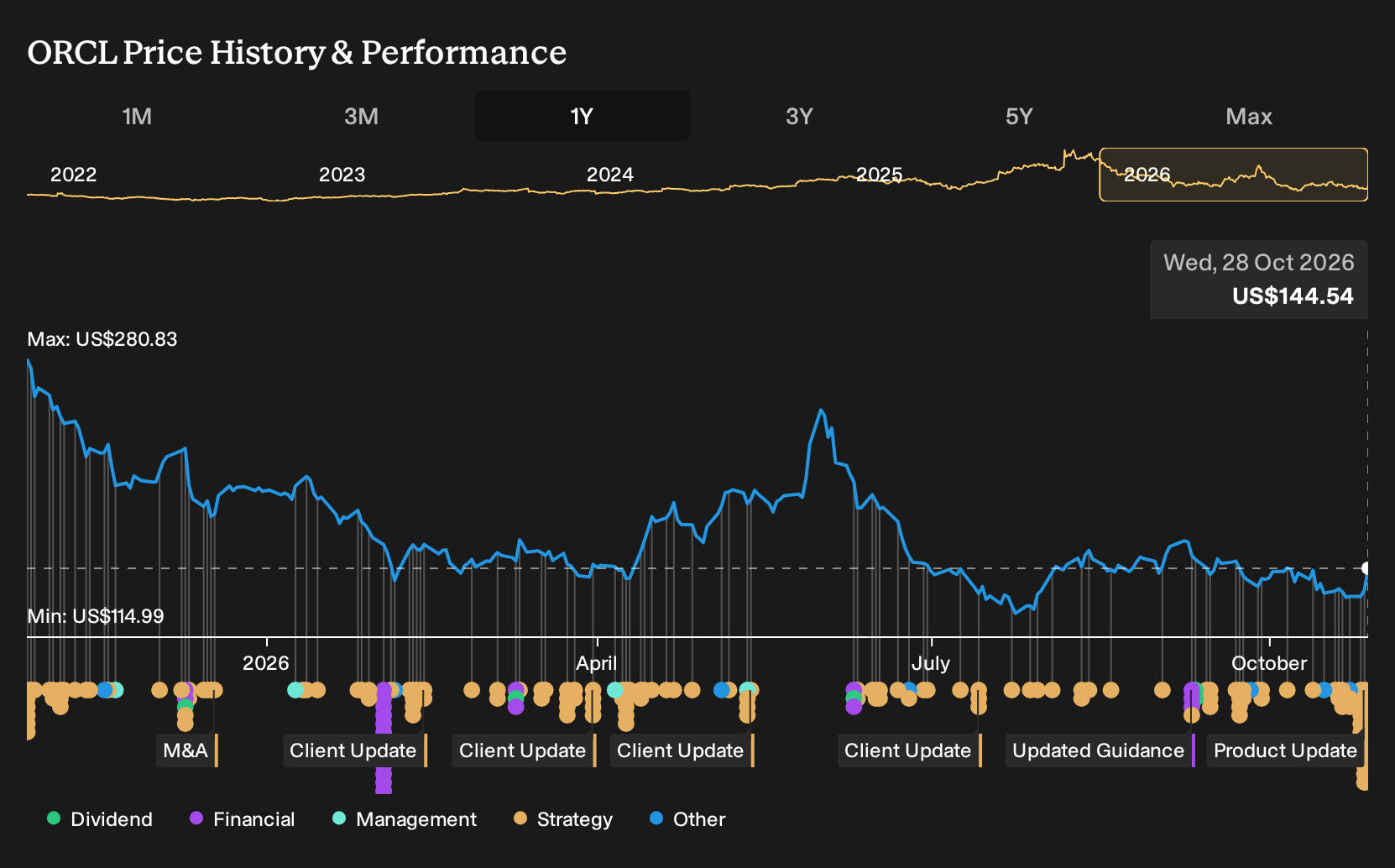
To make those numbers line up with current share price targets, the stock would need to trade on a P/E of 24.2x those projected 2029 earnings, compared with 22.3x today and below a quoted 29.7x for the broader US software group. Some investors read that gap as a margin of safety, while others see it as a sign that the Street is still giving Oracle a discount for execution risk around AI CapEx and funding.
Analysts are also factoring in share issuance. Their models assume the share count rises by 6.41% per year over the next three years, which can dilute per share outcomes if operating performance does not keep up with the higher equity base.
To pull future cash flows back into today's terms, the consensus framework uses a discount rate of 9.7% to 9.73%. That rate helps translate those 2029 revenue and earnings estimates into a present value range and underpins the current target prices that cluster around the low to mid US$200s.
Oracle's narrative projects US$193.6b revenue and US$47.2b earnings by 2029. This requires 39.2% yearly revenue growth and roughly a 2.5x earnings increase from US$18.7b today.
Uncover why Oracle's fair value indicates a 65% potential upside to its current price that could narrow quickly.
Exploring Other Perspectives
One alternate Oracle story puts more weight on upside from data center execution than on funding strain. The most optimistic analysts were penciling in US$216.9b of 2029 revenue and US$52.5b of earnings, with a 32.3x P/E, before the F5 security collaboration and OpenAI deals. You can treat those projections as one end of a wide opinion range that may shift as this new security push lands.
Explore 18 other Oracle fair value estimates, including one that suggests potential upside of as much as 170% from the current price.
Form Your Own Verdict
Disagree with existing narratives? Extraordinary investment returns rarely come from following the herd, so trust your own research and judgment.
- A great starting point for your Oracle research is our analysis highlighting 4 key rewards and 3 important warning signs that could impact your investment decision.
- See our latest analysis for Oracle. The report includes a comprehensive fundamental analysis summarized in a single visual, the Snowflake, making it easy to evaluate Oracle's overall financial health at a glance.
Looking for more investment ideas beyond Oracle?
Once you have a view on Oracle, it often helps to compare it with other opportunities that fit different risk, income, and quality profiles. The Simply Wall St Screener can surface a range of stocks that match what you are actually looking for, rather than forcing your research to orbit a single ticker.
- If you want potential growth with tighter risk controls, focus on companies that already score well on resilience and stability using our 32 resilient stocks with low risk scores.
- For investors who care most about strong balance sheets and durable fundamentals, build a watchlist starting from this curated list of solid balance sheet and fundamentals (24 results).
- If you are hunting for less crowded ideas with punchy fundamentals, broaden your radar with a 19 high quality undiscovered gems that the wider market may be overlooking.
Have feedback on this article? Concerned about the content? Get in touch with us directly. Alternatively, email editorial-team@simplywallst.com