
Should Strong Q3 Growth Require Action From Schneider Electric (ENXTPA:SU) Investors?
- Schneider Electric reported 17% Q3 revenue growth, led by a 20% increase in North America energy management, alongside a €6b follow-on equity offering and a €500m partnership with Budderfly to upgrade U.S. municipal energy infrastructure.
- New collaborations with NVIDIA and HPE on Physical AI and Schneider Electric’s RapidScale modular data center design tie its data center strength directly to edge AI demand and industrial automation workloads.
- The focus now turns to how Schneider Electric’s push into Physical AI and modular AI infrastructure could influence the broader investment narrative.
Schneider Electric Investment Narrative Recap
To own Schneider Electric, you need to believe its mix of energy management, industrial software and AI centric infrastructure can keep attracting long term project and service work, even as cycles move around. The Q3 update and Physical AI push both speak to that operating focus. In the near term, data center and nonresidential demand remain the key swing factors for orders and execution quality.
The biggest short term catalyst is Schneider Electric’s ability to convert interest in AI and electrification into repeatable blueprints, such as modular data center designs, while keeping margins disciplined. The main risk still sits around capital intensity and balance sheet flexibility, particularly in light of the PTC deal and higher debt, if integration or project delivery slows.
The RapidScale Modular Data Center Reference Design 115 looks most directly tied to what investors are watching. It packages high density NVIDIA Vera Rubin based AI hardware, liquid cooling, software and lifecycle services into a pre engineered template that is validated to ANSI standards for U.S. use. There is also an IEC path flagged for later expansion.
For shareholders, the focus is on execution rather than headlines. If Schneider Electric can roll out RapidScale as a repeatable, mostly in house kit with roughly 90% internal equipment, it can tighten control over performance, supply chains and service revenue. Any missteps on delivery, cost or uptime would quickly test confidence in its AI infrastructure narrative.
Schneider Electric Consensus Setup To 2029
Analysts frame Schneider Electric’s Physical AI and modular data center push against a fairly specific earnings path. The current consensus expects revenue to compound at 11.4% a year over the next three years, with profit margins moving from 11.3% today to 14.9% by 2029 as more software and services feed into the mix. That profit mix is what many investors are really watching rather than headline top line growth.
On earnings, the group is modeled to move from €4.7b today to €8.7b by about 2029, with the most optimistic forecasts pointing to €10.0b. That implies earnings would need to roughly double over the period, supported by the PTC acquisition, a larger digital platform and the data center build out that underpins Physical AI. The equity story depends on that shift landing through actual project delivery and software integration rather than just pipeline commentary.
Margin expectations are explicit. Forecasts assume the push into higher value software, industrial automation control and lifecycle services around AI infrastructure can lift profitability while keeping capital intensity in check. If PTC integration proves slower or more expensive, or if Industrial Automation margins stall, the gap between current 11.3% margins and the projected 14.9% could become harder for investors to underwrite.
On valuation, consensus numbers suggest Schneider Electric could be on €58.1b of revenue and €8.7b of earnings by 2029, with the stock on a P/E of 27.7x using a 9.3% discount rate in the modeling. That compares to a current multiple of 27.5x and an industry level of 27.5x for the GB Electrical sector. The picture is of a company that is already priced in line with peers but is being modeled to warrant a slightly richer earnings multiple if the Physical AI and software story plays out as expected.
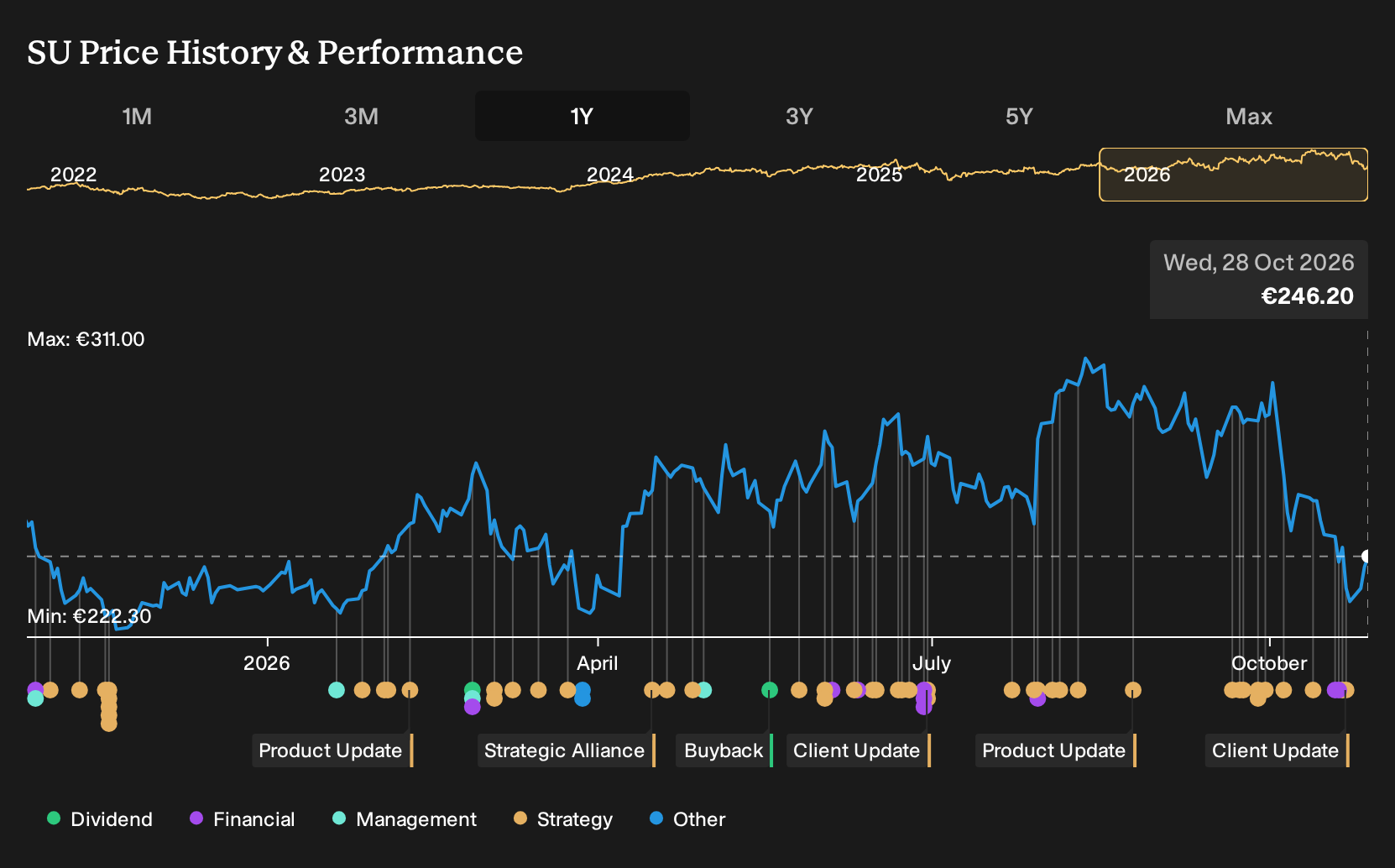
Price targets are tightly bound to those metrics. The consensus target sits at €326.55 per share, compared with a current price of €231.4, with the most optimistic analysts at €370.0 and the most cautious at €262.0. That spread shows that while there is broad agreement on the direction of earnings, there is less alignment on how much investors will pay for Schneider Electric’s AI infrastructure and digital business once the PTC deal is fully absorbed.
Schneider Electric's narrative projects €58.1b revenue and €8.7b earnings by 2029. This requires 11.4% yearly revenue growth and roughly a €4.0b earnings increase from €4.7b today.
Uncover why Schneider Electric's fair value indicates a 33% potential upside to its current price, a gap that could narrow quickly if Schneider Electric executes its AI build out.
Exploring Other Perspectives
Five fair value estimates from the Simply Wall St Community cluster between about €229 and €379, with one view sitting close to the top of that band pointing to far richer upside for Schneider Electric than the rest. You are seeing real disagreement. Set those opinions against PTC integration risk and the AI data center build out, then weigh how much execution confidence you really have.
Explore 4 other Schneider Electric fair value estimates, including one that suggests the potential for as much as 54% upside from the current price.
Reach Your Own Conclusion
Don't just follow the ticker. Dig into the data and build a conviction that's truly your own.
- A great starting point for your Schneider Electric research is our analysis highlighting 3 key rewards and 1 important warning sign that could impact your investment decision.
- See our latest analysis for Schneider Electric. The report includes a comprehensive fundamental analysis summarized in a single visual, the Snowflake, making it easy to evaluate Schneider Electric's overall financial health at a glance.
Looking for more investment ideas beyond Schneider Electric?
Once the Schneider Electric story is clear in your mind, it helps to widen the lens and compare it with other opportunities that fit different risk, quality and income profiles. The Simply Wall St Screener can surface a range of stocks that line up with the kind of portfolio you want to build, not just the one headline you happen to be reading about today.
- If capital preservation comes first for you, start with a group of companies that pair resilient operations with measured risk using the 232 resilient stocks with low risk scores.
- For investors who care most about underlying strength, filter for businesses with cleaner balance sheets and steadier fundamentals by running a list of solid balance sheet and fundamentals (204 results).
- If you prefer ideas that the market may be overlooking, focus on strong fundamentals at more modest valuations by scanning a 610 high quality undiscovered gems.
Have feedback on this article? Concerned about the content? Get in touch with us directly. Alternatively, email editorial-team@simplywallst.com