
Open-Weight AI Models Are Still Expensive. That Is a Win for Nvidia Stock.
Open-weight artificial intelligence (AI) models are gaining traction as businesses look for cheaper and more flexible alternatives to proprietary AI systems, but Bank of America says their lower upfront costs do not necessarily translate into lower demand for computing infrastructure. In a recent analysis, BofA analyst Vivek Arya argued that open-weight models can actually expand AI usage because running and deploying these models still requires significant computing power. Open-weight models accounted for about 71% of tokens on OpenRouter in 2026 year-to-date, up from roughly 27% in 2025, while cloud capital spending is expected to nearly double to about $1 trillion this year.
For NVIDIA (NVDA), that dynamic could be particularly important. Rather than reducing demand for AI chips, BofA believes open-weight models could shift spending away from model providers and toward the semiconductor and infrastructure companies supplying the compute needed to run them.
With Nvidia among BofA’s preferred beneficiaries, the analysis offers investors another reason to remain bullish on Nvidia’s AI infrastructure opportunity.
About Nvidia Stock
NVIDIA is a global leader in accelerated computing and AI, renowned for pioneering the GPU that revolutionized gaming, data centers, and AI-driven computing. Headquartered in Santa Clara, California, NVIDIA's technology now powers everything from high-performance gaming and cloud computing to autonomous vehicles and generative AI applications. With a market cap of $5.3 trillion, Nvidia stands among the world’s most valuable companies, driven by its dominance in AI infrastructure and continued innovation in next-generation chip design.
NVIDIA stock has delivered overall gains over the past year despite recent volatility, rising 13.8% over the past 52 weeks and 16.9% year-to-date (YTD). However, the shares have pulled back 3.2% over the past month and are currently about 10.5% below their 52-week high reached in June, reflecting a more cautious stance among investors toward richly valued AI stocks. The recent weakness comes as markets increasingly scrutinize the pace and returns of massive AI infrastructure spending, with concerns about elevated capital expenditures, financing requirements, and whether hyperscalers can sustain their aggressive investments.
Still, the pullback does not appear to undermine Nvidia’s core growth story. The company remains the leading supplier of AI accelerators, while demand for data-center computing continues to expand as cloud providers and enterprises invest in AI infrastructure. Nvidia is also preparing for the transition from its Blackwell platform to the next-generation Rubin architecture, providing another potential growth catalyst.
On the other hand, Bank of America has recently highlighted that the rise of open-weight AI models is not a threat to semiconductor demand. Instead, the bank sees companies like Nvidia as potential beneficiaries because these models can still require substantial computing resources to run. BofA argues that open-weight models are adding to overall AI token demand rather than replacing proprietary models.
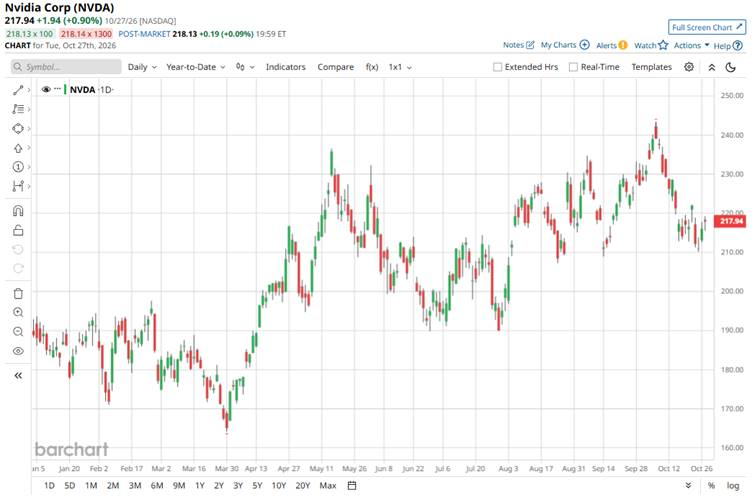
NVIDIA trades at 22.69 times forward earnings and 23.54 times sales, which is currently a premium compared to industry peers.
Q2 Earnings Exceeded Expectations
NVIDIA delivered another blockbuster quarter, reporting its fiscal second-quarter 2027 results on Aug. 26, for the quarter ended July 26. Revenue reached a record $96.2 billion, up 106% year-over-year (YOY) from $46.7 billion, and increased 18% sequentially. The result also comfortably exceeded Nvidia’s prior guidance of $91 billion, plus or minus 2%.
The company’s profitability expanded even faster. On a non-GAAP basis, net income climbed 118% to $54 billion, versus $24.8 billion in Q2 fiscal 2026, while adjusted EPS jumped 120% to $2.22, exceeding expectations. Non-GAAP gross margin rose to 75% from 72.5%. Operating income surged 124% YOY to $63.7 billion.
Nvidia’s Data Center segment remained the primary growth engine, generating $89 billion in revenue, up 117% YOY from the prior-year quarter and representing the majority of total company revenue. The performance reflects continued demand for Nvidia’s accelerated-computing platforms as hyperscalers and AI companies expand infrastructure.
Furthermore, Nvidia issued an even stronger outlook. For Q3 fiscal 2027, the company expects revenue of $108 billion, plus or minus 2%. Importantly, the forecast assumes no Data Center compute revenue from China. Nvidia expects GAAP and non-GAAP gross margins of approximately 74%, plus or minus 50 basis points.
It’s worth noting that Nvidia is not merely maintaining its AI growth trajectory; it is accelerating it, with management pointing to full production of its next-generation Vera Rubin platform and continued strength across AI infrastructure.
Street expects Nvidia’s momentum to continue, with analysts forecasting EPS growth of 103.5% YOY to $9.30 in fiscal 2027, followed by another 69.3% increase to $15.74 in fiscal 2028.
Wall Street Is Highly Bullish About Nvidia
Most recently, Bernstein analyst Stacy Rasgon maintained a “Buy” rating on Nvidia and a $400 price target, reinforcing his bullish view on the semiconductor giant.
Also, Barclays analyst Thomas O’Malley maintained a “Buy” rating on Nvidia with a $275 price target, citing continued strength in GPU demand from major cloud providers. O’Malley’s bullish stance reflects expectations that sustained AI infrastructure spending will support Nvidia’s data-center business as hyperscalers continue expanding their AI computing capacity and deploying the company’s latest-generation GPUs.
Plus, Piper Sandler reiterated its “Overweight” rating on Nvidia with a $300 price target.
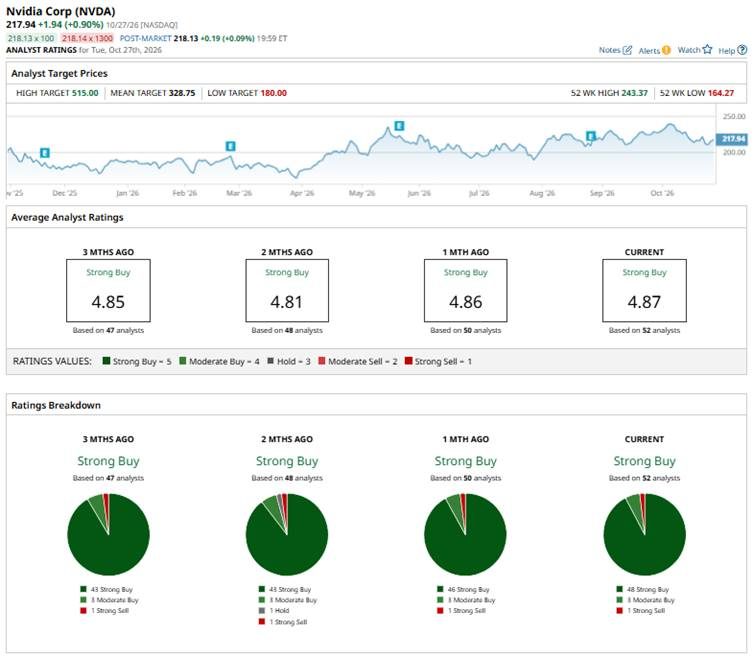
Overall, NVDA has a consensus “Strong Buy” rating. Of the 52 analysts covering the stock, 48 advise a “Strong Buy,” three suggest a “Moderate Buy,” and one offers a “Strong Sell” rating.
The average analyst price target for NVDA is $328.75, indicating a potential upside of 50.8%. Also, the Street-high target price of $515 suggests that the stock could rally as much as 136.3%.
On the date of publication, Subhasree Kar did not directly have a position in any of the securities mentioned in this article. All information and data in this article is solely for informational purposes. For more information please view the Barchart Disclosure Policy here.