
QCOM Stock Earnings Preview: What to Expect From Qualcomm’s Q4 Report
Qualcomm (QCOM) will release its fourth-quarter fiscal 2026 results on Wednesday, Nov. 4. The report is likely to highlight persistent headwinds affecting the company’s financial performance, with revenue and earnings constrained by challenges in its CDMA Technologies (QCT) business and its data center product investments.
Despite these near-term pressures, Qualcomm’s longer-term growth outlook remains encouraging. Its efforts to diversify beyond its traditional handset business are opening up opportunities across automotive technology, the Internet of Things (IoT), data center computing, and AI infrastructure. However, in the near-term, QCOM’s top and bottom lines could remain under pressure.
Qualcomm Q4 Outlook
Qualcomm’s near-term growth outlook remains challenged by persistent weakness in the Android smartphone market, investments in data center products, and a lower revenue contribution from Apple (AAPL).
The rapid expansion of AI infrastructure has redirected memory supply toward data centers, tightening availability, and increasing costs for smartphone manufacturers. These supply-side pressures have prompted several Android OEMs, mainly in China, to reduce production volumes, creating headwinds for Qualcomm’s handset business.
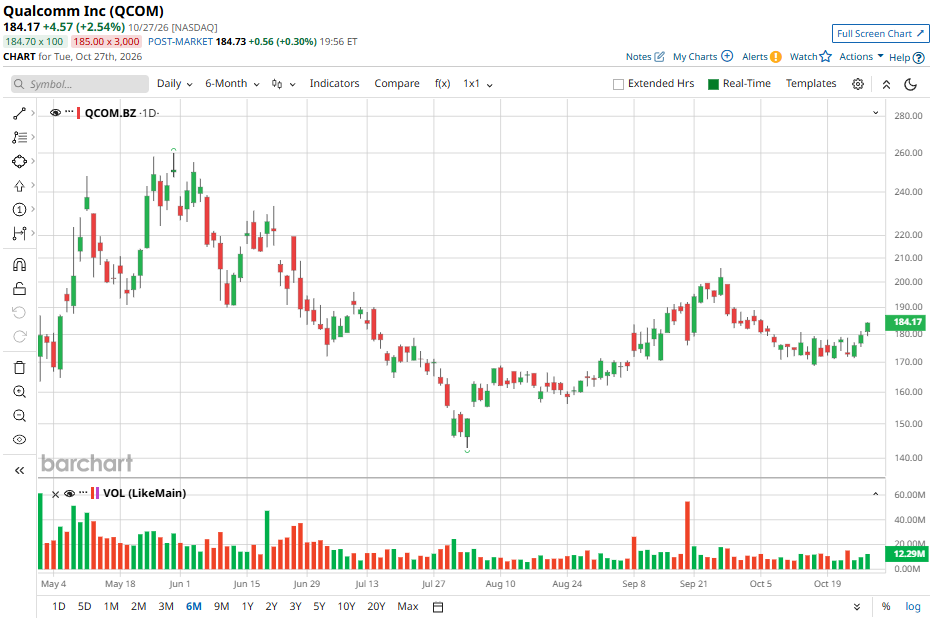
Management indicated that QCT handset revenue from Chinese OEMs likely reached a trough in the third quarter, with sequential growth expected to return to double-digit levels in the fourth quarter. However, this recovery may not offset broader industry weakness and declining Apple-related revenue. Consequently, Qualcomm’s handset business is likely to remain under pressure in the near term.
Qualcomm forecasts fourth-quarter revenue of $9.7 billion to $10.5 billion, implying a midpoint of $10.1 billion, about 10% below the prior-year period. QCT revenue is projected at $8.4 billion to $9.0 billion, compared with $9.8 billion a year earlier.
QCT handset revenue is expected to reach about $5.2 billion, down roughly 25% year over year. Although improving sequential demand from Android manufacturers should provide some support, lower Apple-related revenue is expected to outweigh the benefit. Qualcomm anticipates a sharper reduction in Apple product revenue beginning in the fourth fiscal quarter, as its share of components for the upcoming iPhone launch is expected to decline materially. Management projects Apple-related revenue to fall by approximately 50% between the September and December quarters. This anticipated contraction represents a significant near-term headwind.
Within QCT, the Internet of Things (IoT) business is expected to deliver revenue broadly in line with the year-ago quarter. Double-digit growth across industrial, networking, and robotics applications should support performance, though memory-related constraints affecting tablets and other consumer-oriented products are likely to offset these gains.
By contrast, Qualcomm’s automotive business is expected to remain a key growth driver, with management forecasting another record quarter and approximately 60% year-over-year revenue growth. Continued expansion in automotive connectivity and computing solutions could help diversify Qualcomm’s revenue base over time.
Qualcomm Technology Licensing (QTL) revenue is projected to range between $1.2 billion and $1.4 billion, with a midpoint of $1.3 billion. This would represent a decline from the $1.4 billion reported in the prior-year quarter.
At the earnings level, Qualcomm forecasts adjusted fourth-quarter earnings per share of $2.05 to $2.25, down from $3.00 in the corresponding period last year. The anticipated decline reflects lower revenue, weaker handset economics, and continued investment in the company’s data center product roadmap.
Analysts Remain Divided on QCOM Stock
Qualcomm’s Q4 FY2026 results are likely to reflect continued pressure on revenue and earnings, driven by smartphone market weakness, declining Apple-related revenue, and ongoing data center investments.
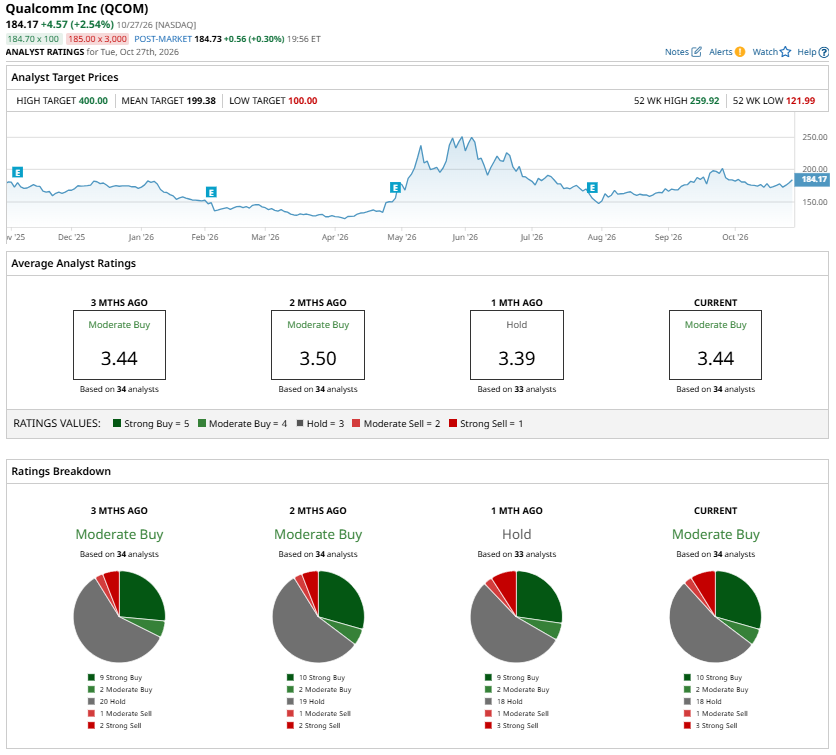
Despite a consensus analyst rating of “Moderate Buy,” sentiment remains mixed, with most analysts maintaining “Hold” or “Sell” recommendations ahead of the quarterly earnings announcement.
From a longer-term perspective, however, Qualcomm’s expanding presence in automotive technology, the IoT, and AI infrastructure provides potential avenues for sustainable growth. The company now targets more than $40 billion in non-handset QCT revenue by FY2029. Automotive and IoT are expected to account for over $24 billion of this total, while data center-related opportunities could contribute more than $15 billion.
Overall, QCOM’s long-term prospects remain solid. However, in the near term, its top and bottom line could remain under pressure.
On the date of publication, Amit Singh did not directly have a position in any of the securities mentioned in this article. All information and data in this article is solely for informational purposes. For more information please view the Barchart Disclosure Policy here.