
Dear BP Stock Fans, Mark Your Calendars for October 30
The global energy market has given oil investors plenty to chew on, with Middle East tensions disrupting supply routes and sending crude prices higher. On Friday, Oct. 23, Brent crude settled at $116.72 a barrel, its highest level in nearly six months, after Houthi attacks in Saudi Arabia heightened fears of further supply disruptions.
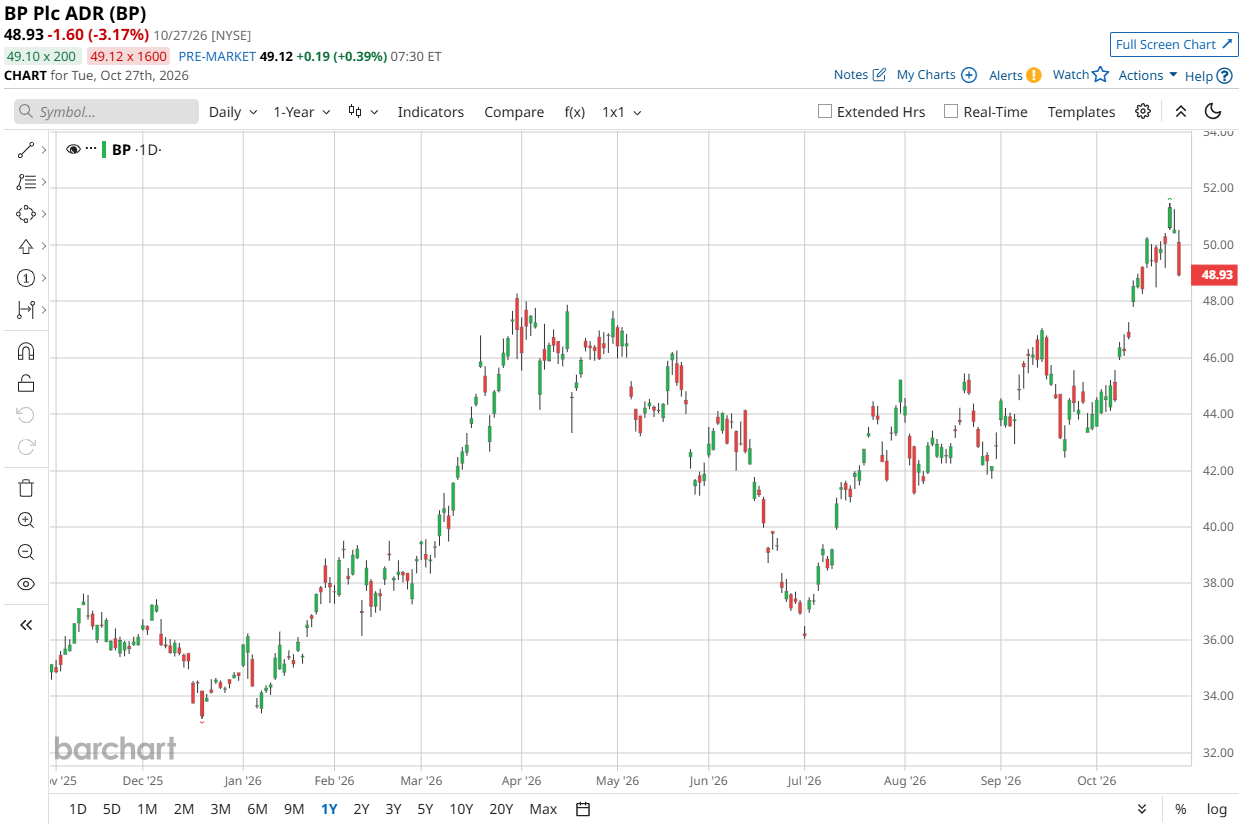
European shares also slipped as political uncertainty and rising energy costs rattled investors. Yet BP (BP) went against the broader market mood, climbing to a 52-week high of $51.49. The rally makes sense, given that higher refining margins and stronger trading prospects have given investors fresh reasons to back the London-based energy giant.
BP is now set to release its Q3 FY2026 results on Friday, Oct. 30, and its trading update has already outlined several potential earnings drivers. The company’s refining indicator margin rose to $46.70 per barrel from $29.60 in Q2.
BP expects stronger realized refining margins to add $1.9 billion to $2.1 billion to Products’ underlying replacement-cost profit before interest and tax compared with the previous quarter. The company also expects its gas marketing and trading results to be significantly higher than in Q2.
However, investors should keep their feet on the ground despite the rally. BP expects $3 billion to $4.5 billion in post-tax impairments, primarily related to transition businesses within its gas and low-carbon energy segment.
Separately, the company has agreed to make a single early payment of approximately $350 million to Louisiana, replacing $373 million in payments scheduled over the next seven years under the 2015 Deepwater Horizon Economic Damages Settlement. Against this backdrop, the measured approach would be to watch out for Oct. 30 when the company sheds more light on its current affairs.
About BP Stock
BP is a global integrated energy company headquartered in London, United Kingdom. With a market cap of nearly $132.4 billion, the company operates across oil and gas production, refining, trading, and retail. Its business also spans natural gas, aviation fuels, lubricants, electric vehicle (EV) charging, renewable energy, hydrogen, and sustainable bioenergy solutions.
BP stock has delivered a strong run over the past year, climbing 40.7% in the last 52 weeks and advancing 40.9% year-to-date (YTD). The rally has continued over the past three months, with shares gaining 15.7%.
On the valuation front, BP stock is currently trading at 6.02 times forward adjusted earnings and 0.55 times sales. Both multiples sit below their respective industry averages, potentially providing an attractive entry point in the stock before the company reports its latest results.
The company has also increased its dividend for four consecutive years and currently pays $2.02 per share annually, delivering a yield of 4.12%. That being said, the company paid its most recent dividend of $0.52 per share on Friday, Sept. 18 to shareholders of record as of Friday, Aug. 14.
A Closer Look at BP’s Q2 Earnings
On Aug. 4, BP reported a strong Q2 FY2026 earnings rebound, with underlying replacement cost profit, its key non-GAAP earnings measure, surging 143.6% year over year (YOY) to $5.7 billion. Higher crude prices amid the Middle East conflict, stronger refining margins, and improved oil trading all helped fuel the gains.
Operating cash flow also gathered momentum, climbing 73.1% YOY to $10.9 billion despite a $1 billion working capital build. Net debt fell 14.6% to $22.3 billion, while underlying operating expenditure declined 2.3% to $5.3 billion, reflecting modest cost discipline.
However, operational performance weakened. Upstream plant reliability slipped to 92.4% from 95.7% in the previous quarter, production declined, and refineries processed less crude. Planned maintenance and Middle East disruptions contributed to the setbacks.
For full year 2026, BP expects reported upstream production of 2.18 million to 2.27 million barrels of oil equivalent per day, down from 2.312 million in 2025, reflecting Middle East disruptions, portfolio divestments, and a reduced equity interest in Latin America. Underlying oil production and operations should remain broadly flat, while gas and low-carbon energy output is expected to decline.
BP forecasts capital expenditure of $13.5 billion to $14 billion and divestment and other proceeds of $8 billion to $9 billion, including approximately $6 billion from the announced Castrol transaction.
For Q3, BP initially guided reported upstream production of 2.10 million to 2.25 million barrels of oil equivalent per day and refining throughput of 1.30 million to 1.36 million barrels per day. The company also warned of a significantly weaker Customers result amid lower midstream earnings and Castrol profitability.
Despite these operational headwinds, analysts expect Q3 FY2026 EPS to jump 212.9% YOY to $2.66. For FY2026, they project EPS of $8.17, representing 183.7% growth from the previous year.
What Do Analysts Expect for BP Stock?
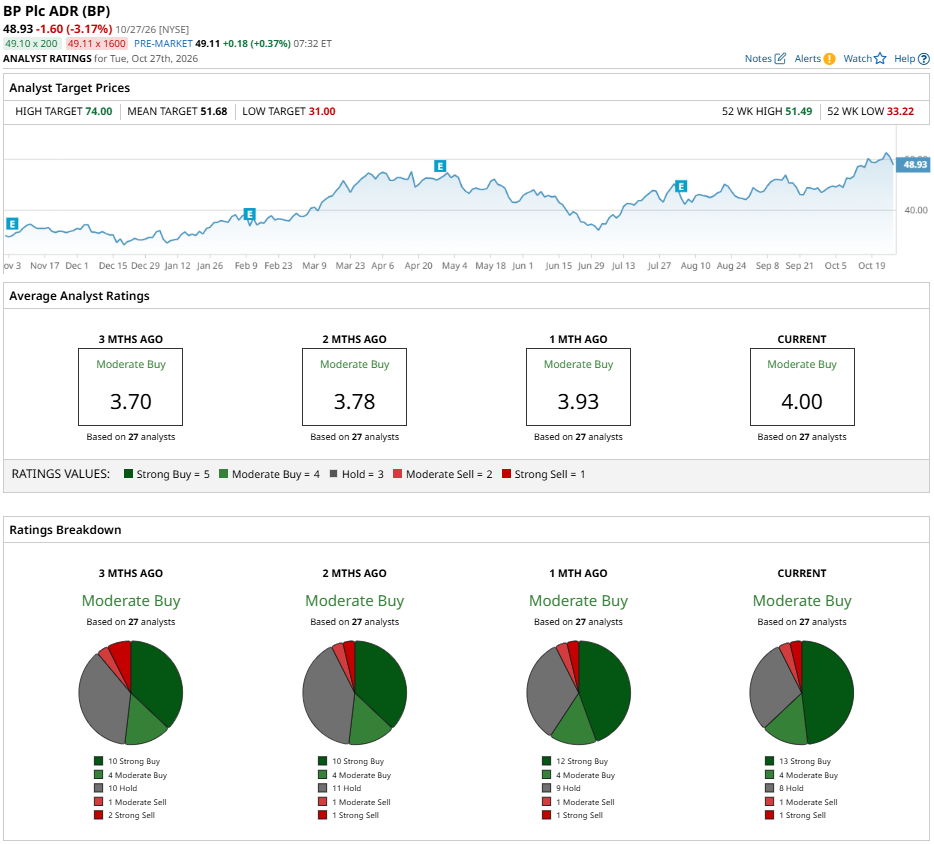
Wall Street currently gives BP stock an overall rating of “Moderate Buy,” reflecting a generally positive outlook tempered by some lingering concerns. Among the 27 analysts covering the name, 13 assign a “Strong Buy” rating, four recommend a “Moderate Buy,” eight maintain a “Hold,” one issues a “Moderate Sell,” and one gives a “Strong Sell.”
To that end, the average analyst price target stands at $51.68, suggesting potential upside of 5.6% from the current share price. Meanwhile, the Street-High target of $74 points to a potential gain of 51.2% from current levels.
On the date of publication, Aanchal Sugandh did not directly have a position in any of the securities mentioned in this article. All information and data in this article is solely for informational purposes. For more information please view the Barchart Disclosure Policy here.