
Is Bitcoin Linked ETFs Altering The Investment Case For Franklin Templeton (BEN)?
- Franklin Templeton recently moved to launch two Nasdaq listed ETFs that combine US equities with capped Bitcoin exposure, while also pushing deeper into private markets and asset backed finance platforms.
- This mix of Bitcoin linked equity ETFs and expanded private market structures signals a focus on differentiated products that target fee rich, alternative oriented client demand across both retail and institutional channels.
- We will now examine how Franklin Templeton's Bitcoin linked equity ETFs could influence the broader investment narrative around its business.
Scan for other asset managers that are leaning into alternatives and complex structures by reviewing our hand picked 19 high quality undiscovered gems, which echo Franklin Templeton's latest ETF and private markets push.
Franklin Templeton Investment Narrative Recap
To own Franklin Templeton, you need to buy into a story where a large, global asset manager steadily shifts its mix toward higher fee alternatives, ETFs and customized solutions while keeping overall fee pressure in check. The near term swing factor is execution on that mix shift without eroding margins through discounts and revenue sharing.
The biggest risk is that distribution platforms keep squeezing fees faster than Franklin Templeton can grow alternative assets and digital products. The recent Bitcoin linked equity ETFs and private market structures may be attention grabbing, but they do not yet look large enough to change that risk reward balance on their own.
The most relevant development for this theme is Franklin Templeton’s filing for the two ETFs that pair US equities with capped Bitcoin exposure. These launches sit beside roughly 294b of alternatives and an expected 40b in fiscal 2026 private markets fundraising, which together tilt the business toward areas with higher stated base fee rates.
For you as a shareholder, the operational question is whether these complex products turn into sustained net inflows without undermining pricing or adding undue complexity. Execution risk rises as Franklin Templeton stretches across public fixed income, private credit, digital assets and tokenized funds, so any stumble on performance, compliance or integration could blunt the intended catalyst.
Franklin Templeton Forecasts Behind The ETF And Alternatives Story
Franklin Templeton's narrative projects US$9.2b revenue and US$1.4b earnings by 2029. This assumes revenue remains broadly flat over the next few years and implies an earnings increase of about US$640.8m from current earnings of US$759.2m.
Analysts are effectively tying the Bitcoin linked equity ETFs and the broader alternatives build out to a higher earnings base rather than faster top line expansion. Revenue is expected to stay relatively steady, while profit margins are assumed to rise from 8.1% today to 15.3% by 2029 as the mix shifts toward higher fee strategies and more efficient distribution.
On these numbers, the market story around Franklin Templeton hinges on whether the business can earn US$1.4b on US$9.2b of revenue by 2029 without relying on strong headline growth. That requires meaningful operating leverage from alternatives, private markets platforms and data tools, while still absorbing fee compression from large distributors and the costs of maintaining digital and tokenized offerings.
The earnings bridge from US$759.2m today to US$1.4b in 2029 also intersects directly with the P/E multiple that analysts are using. The consensus assumes the stock trades on about 15.0x those projected earnings, compared with 21.7x today and an industry level cited at 39.7x. For you as an investor, that means the thesis blends two moving parts: a higher earnings base and a lower multiple, rather than relying on valuation expansion alone.
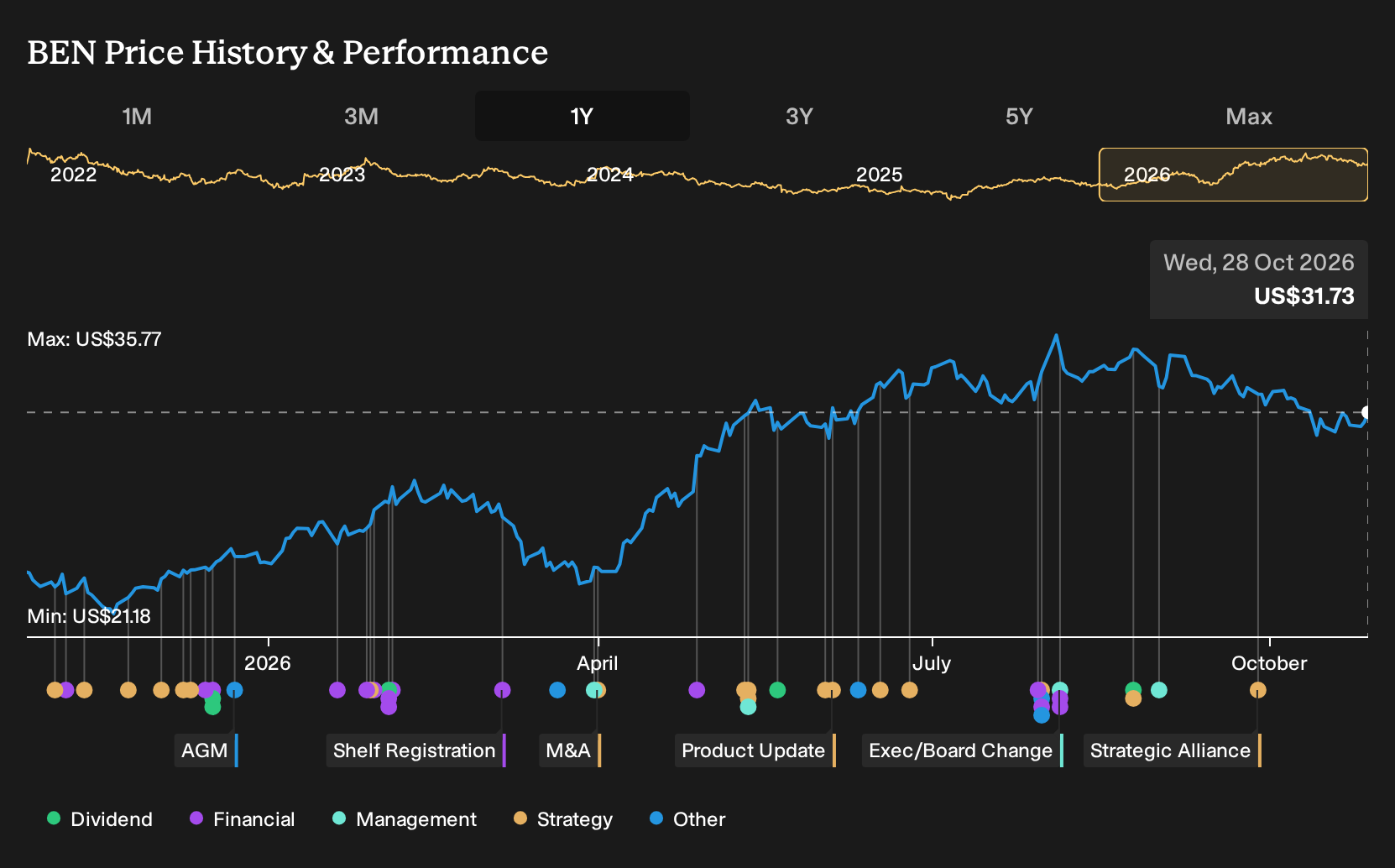
Consensus fair value work folds these assumptions together into a price target of US$35.5, with a bullish case at US$41.0 and a bearish view at US$26.0. With the current share price at US$32.5, the gap implied by consensus is 8.5%, which signals that analysts broadly see Franklin Templeton as close to fairly priced based on the present mix of ETFs, private markets and traditional active products.
These headline targets sit on top of more technical inputs, including discount rates in the 8.3% range and an expectation that shares outstanding decline by roughly 2.47% a year over the next three years. For readers, that buyback and capital return layer matters because it interacts with the earnings path and can influence per share figures even if headline profit or revenue do not move quickly.
Uncover why Franklin Templeton's fair value indicates a 12% potential upside to its current price, which could narrow quickly.
Exploring Other Perspectives
One alternate view focuses on margins rather than Bitcoin. The most cautious analysts already modeled flatter revenue at about US$9.2b and lower 2029 earnings near US$1.3b, with a 12.5x P/E. That is a much harsher lens on Franklin Templeton. This fresh ETF and private markets news could eventually push those assumptions in either direction.
Explore 5 other Franklin Templeton fair value estimates, including one that suggests as much as 15% downside from the current price.
Form Your Own Verdict
Disagree with existing narratives? Extraordinary investment returns rarely come from following the herd, so go with your instincts.
- A great starting point for your Franklin Templeton research is our analysis highlighting 3 key rewards and 2 important warning signs that could impact your investment decision.
- See our latest analysis for Franklin Templeton. The report includes a comprehensive fundamental analysis summarized in a single visual, the Snowflake, making it easy to evaluate Franklin Templeton's overall financial health at a glance.
Looking For More Investment Ideas Beyond Franklin Templeton?
If Franklin Templeton's mix of ETFs, alternatives and digital products has sharpened your interest, it can help to scan a broader field of opportunities that fit different risk and income profiles. The Simply Wall St Screener lets you filter for traits that match your own playbook rather than relying only on headline stories.
- If capital preservation and lower volatility rank high for you, start with 32 resilient stocks with low risk scores which may better align with a steadier risk profile.
- If balance sheet strength matters more than headlines, review a list of solid balance sheet and fundamentals (24 results) that can support dividends, reinvestment and potential downturns.
- If you want ideas that are not widely followed yet still grounded in fundamentals, scan through a curated set of 19 high quality undiscovered gems that might deserve a closer look.
Have feedback on this article? Concerned about the content? Get in touch with us directly. Alternatively, email editorial-team@simplywallst.com