
How Investors May Respond To AstraZeneca (LSE:AZN) EU Breast Cancer Approval
- AstraZeneca secured EU approval for Enhertu in HER2 positive early breast cancer based on DESTINY Breast05, while also reporting broad Phase III oncology data across bladder, lung and gastric cancers at ESMO 2026.
- The combination of a new adjuvant approval for Enhertu and first in class ADC data in Claudin 18.2 positive gastric cancer is tightening AstraZeneca’s focus on antibody drug conjugates as a core oncology priority.
- This article examines how AstraZeneca’s investment narrative is influenced by the EU Enhertu approval together with the broader ESMO 2026 oncology data.
AstraZeneca Investment Narrative Recap
To own AstraZeneca, you need to believe the late stage pipeline in oncology, cardiometabolic disease and rare conditions can keep earnings growing even as older drugs face expiry and capital spending rises. The near term story still leans on execution in these franchises, with recent Enhertu and ADC data reinforcing that focus rather than changing it.
The biggest short term swing factor remains how efficiently AstraZeneca converts late stage cancer assets and weight management or cardiometabolic drugs into approved, reimbursed treatments while managing higher debt and heavy investment in ADC capacity. Clinical setbacks similar to Wainua or Ultomiris would remain the key risk to that thesis.
The Tremont AI collaboration is tightly linked to this oncology heavy story. It targets one of the slowest parts of R&D: safety review in toxicologic pathology, which is both labour intensive and prone to variability. Faster, more reproducible reads could influence how many ADC or biologic candidates AstraZeneca can move through preclinical testing and into the clinic.
If these AI tools prove reliable in spotting rare or subtle safety findings, they could support AstraZeneca’s plan to run a broad pipeline while keeping timelines and cost inflation under some control. That matters directly for upcoming catalysts in ADCs and immuno oncology, and it sits on the same risk axis as capital intensive manufacturing bets that need a steady stream of viable molecules to justify the spend.
How the AstraZeneca consensus story is built in the numbers
Analyst models around AstraZeneca are effectively asking you to weigh the oncology and cardiometabolic pipeline against a fairly specific set of top line and profit targets. The consensus sketch is clear. Revenue is projected to rise at 6.3% a year over the next three years. Profit margins in those models move from 17.0% today to 22.6% by 2029 as higher value oncology, rare disease and cardiometabolic drugs mix into the portfolio.
Earnings sit at about US$10.4b today in those estimates and are expected to reach US$16.7b by 2029, with a wide spread between the most bullish and most cautious forecasts at US$19.6b and US$14.0b. That implies an earnings increase of roughly US$6.3b over the period, which is a large absolute step up that rests heavily on the late stage assets linked to ESMO 2026 data, weight management programs and the rare disease portfolio. The share count is assumed to stay broadly flat, so any uplift in earnings per share in these scenarios comes mainly from that profit pool expansion rather than buybacks.
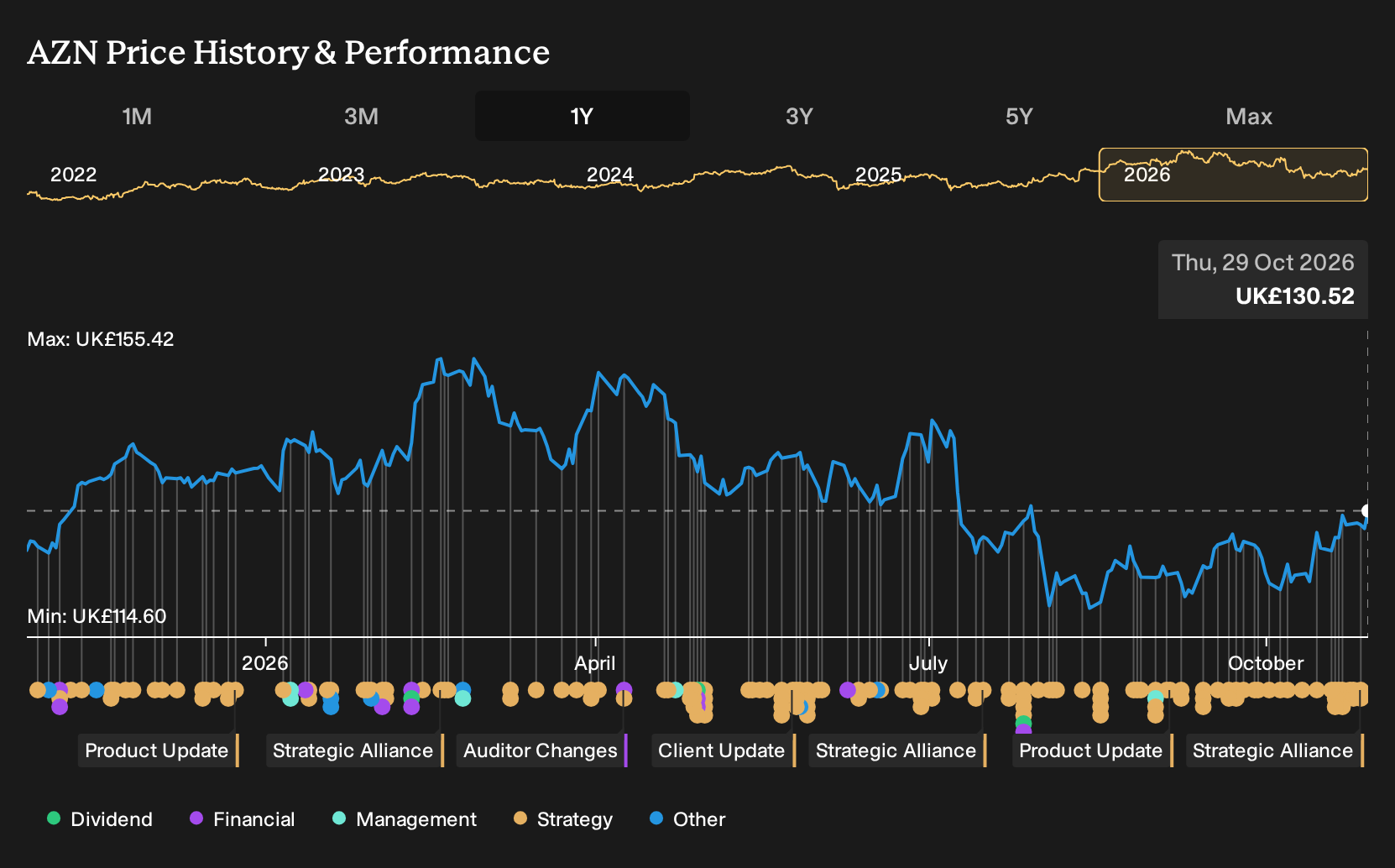
On valuation, the consensus view ties AstraZeneca’s fair value to 2029 revenue of about US$73.7b and earnings of US$16.7b. Those figures sit alongside an assumed P/E multiple of 24.3x on the 2029 earnings, compared with about 25.5x today and an industry level quoted at 23.1x. At the current share price of £128.24, the average analyst target of £157.13 is 18.4% higher, with a wide band of expectations running from £115.78 to £196.64 that reflects both the breadth of the pipeline and the execution risk built into it.
AstraZeneca's narrative projects US$73.7b revenue and US$16.7b earnings by 2029. This rests on 6.3% yearly revenue growth and an increase in earnings of about US$6.3b from US$10.4b today.
Uncover how AstraZeneca's fair value indicates a 20% potential upside to its current price that may not last much longer.
Exploring Other Perspectives
One alternate view is that AstraZeneca’s heavy AI and ADC build out is the real swing factor, not just the late stage trials. The most cautious analysts were pencilling in 4.0% yearly revenue growth and about US$13.4b in 2029 earnings before this news. That is a much tougher bar, and it shows how far opinions can spread. Use these differences as a prompt to compare several scenarios and decide which story you think the new Enhertu and Tremont AI updates might shift.
Explore 4 other AstraZeneca fair value estimates, including one that suggests there could be as much as 10% downside from the current price.
The Verdict Is Yours
Disagree with existing narratives? Extraordinary investment returns rarely come from following the herd, so go with your instincts.
- A great starting point for your AstraZeneca research is our analysis highlighting 4 key rewards and 1 important warning sign that could impact your investment decision.
- See our latest analysis for AstraZeneca. The report includes a comprehensive fundamental analysis summarized in a single visual, the Snowflake, making it easy to evaluate AstraZeneca's overall financial health at a glance.
Looking for more AstraZeneca style investment ideas?
If the AstraZeneca story has you thinking about what else might fit into a healthcare focused portfolio, the Simply Wall St Screener can help you line up other candidates with clear, data driven filters before you commit capital.
- For income focused investors who still want robust balance sheets, review a curated set of high yield opportunities by checking out 5 dividend fortresses.
- If capital preservation and steadier business profiles matter most to you, narrow your search to companies with stronger risk scores through the 5 resilient stocks with low risk scores.
- For those willing to do extra work in return for under followed opportunities, start with a focused universe of smaller, high quality businesses via the 5 high quality undiscovered gems.
Have feedback on this article? Concerned about the content? Get in touch with us directly. Alternatively, email editorial-team@simplywallst.com