
Both investment and exports are lagging behind! France's GDP contracted unexpectedly in the third quarter, making fiscal consolidation even more difficult
The Zhitong Finance App learned that due to multiple obstacles such as soaring borrowing costs, violent protests, and political and budget uncertainty, the French economy contracted unexpectedly in the third quarter. According to the French National Institute of Statistics and Economics (Insee), gross domestic product (GDP) fell 0.1% month-on-month in the third quarter, which was lower than the 0.1% month-on-month increase expected by economists. The reason was that investment continued to decline and exports also declined. In the third quarter, GDP also fell 0.1% year over year, falling short of economists' expectations of 0.3% year-on-year growth.
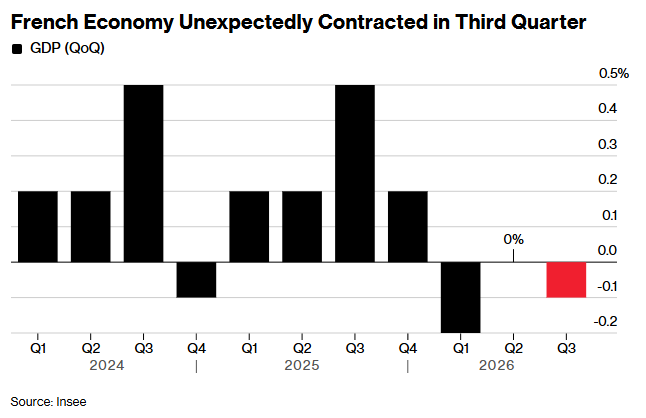
France's economy unexpectedly contracted in the third quarter
The weak performance of the French economy, as shown by this latest data, is worrying. Previously, the French economy was already the most underperforming major economy in the Eurozone. In the first half of the year, against the backdrop of weak domestic demand, falling investment, and hot weather impacting agriculture, the French economy only narrowly avoided falling into recession. At a time when fiscal risks and political instability have made France the focus of attention throughout Europe, the sharp rise in global bond yields has brought new problems.
The report released on Friday showed a slight rebound in household consumption in the third quarter, up 0.2%. However, investment declined, and exports fell 1.7%, leading to a negative 0.6 percentage point contribution of trade to GDP growth. Since this year, corporate investment has been declining every quarter.
Another separately released monthly data showed that for September alone, consumer spending unexpectedly fell by 0.5%, after a similar contraction in August. Economists had expected consumer spending to rise 0.1% in September. Protests over rising education funding and living costs turned into street violence on October 17, during which widespread robberies occurred and thousands of people were arrested. The survey showed that companies generally adopted a wait-and-see attitude, while an indicator of consumer confidence fell to its lowest level in 13 years. This means that the slump in consumer spending is likely to continue.
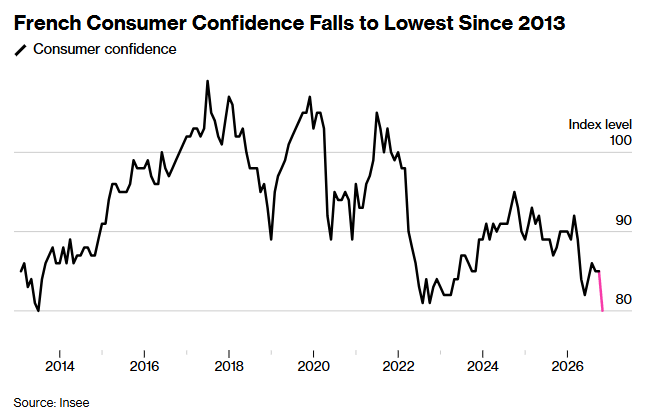
French consumer confidence falls to lowest level since 2013
The short-term outlook is also difficult to reassure. The minority government led by French Prime Minister Sébastien Le Corny is once again mired in a parliamentary confrontation over austerity measures. Meanwhile, France's social and political situation continues to be turbulent. Next year's presidential election is not far away. The far-right faction is currently leading the polls.
French Finance Minister Roland Lescure said in an interview on Friday: “In 2026, the French economy will come to a standstill due to the simultaneous convergence of unprecedented external and internal shocks. The economy must restart. We need to restore confidence, and to do that, budgeting is critical because it will allow us to lower interest rates.”
Insee officials said that the French economy needed 0.9% growth in the fourth quarter to meet the government's annual economic growth forecast of 0.5%. To meet the statistics agency's own forecast of 0.4% economic growth in 2026, growth of 0.5% is required in the fourth quarter.
Economist Jean Dalbard said, “The French economy entered the final quarter without momentum for growth, and the risks faced by the economy were clearly biased downward. The French economy unexpectedly contracted by 0.1% in the third quarter, while the market was expected to grow by 0.1%. Trade fluctuations explain why actual performance fell far short of expectations. What is even more worrisome is that investment has declined sharply again. This is the third consecutive quarter of decline, and the effects of the recent tightening of financing conditions have not even been fully felt.”
More importantly, a weak French economy will further make it more difficult for the government to control the budget deficit. After lowering the GDP growth forecast to 0.5%, the French government has abandoned the goal of slightly reducing the budget deficit this year. According to Insee data, if the economy stagnates in the fourth quarter, France's economic output will grow by only 0.2% for the full year 2026.
If it becomes more difficult to control the budget deficit, heightened concerns about France's debt problem may continue to push up French bond yields. This year, France's fiscal deficit rate (the difference between fiscal expenditure exceeding fiscal revenue as a percentage of GDP) is expected to reach 5.4%, far exceeding the 3% limit set by the European Union. At the same time, the French government must not only finance huge deficits, but also bear an increasingly heavy debt interest burden, further boosting the debt ratio. At the beginning of this month, French treasury bonds were sold off, reflecting the market's concerns about its financial situation.
The root cause of France's debt problem is a long-term fiscal deficit. Over the years, the French government has been used to dealing with economic and social crises by expanding public spending, but the huge welfare system made spending cuts face huge resistance, and the two prime ministers were forced to step down as a result. Over the decades, France's fiscal expenditure has long exceeded revenue, and 2024 was unable to reverse this situation.
According to the 2027 draft budget announced on October 1, the French government plans to implement fiscal consolidation measures of about 54 billion euros, covering the fields of pensions, health care, public expenditure, etc., with the goal of reducing the fiscal deficit rate to 5%. However, Riccardo Belesia, an economist at the Bank of San Paolo in Italy, pointed out: “Even if France achieves its 5% fiscal deficit target, the size of its debt will continue to rise. Its weak point is who is actually funding these debts.”