
Brilliant clinical data on anti-cancer drugs is a “booster”! Genmab (GMAB.US) market capitalization soared by more than $10 billion in a single week
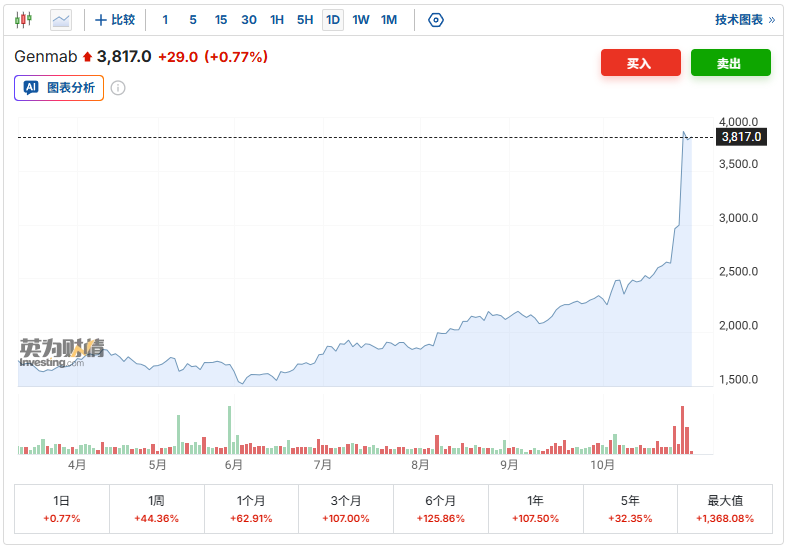
The Zhitong Finance App learned that for Danish biotech company Genmab (GMAB.US), this week can be described as a breakthrough moment. The two potential anti-cancer drugs announced positive late-stage clinical trial developments, driving the company's stock prices listed in Denmark and the US to soar to record highs. According to the data, Genmab's shares listed in Denmark rose 44% this week, the biggest weekly gain since 2008. The market capitalization increased by more than 10 billion US dollars in a week, and the cumulative increase from the beginning to date has increased to nearly 90%. Meanwhile, Genmab's shares listed in the US rose 29% this week until Thursday's close, and the stock price hit a record high of $59.97 in Wednesday's session.
On Wednesday, Genmab announced positive top-line results from its global phase III Liger-HN1 clinical trial. The trial evaluated the efficacy of petosemtamab in combination with pembrolizumab (pembrolizumab, MSD's major anti-cancer drug Keytruda) and pembrolizumab monotherapy for first-line treatment of patients with PD-L1 positive recurrent or metastatic head and neck squamous cell carcinoma (HNSCC). According to the results of the first interim analysis evaluated by the Independent Data Monitoring Committee (IDMC), compared with pembrolizumab alone, combination therapy achieved statistically significant and clinically significant improvements in overall survival (OS) and objective response rate (ORR). The risk of death was reduced by 50%, reached the two main endpoints of the study, and was not affected by the patient's HPV status.
Petosemtamab is particularly important to GenMab because the company owns all rights in the drug, which is expected to open up new revenue streams and reduce reliance on royalty revenue from partners developing and selling the drug.
Last week, Genmab said its experimental drug Rinatabart Sesutecan (Rina-S) for ovarian cancer had reached a primary end point and a key secondary endpoint in a late-stage clinical trial. Test results showed that Rina-S brought “statistically significant and clinically significant progression-free survival (PFS) and overall survival (OS) improvements” in patients with platinum-resistant ovarian cancer. Rina-S reduced the risk of disease progression or death by 71% among people with intent to treat (ITT). In the main analysis set (PAS) population, Rina-S reduced the risk of disease progression or death by 67%. The trial also reached its critical secondary endpoint overall survival (OS), showing statistically significant and clinically significant improvements in both ITT and PAS people.
Recent positive test results have pushed the market to significantly raise the stock's valuation, and have also allayed investors' concerns about whether it can cultivate new sources of growth, making investors believe that in addition to its major blood cancer drugs, the company has found a new growth engine. Earlier, the market feared that royalty revenue from the company's major multiple myeloma drug, Darzalex, would begin to decline.
Jefferies analyst Benjamin Jackson said, “Biotech companies often face this dilemma. If you develop a highly successful drug and earn significant revenue from it, it can be difficult to find the next innovation. Genmab is one of the few companies that can now be said to have achieved this goal.”
Benjamin Jackson added, “Currently, the company has three assets. Not only can they generate royalties, but they are actually the company's own commercial assets. The company is committed to promoting the marketing and development of these drugs on its own.”
What is the next trend in stock prices? Analysts have mixed opinions
Analysts were quick to reflect the potential future benefits of these drugs in their valuations. This week, Van Lanschot Kempen raised Genmab's price target to 4,900 Danish kroner, the highest level among analysts. This means that compared to the current share price, the stock still has nearly 30% potential to rise. “Petosemtamab is now clearly moving towards building a multi-billion dollar product line,” said Van Lanschot Kempen's team of analysts led by Romy O'Connor. The team also added that this treatment is expected to become the next standard treatment plan.
According to a report released by J.P. Morgan analysts on October 27, the peak sales potential of petosemtamab is about $5 billion, of which $3.5 billion comes from head and neck cancer indications, and the rest comes from colorectal cancer indications.
However, the speed at which Genmab's stock price is rising has caused some analysts to be cautious. On Thursday, both Jyske Bank and Al Sydbank downgraded their ratings for the stock. Sydbank analyst Søren Løntoft Hansen said the stock is about to enter a period of relative calm as investors await evidence of successful commercialization of the new drug. After the recent sharp rise in stock prices, Jyske Bank analyst Henrik Hallengreen Laustsen downgraded the stock to “sell.” He said it is expected that the company's news catalyst will decrease for some time to come, but he also acknowledged that recent clinical trial results “significantly reduced the risk in the company's R&D pipeline and strengthened the future growth prospects of Darzalex.”