
Earnings Pressure Might Change The Case For Investing In Bladex (BLX)
- Bladex reported Q3 2026 results with net interest income of US$79.8 million, net income of US$63.2 million, and basic EPS of US$1.48, alongside a Q3 dividend of US$0.6875 per share approved for payment on November 24, 2026.
- Despite higher net interest income and net income than a year earlier, Bladex's sequential earnings per share compression and net interest margin pressure highlight how funding costs and a dilutive Panama loan are weighing on per share profitability.
- We will now look at how Bladex's weaker sequential EPS, despite higher net income, could reshape the bank's longer term investment narrative.
Compare Bladex's income and dividend profile with a curated 7 dividend fortresses that shares a similar focus on consistent cash payouts.
Bladex Investment Narrative Recap
To stay invested in Bladex, you need to be comfortable with a trade off. The bank is leaning on higher net interest income and a record commercial portfolio, while accepting pressure on spreads and per share metrics. Q3 confirmed that story. Net income and returns looked solid, even as earnings per share softened against higher funding costs and the Panama loan impact.
The near term swing factor is whether management can stabilize net interest margin around the guided 2.25% level while keeping credit provisions contained. The main risk is that competition in short term lending and a thinner pipeline of large fee deals pull both margin and non interest income below what recent quarters have suggested.
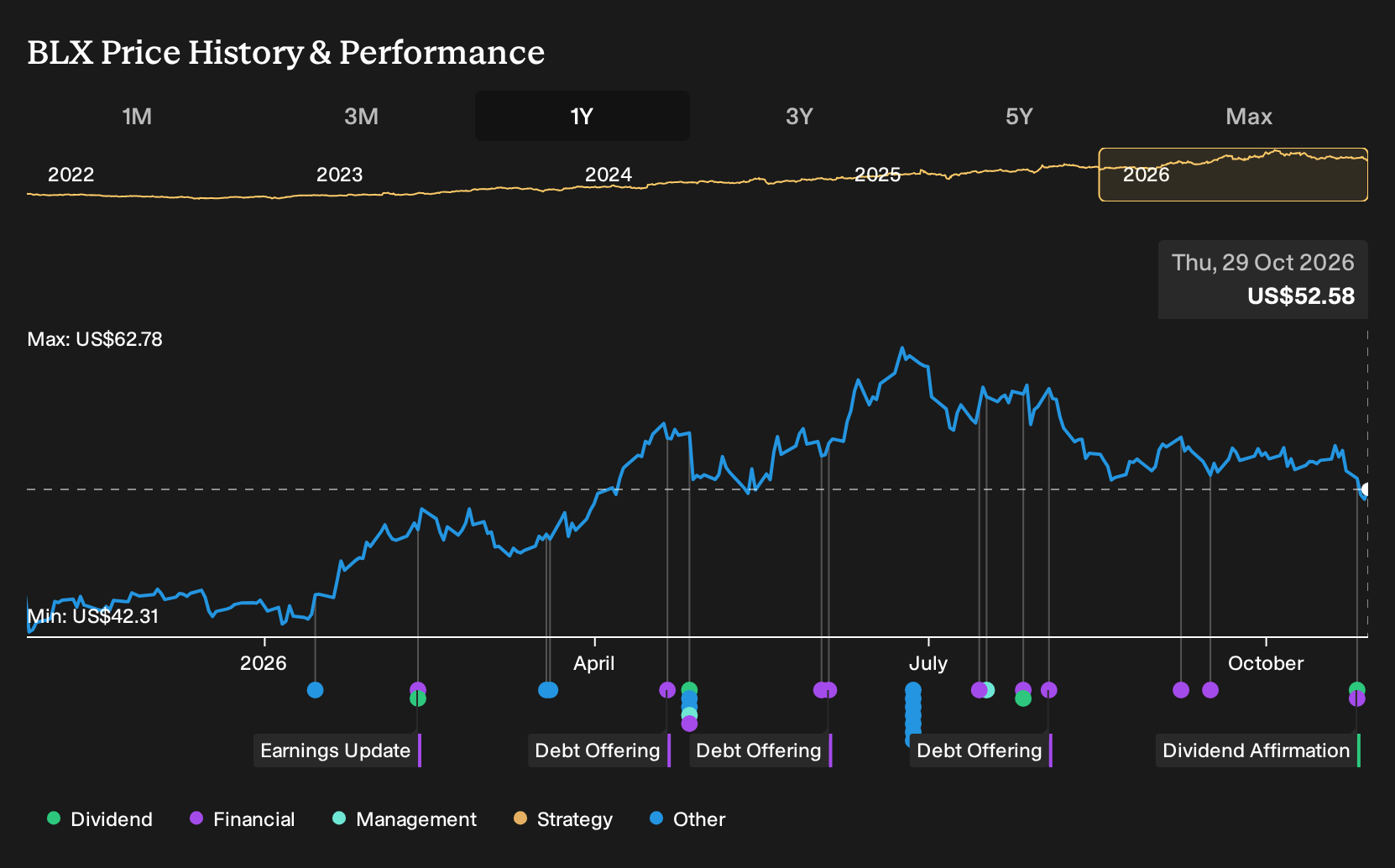
The Q3 2026 dividend affirmation to US$0.6875 per share matters directly for this narrative. It signals that Bladex is comfortable returning cash even in a quarter where EPS compressed from Q2 and funding costs weighed on profitability. For income focused holders, that decision sets a reference point for what the board currently sees as a sustainable payout level.
From here, watch how that dividend interacts with the key catalysts. If net interest margin pressure persists or fee income from transactions like the Panama loan proves patchier, the payout could consume a larger share of earnings. If execution on digital trade platforms and short tenors supports volume and fees, the same dividend may look more easily covered by operating performance.
Bladex Forecasts Anchored In Analyst Assumptions
Analysts frame Bladex as a bank where Q3's tension between strong net income and softer per share metrics feeds directly into longer term modeling. The forecasts are not a promise, but they show what needs to line up for today's dividends and earnings profile to make sense against the current share price.
On the top line, the analyst group uses a projected 14.1% annual revenue expansion over the next three years as a core input. That pace sits on the assumption that fee and commission streams can keep playing a bigger role, while the commercial portfolio and deposit funding continue to support trade finance volumes even as spreads face pressure.
Earnings expectations rest on a similar balancing act. The consensus view looks for profit margins to soften from 68.9% today to 64.2% in three years, which acknowledges that higher funding costs and competition can weigh on profitability. Even with that margin compression baked in, the same models point to higher absolute earnings driven by revenue growth and scale benefits in the franchise.
Bladex's narrative projects US$487.4 million revenue and US$313.1 million earnings by 2029. This rests on analysts assuming 14.1% yearly revenue growth and an earnings increase of about US$86.8 million from US$226.3 million today.
By 2029, those consensus estimates cluster around earnings of US$313.1 million and earnings per share of US$8.40. That compares with current earnings of US$226.3 million, implying roughly a US$86.8 million uplift if the assumptions around revenue, margins and share count all hold together. The forecast year is 2029, which gives several reporting cycles for you to test whether actual results are tracking anywhere near that path.
Valuation work in the same reports then layers a P/E multiple over those projected profits. To reach the US$65.90 average price target cited by analysts, the stock would need to trade on a P/E of 10.7x applied to the 2029 earnings consensus, up from about 8.9x on the current numbers. That implied future multiple also sits below the 16.8x P/E that is referenced for the wider US diversified financial sector, which is one reason some investors see the shares as priced below the earnings profile described in the forecasts.
Revenue expectations are also explicit in those valuation checks. The models call for Bladex to generate US$487.4 million of revenue in 2029, matched with US$313.1 million of earnings in that same year. Those paired figures underpin the discounted cash flow work that uses a 9.4% to 9.41% discount rate, depending on source, to translate future income streams into a present value range around the current price and the consensus target.
The gap between the latest quoted share price of US$54.24 and the US$65.90 average target equates to a 17.7% uplift in those reports. That difference is not a certainty or a recommendation. It is simply the mathematical result of applying the forecast revenue line, shrinking margins, projected earnings and a higher P/E to 2029 estimates, then comparing that output with where the stock trades today.
For an income oriented holder in Bladex, the practical takeaway is straightforward. Q3 2026 showed that the bank is still willing to return cash through dividends even as spreads compress and a large Panama loan weighs on per share profitability. Analyst models now sketch out what would need to happen on revenue, earnings and valuation multiples by 2029 for that approach to look well supported over time, which gives you a yardstick to monitor rather than a fixed roadmap.
Uncover why Bladex's fair value indicates a 25% potential upside to its current price, which could narrow quickly.
Exploring Other Perspectives
One optimistic twist on Bladex focuses on fee growth rather than margin pressure. The most bullish analysts were assuming revenue of about US$505.8 million and earnings of roughly US$337.3 million by 2029, before this Q3 report. If you lean toward that story, the flat US$1.48 EPS now could encourage a reassessment of how quickly those fee heavy businesses need to scale, and support a comparison of several narratives rather than reliance on a single view.
Explore 3 other Bladex fair value estimates, including one that suggests as much as 101% upside from the current price!
Form Your Own Verdict
Disagree with existing narratives? Extraordinary investment returns rarely come from following the herd, so go with your instincts.
- A great starting point for your Bladex research is our analysis highlighting 5 key rewards and 1 important warning sign that could impact your investment decision.
- See our latest analysis for Bladex. The report includes a comprehensive fundamental analysis summarized in a single visual, the Snowflake, making it easy to evaluate Bladex's overall financial health at a glance.
Looking For More Investment Ideas Beyond Bladex?
Once you have formed a view on Bladex, it can help to line it up against other companies with different income profiles, risk levels and balance sheet strength using the Simply Wall St Screener.
- If you want income to do more of the heavy lifting in your portfolio, compare Bladex's payout with a curated 7 dividend fortresses that prioritize resilience in cash distributions.
- For investors who care most about capital preservation and steadier return profiles, weigh Bladex against a 30 resilient stocks with low risk scores that score well on our risk checks.
- When you are searching for the next potential opportunity before it becomes widely followed, broaden your watchlist with a 18 high quality undiscovered gems that pair quality fundamentals with lighter market attention.
Have feedback on this article? Concerned about the content? Get in touch with us directly. Alternatively, email editorial-team@simplywallst.com