
How Investors Are Reacting To Honda (TSE:7267) Production Drop
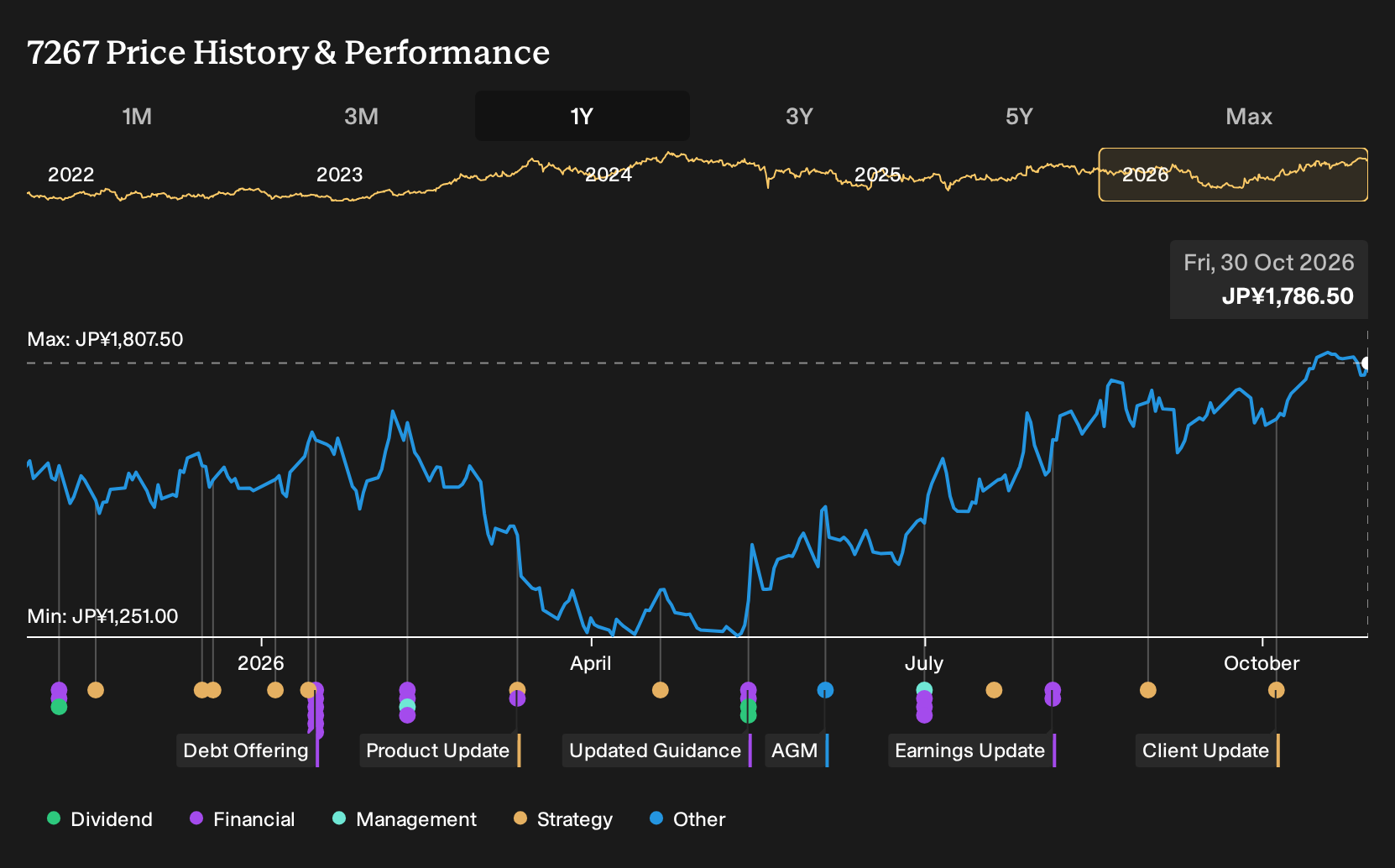
- Honda Motor reported that global vehicle production fell 12% in September 2026 to 273,189 units, with overseas output declining 14% and Asia excluding Japan down sharply over the first nine months of the year.
- The production slump arrives just as Honda Motor flags potentially severe disruption from proposed 50% U.S. tariffs on Canadian-built vehicles and parts, putting both factory utilization and North American supply planning under pressure.
- We will now look at how Honda Motor's investment narrative could be affected by the production drop and tariff risk.
Scan other auto stocks with production or trade pressures to see how they are setting up for potential mispricing by running your filters against the 15 high quality undervalued stocks.
Honda Motor Investment Narrative Recap
To own Honda Motor, you need to be comfortable with a car business that is still fixing core auto profitability while leaning on motorcycles, cost cuts and localization to steady the ship. The September production drop, especially the 35% year to date hit in Asia excluding Japan, makes near term volume recovery less certain but does not fundamentally rewrite the long term plan.
The sharper risk sits in tariffs and EV losses rather than a single weak production month. Potential 50% U.S. duties on Canadian vehicles and parts could disrupt North American utilization, while ongoing EV related losses and debt coverage questions keep pressure on cash generation and execution quality.
The tariff warning from Honda Motor around possible 50% U.S. duties on Canadian built vehicles is the announcement that matters most against this production update. A business already seeing overseas volumes under strain now faces the prospect of higher trade friction on a key supply route into its largest profit pool.
If those tariffs materialize, North American localization plans, hybrid system manufacturing shifts and potential three shift U.S. operations move from long range optimization ideas to urgent execution tests. For you as a shareholder, the key catalyst is whether Honda can reconfigure production and supply chains fast enough to keep volumes and margins from deteriorating further.
Honda Motor's current analyst storyline points to revenue of ¥25,170.5b and earnings of ¥1,021.1b by 2029, built on 3.8% yearly revenue growth and an earnings swing of about ¥1,190.8b from a loss of ¥169.7b today.
Uncover why Honda Motor's fair value is essentially consistent with its current price.
Exploring Other Perspectives
Some of the most optimistic analysts frame Honda Motor less around tariff risk and more around the Triple Half cost reset. Before this production news, they were pencilling in revenue near ¥28,430.9b and earnings of about ¥1,365.2b by 2029. That is far more upbeat than consensus. Use this as a reminder that forecasts can swing widely and that fresh data like the September production drop and tariff threat can quickly challenge even the rosiest story.
Explore 2 other Honda Motor fair value estimates, including one that suggests up to 23% upside from the current price.
The Verdict Is Yours
Don't just follow the ticker; dig into the data and build a conviction that's truly your own.
- A great starting point for your Honda Motor research is our analysis highlighting 3 key rewards and 2 important warning signs that could impact your investment decision.
- See our latest analysis for Honda Motor. The report includes a comprehensive fundamental analysis summarized in a single visual, the Snowflake, making it easy to evaluate Honda Motor's overall financial health at a glance.
Looking for more investment ideas beyond Honda Motor?
Once you have a handle on Honda Motor, it can help to widen the lens and see how other businesses with different risk and return profiles stack up against your watchlist using the Simply Wall St Screener.
- If you want potential mispricing with quality in mind, scan a curated 15 high quality undervalued stocks that blend stronger fundamentals with comparatively lower valuations.
- For income focused investing, assess a set of 27 dividend fortresses that combine higher yields with an emphasis on resilience.
- If capital preservation is your first filter, review a group of 24 resilient stocks with low risk scores that screen well on balance sheet strength and risk metrics.
Have feedback on this article? Concerned about the content? Get in touch with us directly. Alternatively, email editorial-team@simplywallst.com