
Bank of Nova Scotia (TSX:BNS) Raises Prime Rate, Is The Stock Fully Valued?
Bank of Nova Scotia (TSX:BNS) has raised its Canadian dollar prime lending rate to 4.70% from 4.45%. This change directly affects borrowing costs and could reshape investor focus on its interest income profile.
Recent trading has been strong for Bank of Nova Scotia, with a 90 day share price return of 8.51% and a year to date share price gain of 30.31% at a current level of CA$133.44. The 1 year total shareholder return of 51.23% and 3 year total shareholder return of about 17x suggest momentum has been building rather than fading.
See how other banks with rising rate stories are trading by comparing Bank of Nova Scotia with a curated set of list of solid balance sheet and fundamentals (6 results).
The prime rate move has sharpened the spotlight on Bank of Nova Scotia at CA$133.44. Does it make more sense to commit capital here, or to wait for a friendlier entry point once valuation is unpacked?
Most Popular Narrative: 0% Overvalued
On the most followed narrative, Bank of Nova Scotia screens as slightly above its CA$132.86 fair value estimate. However, the CA$133.44 share price still leans on the same long term drivers around capital returns, international exposure and digital adoption that analysts keep circling back to.
Expansion of banking and wealth management services in Pacific Alliance markets such as Mexico, Peru, Chile and Colombia remains a live driver. International Banking revenue and loan growth in these regions and ROE above 16% point to further potential for fee income and earnings growth as Bank of Nova Scotia continues to deepen client relationships.
See why 194 investors see Bank of Nova Scotia as 0% overvalued.
Result: Fair Value of CA$132.86 (ABOUT RIGHT)
Still, the Bank of Nova Scotia story can be knocked off course if credit losses in Canada stay elevated or if Latin American volatility keeps provisions higher for longer.
Find out about the key risks to this Bank of Nova Scotia narrative.
Another View: Bank of Nova Scotia Through Earnings Multiples
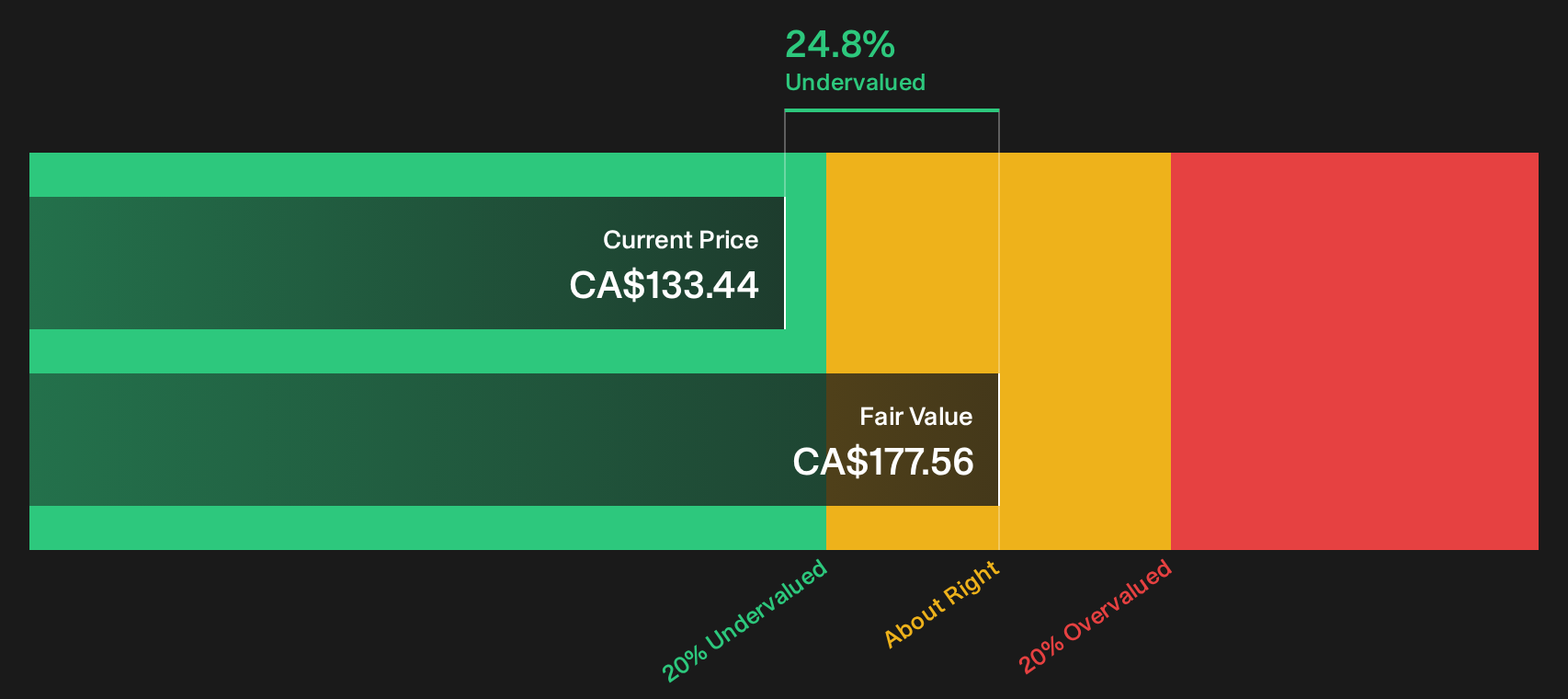
The SWS DCF model points to a different outcome for Bank of Nova Scotia, with an estimated future cash flow value of CA$177.56 against the current CA$133.44 share price. On that lens, the stock screens as undervalued. That sits awkwardly beside analyst targets clustered around CA$132.86, so a key question is which signal deserves more weight.
Our DCF model builds in those long term forecasts and discount rate assumptions in a more explicit way than a simple earnings multiple. It can help you stress test whether the market is being too cautious on Bank of Nova Scotia today. Look into how the SWS DCF model arrives at its fair value.
Next Steps
Momentum cuts both ways. If Bank of Nova Scotia has your attention, act quickly and work through the numbers yourself, starting with the 4 key rewards and 1 important warning sign.
Looking for more investment ideas beyond Bank of Nova Scotia?
If Bank of Nova Scotia has sharpened your focus, do not stop there. Use the Simply Wall Street Screener to pressure test fresh opportunities across different angles.
- Target steady compounding by reviewing a curated set of income opportunities through the 3 dividend fortresses.
- Hunt for mispriced quality by working through the 4 high quality undervalued stocks before sentiment shifts and prices adjust.
- Prioritise capital protection by filtering for companies with resilient profiles using the 8 resilient stocks with low risk scores.
Have feedback on this article? Concerned about the content? Get in touch with us directly. Alternatively, email editorial-team@simplywallst.com