
Is Network Expansion Altering The Investment Case For Comcast Stock (CMCSA)?
- Comcast expanded its fiber powered Xfinity network to thousands of homes and businesses across several U.S. communities and reported Q3 2026 net income of US$3,448 million on sales of US$29,298 million.
- The buildout into underserved areas such as rural Tulare County points to a push for wider broadband coverage, alongside digital inclusion programs like Internet Essentials.
- Next, the focus turns to how this fresh round of broadband expansion into Barrington influences Comcast's broader investment narrative.
Comcast Investment Narrative Recap
To own Comcast, you need to believe its connectivity engine, bundled with wireless, streaming and theme parks, can keep throwing off solid cash even as competition bites. The Barrington, Franklin, Indiana and Tulare expansions fit that belief. They keep the network relevant and widen the pool of broadband and mobile prospects rather than shifting the near term earnings story.
The key near term swing factor is still broadband pricing and subscriber trends, where rival fiber, fixed wireless and satellite options could pressure ARPU and Connectivity margins. Execution risk sits around heavy capex, high debt and already lower net margins, so missteps or slower returns on these builds could tighten financial flexibility.
The Q3 2026 earnings print is the announcement that matters most alongside this buildout. Comcast reported US$29,298m of quarterly sales and US$3,448m of net income, with nine month revenue of US$90,695m and profit of US$9,148m. EPS from continuing operations for the quarter came in at US$0.97 on both a basic and diluted basis.
Those figures give you a current profit baseline while the fiber powered expansions roll through the P&L and cash flow statement over time. They also highlight the trade off. Management is leaning into convergence and footprint growth while contending with softer revenue, slimmer margins than last year and ongoing competitive and cybersecurity risks that could disrupt that thesis.
Comcast's current analyst model points to US$119.0b in revenue and US$10.9b in earnings by 2029, based on a forecast yearly revenue decline of 1.1% and an earnings drop of US$0.4b from US$11.3b today.
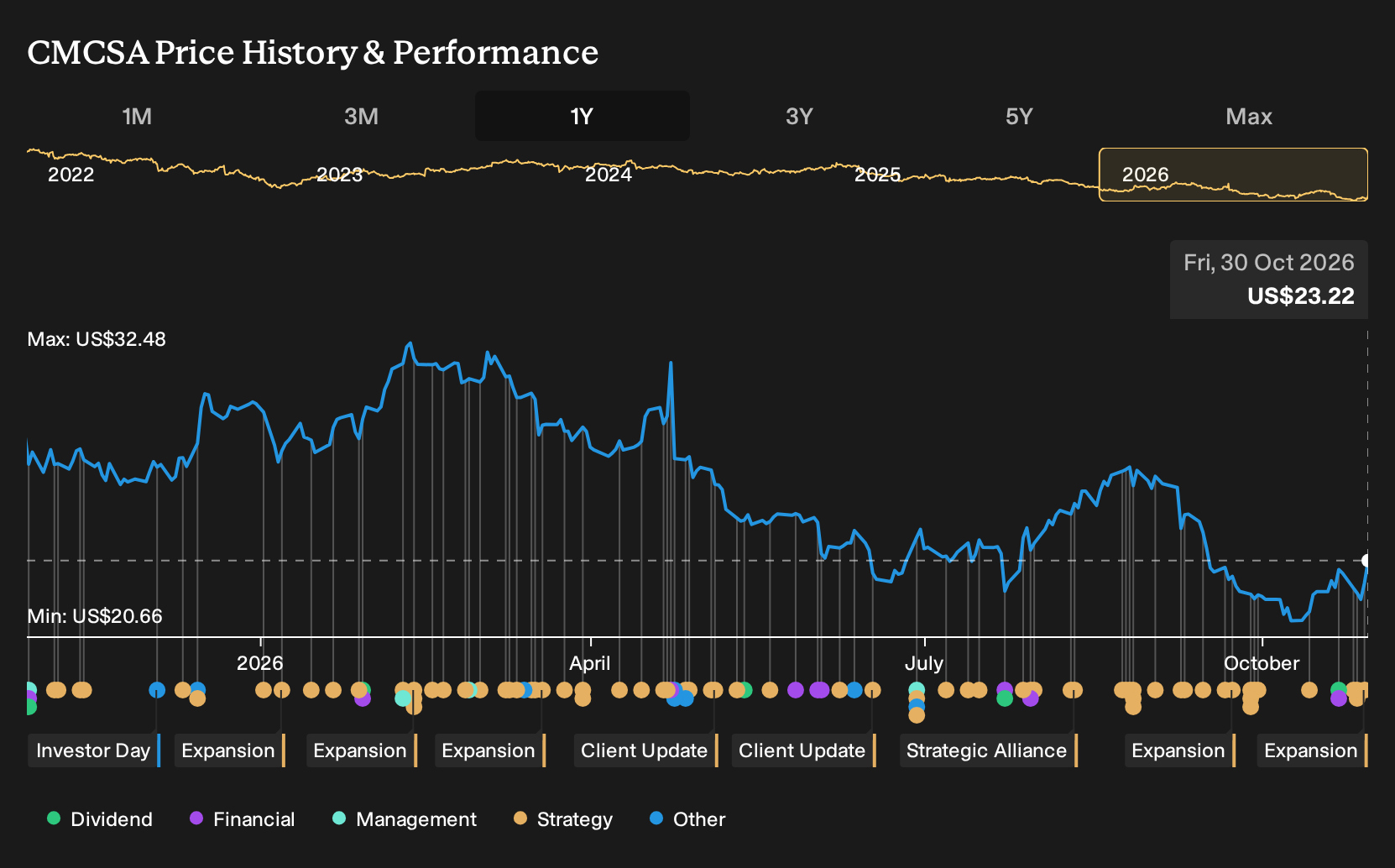
Uncover why Comcast's fair value indicates a 21% potential upside to its current price. This opportunity could narrow quickly as investors reassess Comcast's setup.
Exploring Other Perspectives
Some of the most bearish analysts fixate on the risk that Comcast’s rural and small town builds, including projects like Barrington, end up earning less per connection. Before this news, they were modelling revenue to reach about US$116.6b and earnings of roughly US$9.8b by 2029. That is a more cautious story than consensus. Use it as a reminder that forecasts differ widely and that this latest expansion could still nudge both the optimistic and pessimistic narratives in new directions.
Explore 5 other Comcast fair value estimates, including one that suggests there could be as much as 27% downside from the current price!
The Verdict Is Yours
Disagree with existing narratives? Extraordinary investment returns rarely come from following the herd, so go with your instincts.
- A great starting point for your Comcast research is our analysis highlighting 3 key rewards and 2 important warning signs that could impact your investment decision.
- See our latest analysis for Comcast. The report includes a comprehensive fundamental analysis summarized in a single visual, the Snowflake, making it easy to evaluate Comcast's overall financial health at a glance.
Looking for more investment ideas beyond Comcast?
If Comcast has helped sharpen your thinking about broadband, it can be useful to test that thesis against other businesses with different balance sheet strength, valuation profiles and income potential. The Simply Wall St Screener lets you quickly filter for companies that match the risk and return mix you want to focus on next.
- For investors who care most about resilience and capital preservation, start with a 30 resilient stocks with low risk scores that keep overall risk scores in check while still offering room for upside.
- If the priority is quality at a reasonable price, sort through a 29 high quality undervalued stocks that combine healthier cash generation with what may be more modest expectations baked into their share prices.
- Income seekers who want their capital to work harder can scan a 5 dividend fortresses that pair higher yields with business models built around ongoing distributions.
Have feedback on this article? Concerned about the content? Get in touch with us directly. Alternatively, email editorial-team@simplywallst.com