
Learn Why The Bull Case For Microchip Technology Stock Could Change Following EtherCAT Platform Expansion
- Microchip Technology recently reported new EtherCAT and TSN capabilities on PolarFire FPGAs and SoCs, along with progress on its radiation hardened PIC64 HPSC spaceflight computing platform, including early customer programs and ecosystem support.
- The updates point to Microchip Technology pushing deeper into industrial edge networking and high reliability space computing. These are two areas where specialized hardware, long qualification cycles and ecosystem support can shape demand visibility and product mix.
- The next area of focus will be how Microchip Technology's EtherCAT enabled PolarFire stack could influence its broader industrial centric investment narrative.
Scan beyond Microchip Technology and see which industrial automation players could also benefit from real time networking and edge compute demand with our hand picked 54 AI infrastructure stocks
Microchip Technology Investment Narrative Recap
For Microchip Technology, the central belief is that its exposure to industrial, automotive, data center and aerospace demand can translate into steadier orders and better use of existing capacity. The EtherCAT and TSN additions sit squarely in that thesis, because they push more of the portfolio toward real time industrial networking and edge compute, where product lifecycles are long.
The near term swing factor still looks operational. Management is working through elevated inventories, prior write offs and factory underutilization charges, while also dealing with tight foundry and packaging supply as AI demand competes for capacity. If those pressures ease, the margin framework management has outlined becomes more credible. If they do not, profitability could stay muted even with healthier end markets.
The EtherCAT and TSN enabled PolarFire stack feels most relevant to the current narrative. It directly links Microchip Technology to customers that care about deterministic networking, energy efficiency and integrated security for robotics, motion control and embedded vision. Those are the same areas analysts already flag as contributors to industrial and edge computing recovery.
Operationally, this stack leans on hardware, IP, tools and reference designs that can shorten customer development time in factory automation, autonomous mobile robots and smart infrastructure. That kind of platform approach can support the catalyst of broader industrial demand, but it still has to work through the real constraints investors are watching, including external packaging bottlenecks and the company’s own capital discipline.
What The Current Microchip Technology Forecasts Assume
Microchip Technology's current analyst framework leans heavily on the idea that the industrial and aerospace skew of the portfolio can support steadier earnings, but the numbers behind that view matter just as much as the product headlines. Consensus assumptions call for revenue to grow by 17.4% per year over the next three years, with profit margins moving from 7.2% today to 28.0% over the same period. On that basis, analysts expect earnings to rise from US$367.2 million today to US$2.3b around 2029. This is roughly a 6x step up in profit, even as they acknowledge a wide spread between the more bullish US$3.4b and the more cautious US$2.1b scenarios.
Microchip Technology's narrative projects US$8.3b revenue and US$2.3b earnings by 2029. This assumes 17.4% yearly revenue growth and roughly a 6x earnings increase from US$367.2 million.
For investors tracking the EtherCAT and TSN enabled PolarFire stack, those headline forecasts set a high bar. The implied path asks the business to expand earnings to a level where a 35.2x P/E on 2029 profit supports the current analyst price targets. This is down from a reported 112.2x P/E multiple today and also below the 42.6x P/E quoted for the wider US semiconductor group. That gap effectively bakes in both margin expansion and a sharp reset in how much investors are willing to pay for each dollar of projected profit, which is where execution on industrial edge and space programs starts to matter for sentiment.
Revenue forecasts of US$8.3b by 2029 also intersect directly with the real time networking theme. Growth in EtherCAT focused FPGAs and SoCs, along with radiation hardened computing platforms, could influence how much of that top line ultimately leans on long duration programs in factory automation, aerospace and defense. These are segments where design wins can be sticky and replacement cycles are slow, yet they are still constrained by the same foundry and outsourced packaging limits that management has been flagging as a risk to turning demand into shipped product.
The share count assumption looks modest next to the earnings ramp. Analysts are modeling only 0.47% annual growth in shares outstanding over the next three years, which effectively puts more of the heavy lifting on operating performance rather than financial engineering. That setup gives investors a cleaner read on how EtherCAT enabled PolarFire solutions, space grade computing and edge AI initiatives might translate into per share earnings, without leaning too much on buybacks or aggressive capital structure shifts.
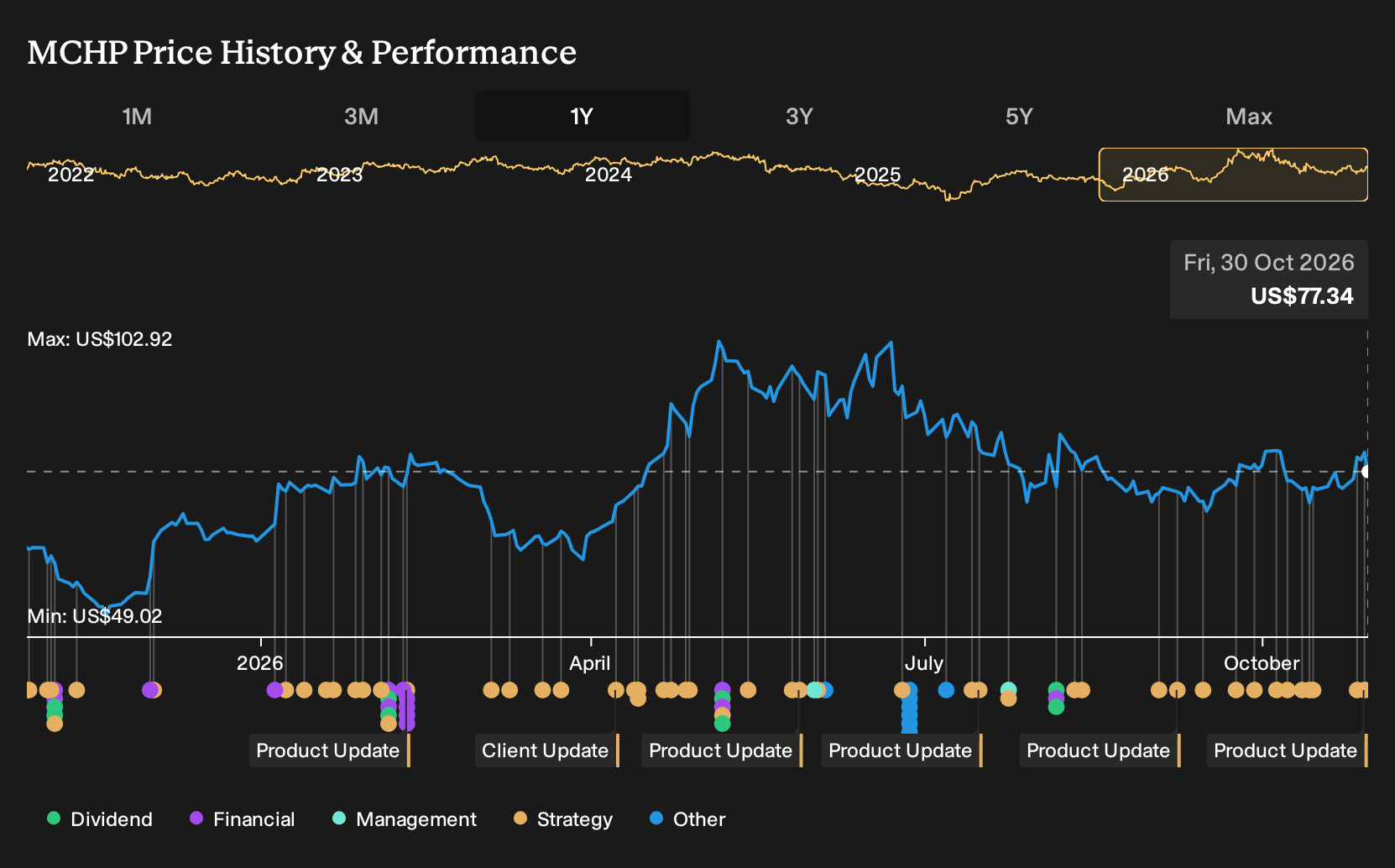
All of this rolls up into a valuation framework that links Microchip Technology's industrial centric story back to concrete numbers. To line up with the consensus target price of US$105.92, up from a spot share price of US$75.90, investors would need to be comfortable with the 2029 scenario that combines US$8.3b in sales, US$2.3b in profit and a 35.2x P/E multiple under an 11.8% discount rate. That picture is not just about how big EtherCAT and TSN become inside the portfolio, but whether those technologies help sustain higher margins and better asset utilization in the face of ongoing inventory clean up and tight external capacity.
Uncover why Microchip Technology's fair value indicates a 37% potential upside to its current price, which could narrow quickly.
Exploring Other Perspectives
Some of the lowest Microchip Technology forecasts treat gross margin as the real swing factor rather than new products. Those analysts were pencilling in about US$8.2b of 2029 revenue and roughly US$2.0b of earnings before this EtherCAT and TSN news, which is far more cautious than consensus and shows how widely views can differ. You can use this new product update as a prompt to compare these competing narratives for yourself.
Explore 4 other Microchip Technology fair value estimates, including one that suggests up to 6% downside from the current price.
Form Your Own Verdict
Disagree with existing narratives? Extraordinary investment returns rarely come from following the herd, so go with your instincts.
- A great starting point for your Microchip Technology research is our analysis highlighting 2 key rewards and 2 important warning signs that could impact your investment decision.
- See our latest analysis for Microchip Technology. The report includes a comprehensive fundamental analysis summarized in a single visual, the Snowflake, making it easy to evaluate Microchip Technology's overall financial health at a glance.
Looking For More Investment Ideas Beyond Microchip Technology?
If you want to put Microchip Technology in context, it often helps to line it up against other opportunities that share similar financial traits. The Simply Wall St Screener can point you toward businesses with different risk and income profiles so you can build a watchlist that actually fits how you like to invest.
- For investors who care most about balance sheet strength and durability, start with a list of solid balance sheet and fundamentals (25 results) that can handle tougher conditions without leaning heavily on fresh capital.
- If your priority is limiting downside and focusing on steadier profiles, look at a 30 resilient stocks with low risk scores that screens for resilience across earnings, debt and volatility.
- Those hunting for opportunities that are not yet crowded can review a 18 high quality undiscovered gems with strong fundamentals that the wider market may not be paying close attention to yet.
Have feedback on this article? Concerned about the content? Get in touch with us directly. Alternatively, email editorial-team@simplywallst.com