
How Investors Are Reacting To Thermo Fisher Scientific (TMO) Raised 2026 Guidance
- Thermo Fisher Scientific reported third quarter 2026 sales of US$12,137 million and net income of US$1,721 million, with basic earnings per share from continuing operations of US$4.65, alongside higher nine month figures versus the prior year period.
- The latest results highlight how Thermo Fisher Scientific is leaning on pharma and biotech demand and AI enabled precision medicine tools to support earnings, even as academic and government budgets remain pressured.
- We will now explore how Thermo Fisher Scientific's stronger Q3 2026 sales performance could reshape the investment narrative investors focus on.
Scan how Thermo Fisher Scientific's AI enabled precision medicine story compares with other potential breakout plays by checking our curated list of 34 healthcare AI stocks.
Thermo Fisher Scientific Investment Narrative Recap
To own Thermo Fisher Scientific, you need to believe its pharma and biotech customers, along with AI enabled precision medicine workflows, remain the main engine for sales and earnings. The Q3 2026 report, with higher quarterly and nine month revenue and profit versus a year earlier, points to that core demand holding up reasonably well.
The near term catalyst is whether pharma, biotech and bioproduction activity stays healthy enough to offset muted academic and government spending and the planned microbiology divestiture. The biggest risk is that funding recovery at those weaker customer groups stays soft, which could limit appetite for high end instruments and slow organic growth.
The most relevant fresh data point is the Q3 2026 release itself. Sales of US$12,137 million and net income of US$1,721 million for the quarter, plus higher nine month figures than a year ago, give investors a clearer read on how Thermo Fisher Scientific is executing in tools, services and AI linked precision medicine.
Those numbers arrive alongside analyst commentary that ties Thermo Fisher Scientific to pharma and biotech demand, AI enabled platforms and margin expansion potential, with some caution around long term organic growth targets. In terms of catalysts, that earnings print feeds directly into how investors weigh the benefits of portfolio shifts and bioproduction capacity against funding risks and balance sheet leverage.
Thermo Fisher Scientific Long Term Analyst Setup
Thermo Fisher Scientific's long range script in the analyst models is surprisingly tight. The story ties its AI enabled precision medicine push directly to old fashioned income statement math. That mix can help you see what has to happen in the real world for the spreadsheet forecasts to line up.
Across the consensus set, forecasters plug in revenue growth of 5.8% each year over the next three years. They also build in an uplift in profit margins from 14.9% today to 19.0% in year three, which is a sizable shift in how much profit drops through from every dollar of sales.
On earnings, the group view calls for net profit of US$10.7b by 2029 compared with US$7.1b today. That is roughly a 50% increase in earnings, and it is the financial backbone that supports most of the AI linked and bioproduction optimism around Thermo Fisher Scientific.
Behind that single consensus number sits a wide spread of opinions. The most optimistic analysts pencil in US$12.3b of profit in 2029 while the most cautious stop at US$9.4b. That range shows how much disagreement there is about how strongly pharma demand and AI enabled workflows will translate into hard cash.
To turn those income projections into a share price, the models assume Thermo Fisher Scientific trades on a P/E of 31.6x in 2029, lower than the current multiple of 36.8x and below the quoted 46.3x P/E for the broader US life sciences group. The forecasts also lean on a 1.52% yearly decline in the share count over the next three years, which lifts earnings per share even if total profit only tracks the mid point of expectations.
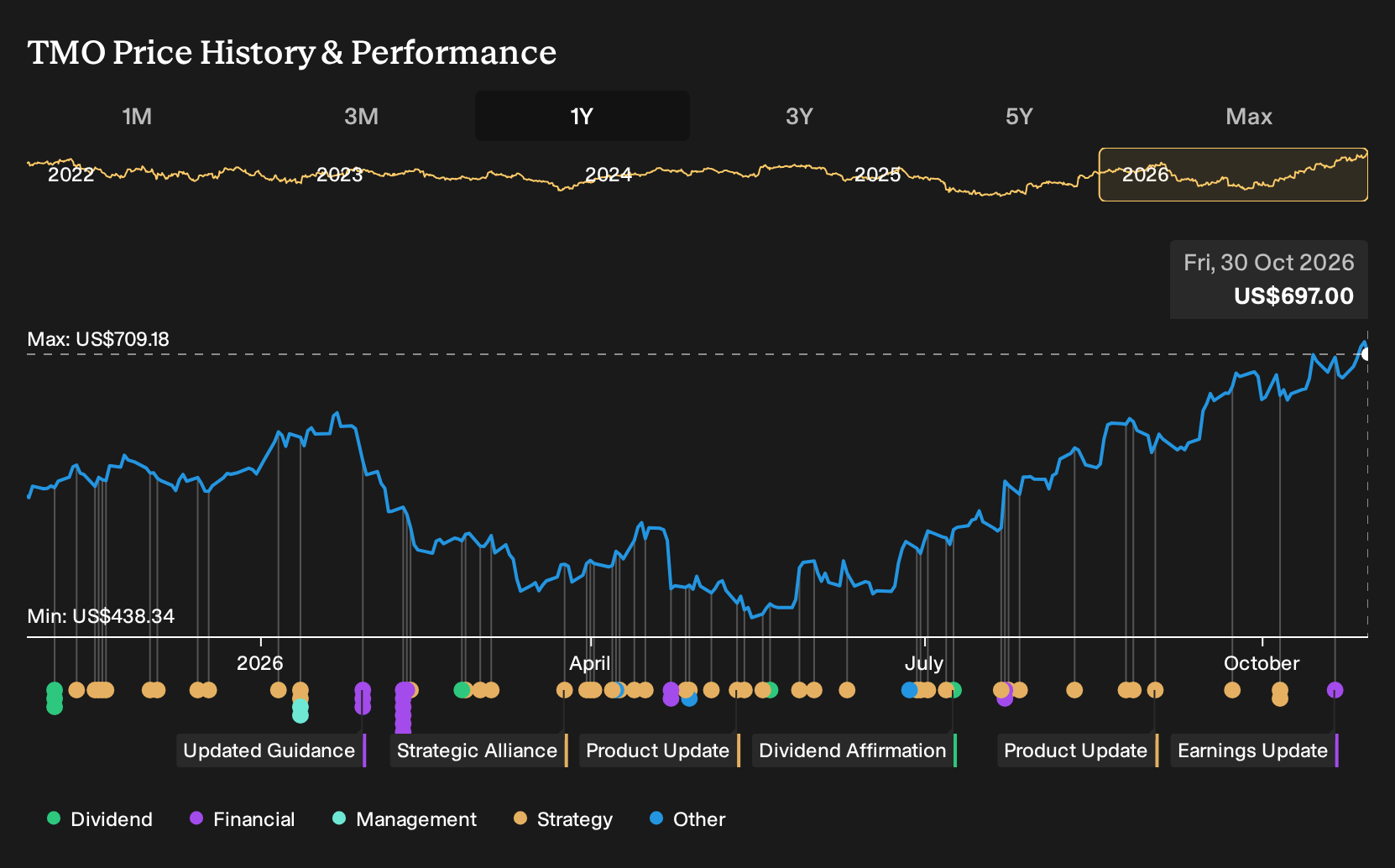
On the valuation side, analysts cluster around a US$750.92 price target with the current share price quoted at US$704.15. That 6.2% gap is not huge. It signals that many market participants already factor in mid single digit revenue gains, higher margins, and contributions from the recent M&A and microbiology divestiture when they look at Thermo Fisher Scientific.
There is still a broad target range for the stock. Some forecasts stretch up to US$830.00 while others sit as low as US$560.00. Those bookends echo the split views on how reliably pharma and biotech budgets, reshoring linked capacity wins, and AI equipped tools can all keep supporting the Thermo Fisher Scientific investment case.
Thermo Fisher Scientific's narrative projects US$56.1b revenue and US$10.7b earnings by 2029. This setup implies 5.8% yearly revenue growth and roughly a US$3.6b earnings increase from US$7.1b today.
Uncover why Thermo Fisher Scientific's fair value indicates an 8% potential upside to its current price before the market closes that gap.
Exploring Other Perspectives
One alternate view on Thermo Fisher Scientific leans hard on microbiology divestiture risk. In that scenario, the lowest analysts were penciling in about US$54.8b of revenue and US$8.9b of earnings by 2029, which is well below the consensus path. Use this new Q3 report to test which narrative you find more convincing.
Explore 4 other Thermo Fisher Scientific fair value estimates, including one that indicates as much as 20% downside from the current price.
Decide For Yourself
Disagree with existing narratives? Extraordinary investment returns rarely come from following the herd, so consider your own research and judgment.
- A great starting point for your Thermo Fisher Scientific research is our analysis highlighting 2 key rewards and 1 important warning sign that could impact your investment decision.
- See our latest analysis for Thermo Fisher Scientific. The report includes a comprehensive fundamental analysis summarized in a single visual, the Snowflake, making it easy to evaluate Thermo Fisher Scientific's overall financial health at a glance.
Looking for more Thermo Fisher Scientific style ideas?
If Thermo Fisher Scientific's blend of AI enabled precision medicine and steady earnings appeals to you, it can help to line it up against other potential opportunities using the Simply Wall St Screener.
- For investors who want mispriced quality on their radar, scan our curated set of 33 high quality undervalued stocks that pair solid fundamentals with more modest expectations baked into their valuations.
- If capital preservation matters as much as upside, filter for companies with steadier risk profiles using a 29 resilient stocks with low risk scores that focuses on resilient balance sheets and business models.
- To widen your opportunity set beyond widely followed giants, broaden your search with a 19 high quality undiscovered gems that highlights under-the-radar businesses with strong underlying metrics.
Have feedback on this article? Concerned about the content? Get in touch with us directly. Alternatively, email editorial-team@simplywallst.com