
How Raised Earnings Guidance At UDR (UDR) Has Changed Its Investment Story
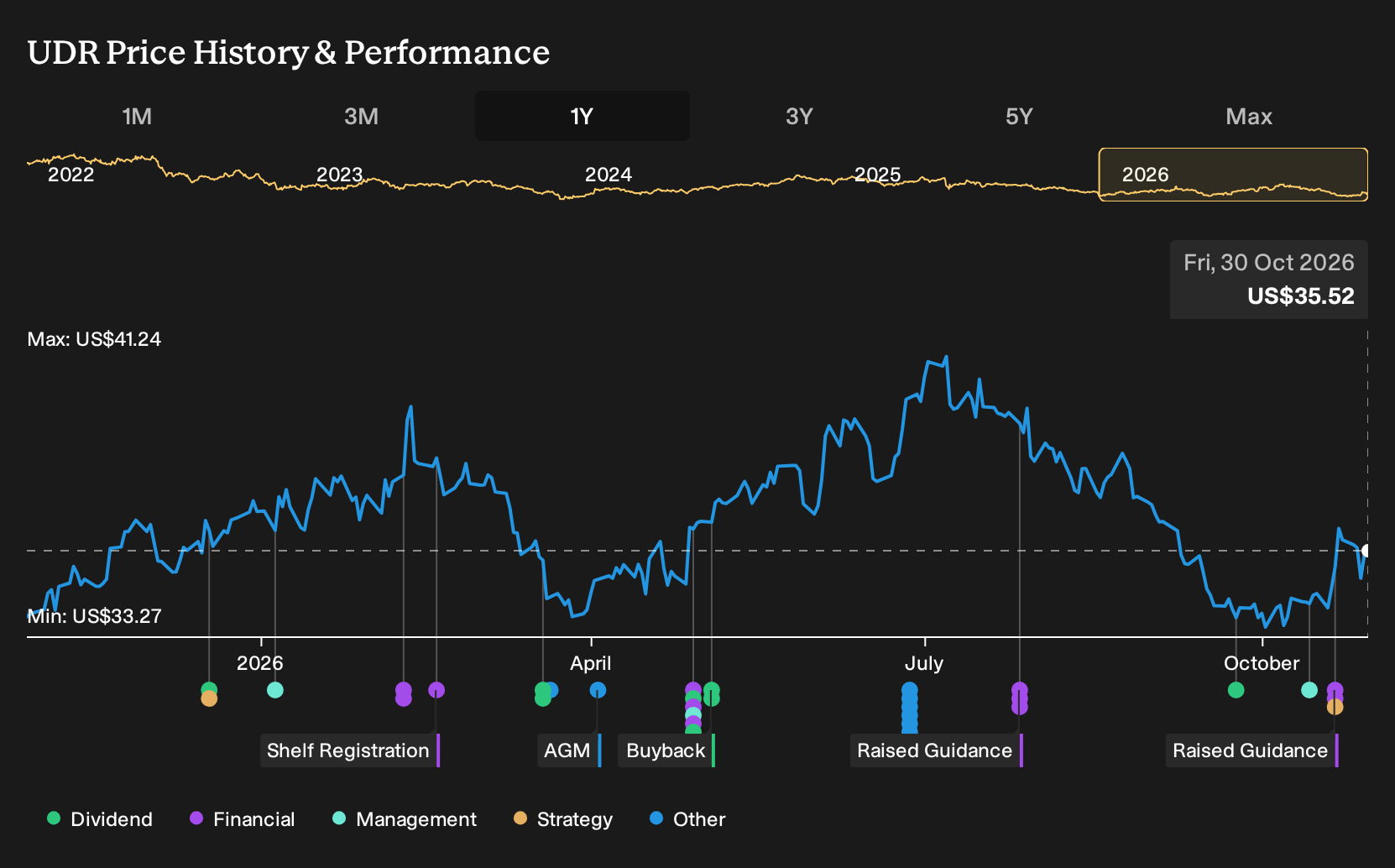
- UDR, Inc. raised its third quarter and full year 2026 net income per diluted share guidance and outlined expectations for fourth quarter earnings, while also announcing a long term joint venture with Apollo involving 19 apartment communities valued at about US$2.0b.
- The Apollo partnership leaves UDR with a one third interest, operating control, and an option to repurchase Apollo’s stake at a fixed 7.00% to 7.50% return, which directly ties future capital deployment flexibility to the performance of this US$2.0b apartment portfolio.
- The focus now turns to how UDR’s raised earnings guidance interacts with its existing investment narrative around capital recycling and data driven operations.
UDR Investment Narrative Recap
To own UDR, you need to be comfortable with a fairly steady apartment platform that leans on data driven pricing, capital recycling and resident retention, while accepting that analysts currently model earnings contraction over the next few years. The sharply higher 2026 net income guidance, especially the move in third quarter expectations to US$0.67 per share, spotlights near term earnings power.
That same guidance does not erase key pressure points. Sunbelt rent softness, regulatory actions and interest coverage concerns still sit in the foreground, and the story remains sensitive to how efficiently UDR reallocates capital from older assets and its debt and preferred equity portfolio. The raised outlook simply buys the business more breathing room.
The joint venture with Apollo is the announcement that most directly interacts with these catalysts. A US$2.0b portfolio of 19 communities, with UDR retaining a one third stake, gives the REIT fee income, ongoing operating control and a clear data set to apply its Orion analytics and operating playbook.
That structure also concentrates execution risk. The implied 6.0% cap rate and the option to repurchase Apollo’s interest at a fixed 7.00% to 7.50% return mean that future capital deployment choices will be closely linked to the performance of this single pool of assets during the option window, at the same time that Sunbelt supply, regulation and funding costs remain key watchpoints.
What UDR's Analyst Numbers Are Really Saying
UDR's narrative points to forecast revenue of about US$1.8b and expected earnings of US$182.4m by 2029, based on analyst projections that build in roughly 1.0% annual revenue growth and an earnings decline of about US$334.9m from current earnings of US$517.3m to the 2029 consensus figure.
Uncover how UDR's fair value indicates a 12% potential upside to its current price that may not last much longer.
Exploring Other Perspectives
Two fair value views from the Simply Wall St Community span roughly US$39.64 to US$56.30, which already shows how far apart retail investors can be on UDR. Those opinions predate the raised 2026 guidance and the Apollo joint venture, so you should weigh fresh Sunbelt, regulatory and capital recycling risks before siding with any single estimate.
Explore another UDR fair value estimate, including one that suggests as much as 59% upside from the current price!
Decide For Yourself
Disagree with existing narratives? Extraordinary investment returns rarely come from following the herd, so go with your instincts.
- A great starting point for your UDR research is our analysis highlighting 3 key rewards and 3 important warning signs that could impact your investment decision.
- See our latest analysis for UDR. The report includes a comprehensive fundamental analysis summarized in a single visual, the Snowflake, making it easy to evaluate UDR's overall financial health at a glance.
Looking For More Investment Ideas Beyond UDR?
If UDR has you thinking about how to position your portfolio for the next few years, it can help to line it up against other companies with different balance sheet strength, income profiles and risk levels. The Simply Wall St Screener lets you do exactly that by filtering for the mix of quality, resilience and income that fits your own plan.
- For investors who want potential mispricings with quality fundamentals, start with a curated set of 19 high quality undiscovered gems that might not yet be widely followed.
- If capital preservation and lower volatility matter more to you than chasing every swing, consider a group of 29 resilient stocks with low risk scores that score well on resilience.
- Income focused investors can scan for companies that combine yield with balance sheet support by reviewing a selection of 5 dividend fortresses that may help anchor the cash flow side of a portfolio.
Have feedback on this article? Concerned about the content? Get in touch with us directly. Alternatively, email editorial-team@simplywallst.com