
Does Discounted Loan Buying Change The Bull Case For KKR Stock (KKR)?
- KKR & Co. Inc. has been buying US leveraged loans trading below face value to package into new collateralized loan obligations, alongside peers like Carlyle and Oaktree, as managers respond to a broader loan selloff and tighter funding conditions.
- This push into discounted loans feeds directly into KKR's credit and CLO platform and reinforces its focus on fee-based income from structured credit products at a time when some borrowers face more limited access to traditional financing.
- We will now look at how KKR's investment narrative could be affected by its heavier use of discounted loans in new CLOs.
Scan other credit driven opportunities that are moving now by reviewing our hand picked 29 resilient stocks with low risk scores that aim to balance loan exposure with stronger balance sheets.
KKR Investment Narrative Recap
To own KKR, you need to believe in a fee-heavy alternatives platform that leans into private credit, asset-based finance and CLOs for earnings power, while living with lumpier performance income. The current focus on discounted leveraged loans fits that credit story. It does not fundamentally change the near term swing factor, which is how resilient fundraising and deployment stay as competition and fee pressure build.
The biggest operational risk remains asset quality and liquidity in private credit and ABF if weaker deals underperform or exits slow. KKR appointing Brian J. Lee to the Board and its Risk and Audit Committees points to more attention on these exposures, but it does not remove earnings volatility if write downs increase or monetizations get delayed.
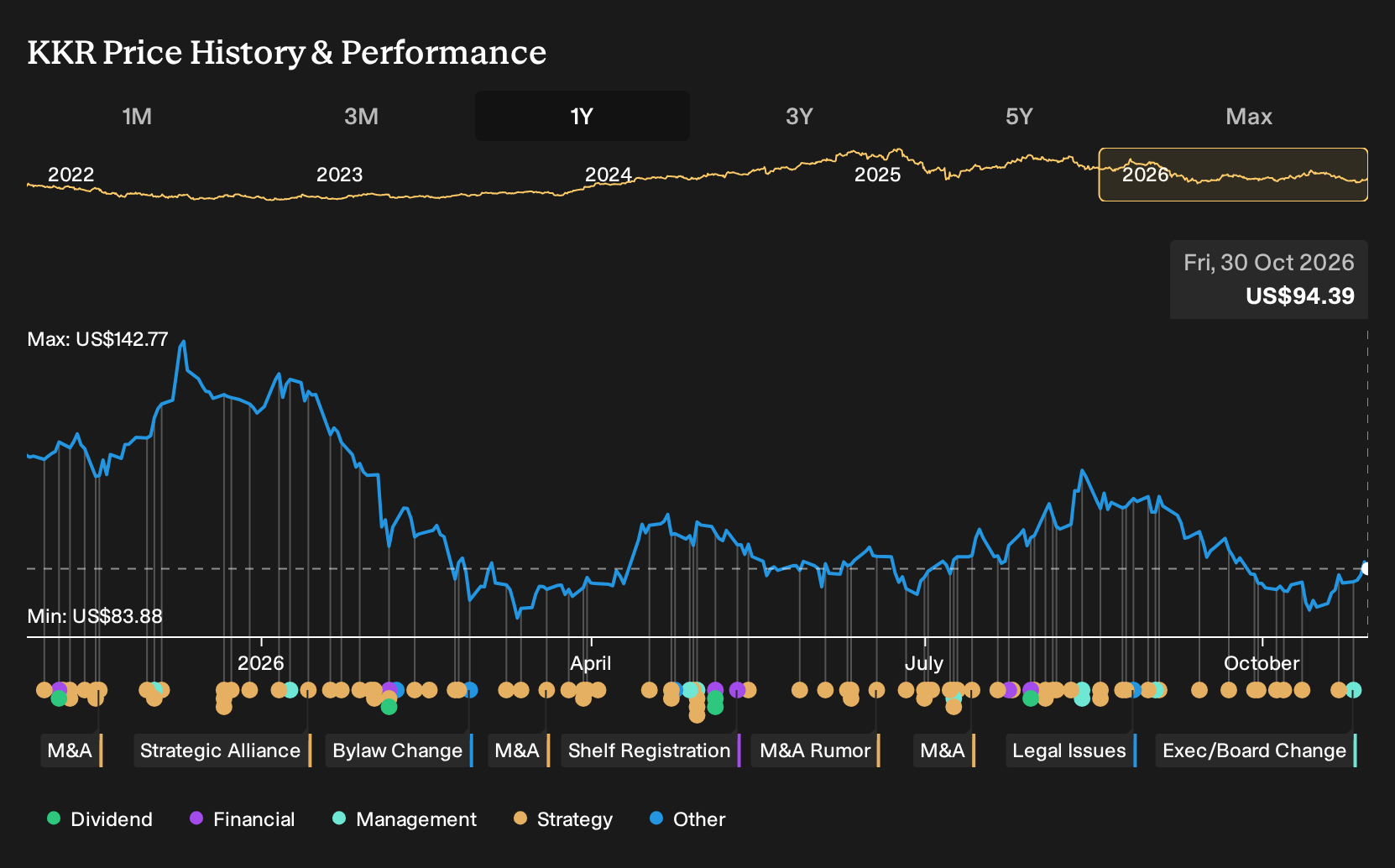
The Brian J. Lee appointment in late October 2026 looks most relevant here because it intersects directly with KKR leaning harder into discounted loans and structured credit. A former Chief Risk Officer from Goldman Sachs on the Audit and Risk Committees gives the firm additional experience around complex balance sheet issues at a time when loan markets have been under pressure.
For you as a shareholder, this is less about optics and more about execution on the current catalysts. KKR is pushing its credit and ABF platforms, where asset selection, portfolio surveillance and liquidity planning matter just as much as origination. Stronger board level risk oversight can support that build out, although the core questions around fundraising durability, fee levels and performance income timing still drive the medium term story.
KKR Analyst Assumptions And Valuation Check
Analysts are effectively sketching a very different earnings mix for KKR over the next few years. Their models fold in a sharp 28.6% yearly decline in revenue on one side and a steep improvement in profit margins from 11.6% today to 63.4% by 2029 on the other. That combination underpins a forecast that earnings could reach US$6.0b by 2029, compared with US$3.0b in earnings today, even as top line projections reset lower.
Those same forecasts imply that for the analyst price targets to stack up, KKR would be trading on a P/E of 25.2x 2029 earnings. This is lower than the current 27.0x multiple on the stock and also below the 39.7x multiple quoted for the wider US capital markets industry. This is framed against a consensus price target of US$125.69, with the highest forecast at US$166.00 and the lowest at US$97.00. At a current share price of US$89.96, that midpoint target sits 28.4% higher, so the gap between today’s quote and the analyst view is meaningful, even if the long range assumptions deserve close scrutiny.
KKR's narrative projects US$9.4b revenue and US$6.0b earnings by 2029. This involves a 28.6% yearly revenue decline and a doubling in earnings of about US$3.0b from US$3.0b today.
For you as an investor, the key piece is how these numbers line up with the discounted loan and CLO story discussed earlier. Higher assumed margins fit with a heavier tilt toward fee based credit strategies and structured products, where earnings today may be more influenced by recurring charges on assets under management than by transaction driven performance fees. At the same time, the projected revenue drop and margin expansion leave less room for error on asset quality and funding costs in credit, because missteps could push that 63.4% margin target out of reach.
These projections also rest on a modest 0.7% yearly increase in the share count over the next 3 years, which influences how that US$6.0b earnings pool flows through to earnings per share. The analyst template uses a discount rate close to 9.3% to pull those later cash flows back to today, so any change in perceived risk around KKR's private credit or asset based finance exposure can quickly move that rate and, in turn, the implied fair value range. For anyone following KKR closely, stress testing these revenue, margin and discount rate inputs against personal expectations is at least as important as the headline price target itself.
Uncover why KKR's fair value indicates a 33% potential upside to its current price, which could narrow quickly.
Exploring Other Perspectives
You could zoom in on one contrasting angle. The lowest analysts anchor on execution risk in asset management, even as KKR leans harder into discounted loans and CLOs. They penciled in about US$10.4b of 2029 revenue and US$6.2b of earnings before this news and still settled on a US$97.0 target. That gap shows how sharply views can differ, so treat this board change and CLO push as reasons to revisit several viewpoints, not just the average forecast.
Explore 5 other KKR fair value estimates, including one that indicates there could be as much as 11% downside from the current price.
Form Your Own Verdict
Don't just follow the ticker. Dig into the data and build a conviction that's truly your own.
- A great starting point for your KKR research is our analysis highlighting 4 key rewards that could impact your investment decision.
- See our latest analysis for KKR. The report includes a comprehensive fundamental analysis summarized in a single visual, the Snowflake, making it easy to evaluate KKR's overall financial health at a glance.
Looking For More Ideas Beyond KKR?
If the KKR story has you thinking more broadly about where to put fresh capital to work, it can help to line up a few contrasting watchlists. Use the Simply Wall St Screener to sort companies by quality, valuation and balance sheet strength so you are not relying on a single narrative.
- For investors who want potential mispricing with some quality filters on top, review a curated 33 high quality undervalued stocks that aim to pair reasonable pricing with stronger fundamentals.
- If resilience and capital preservation matter most to you, consider screening through a list of solid balance sheet and fundamentals (24 results) so you can focus on businesses with healthier financial footing.
- Income focused readers can scan a 5 dividend fortresses that concentrates on higher yielding payers while still keeping an eye on sustainability.
Have feedback on this article? Concerned about the content? Get in touch with us directly. Alternatively, email editorial-team@simplywallst.com