
What Raymond James Financial Stock Buybacks Mean For Shareholders
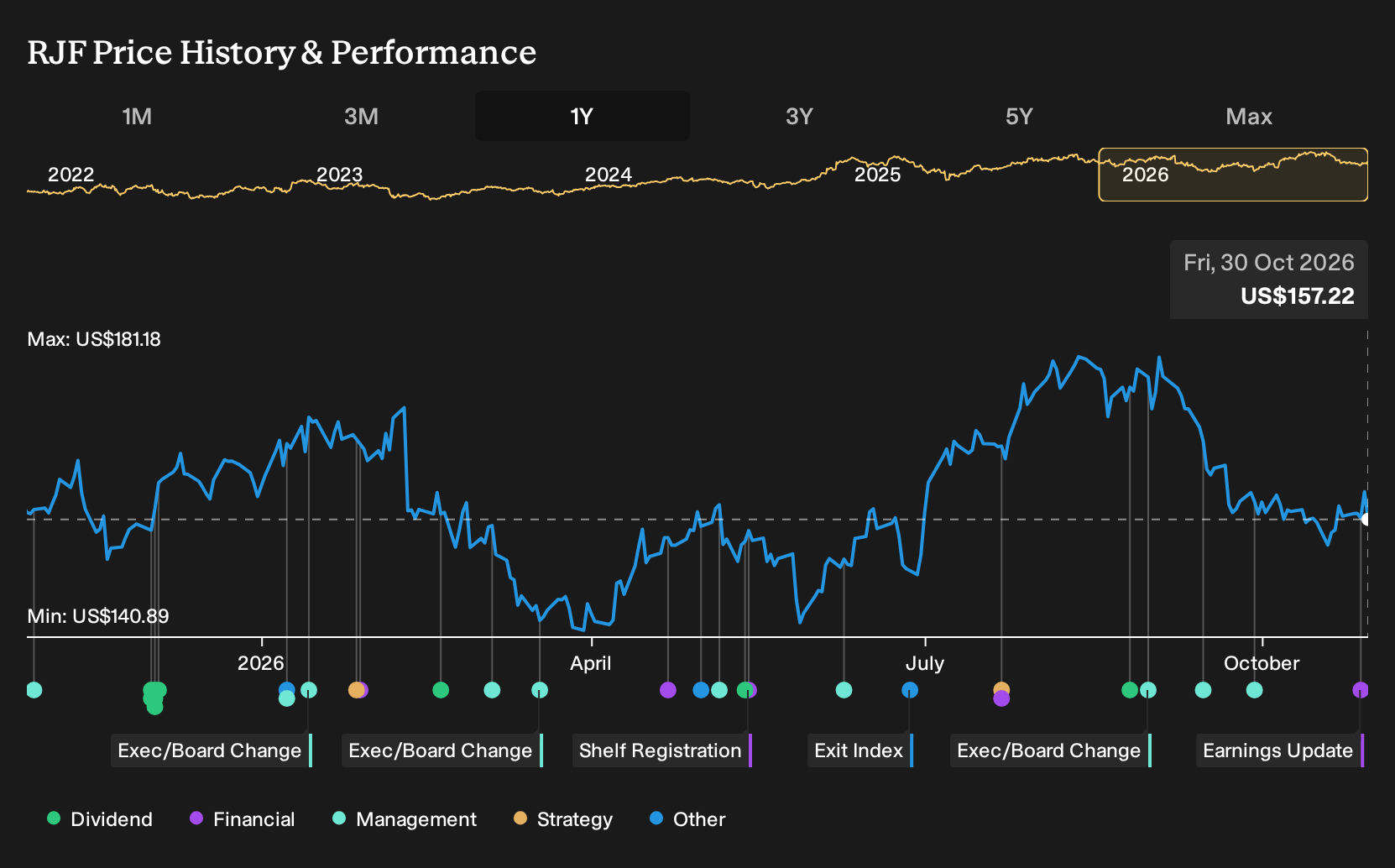
- Raymond James Financial reported its fourth quarter and full year 2026 results, with both periods showing higher revenue, net income, and earnings per share compared with the prior year, alongside completion of a US$949.28m buyback program initiated in December 2025.
- The mix of stronger earnings and ongoing share repurchases highlights management’s focus on using excess capital to support per share metrics and maintain financial flexibility, rather than pursuing the previously evaluated M&A option.
- The focus now turns to Raymond James Financial's broader investment narrative and how resumed buybacks after solid earnings may reshape that story.
Raymond James Financial Investment Narrative Recap
To own Raymond James Financial, you need to be comfortable with a fairly straightforward thesis. The group leans on advisor recruitment, expanding client assets and heavy technology spend to support fee based and interest income, while using excess capital for dividends and repurchases. The latest quarter, with higher revenue, net income and EPS versus last year, fits that operating story rather than changing it.
The near term swing factor still sits in market sensitive businesses like investment banking and fixed income trading, where tariff related uncertainty and rate moves can quickly affect activity. A key risk remains rising non compensation costs such as legal and professional fees, which could chip away at margins even if top line trends stay constructive.
The completion of the US$949.28m buyback program, covering 6,117,504 shares or 3.13% of the company, is the clearest operationally relevant update tied to this earnings release. Management had paused repurchases while weighing a potential M&A transaction. That process has now ended without a deal, which removes one source of short term uncertainty around capital deployment.
For you as a shareholder, the mix of solid reported earnings for both the quarter and full year and the resumption of buybacks ties directly into the existing catalysts. The story around advisor growth, fee based assets and AI driven productivity remains intact. The main watchpoints remain external markets and legal expenses, rather than the balance sheet or capital allocation discipline reflected in this completed program.
Analysts see Raymond James Financial reaching US$18.0b in revenue and US$2.7b in earnings by 2029, which implies 5.8% yearly revenue growth and an earnings increase of about US$0.4b from the current US$2.3b level.
Uncover why Raymond James Financial's fair value indicates an 18% potential upside to its current price that could narrow quickly.
Exploring Other Perspectives
Two fair value estimates from the Simply Wall St Community span a wide band, from US$186 at the low end to about US$277 at the top, which shows how far apart retail views on Raymond James Financial can sit. Consider this in the context of tariff related uncertainty, legal cost risks and resumed buybacks, then decide which camp you lean toward by exploring more of those community viewpoints.
Explore another Raymond James Financial fair value estimate, including one that suggests up to 76% upside from the current price!
Form Your Own Verdict
Disagree with existing narratives? Extraordinary investment returns rarely come from following the herd, so go with your instincts.
- A great starting point for your Raymond James Financial research is our analysis highlighting 5 key rewards and 1 important warning sign that could impact your investment decision.
- See our latest analysis for Raymond James Financial. The report includes a comprehensive fundamental analysis summarized in a single visual, the Snowflake, making it easy to evaluate Raymond James Financial's overall financial health at a glance.
Looking for more investment ideas beyond Raymond James Financial?
Once you have a handle on Raymond James Financial and its current valuation debate, it often helps to widen the lens and compare it with other companies that share traits you care about, whether that is value, resilience or income potential.
- If you are hunting for quality at a reasonable price, scan through a 33 high quality undervalued stocks that may match your sense of what constitutes a bargain backed by fundamentals.
- For investors who care most about strength in the balance sheet and earnings profile, check out the list of solid balance sheet and fundamentals (24 results) to see which businesses line up with that more conservative stance.
- If you want to get ahead of the crowd, track a 19 high quality undiscovered gems that pair robust financials with lower profile coverage before they attract wider attention.
Have feedback on this article? Concerned about the content? Get in touch with us directly. Alternatively, email editorial-team@simplywallst.com