
Binance was hacked for $6 billion and didn't break the market! Bitcoin holds steady near $78,000, and bulls are betting that the pullback is nearing its end
The Zhitong Finance App learned that the record cyber theft against Binance, the world's largest cryptocurrency exchange, did not trigger a panic sell-off of Bitcoin. In contrast, Bitcoin showed unexpected resilience after the incident.
As of Monday's press release, Bitcoin was basically flat at around $78,000, down about 5% from the high before Binance revealed the hacking incident last Thursday. This trend was generally attributed by the market to Binance's initial commitment to cover all losses and respond quickly with remedial measures.
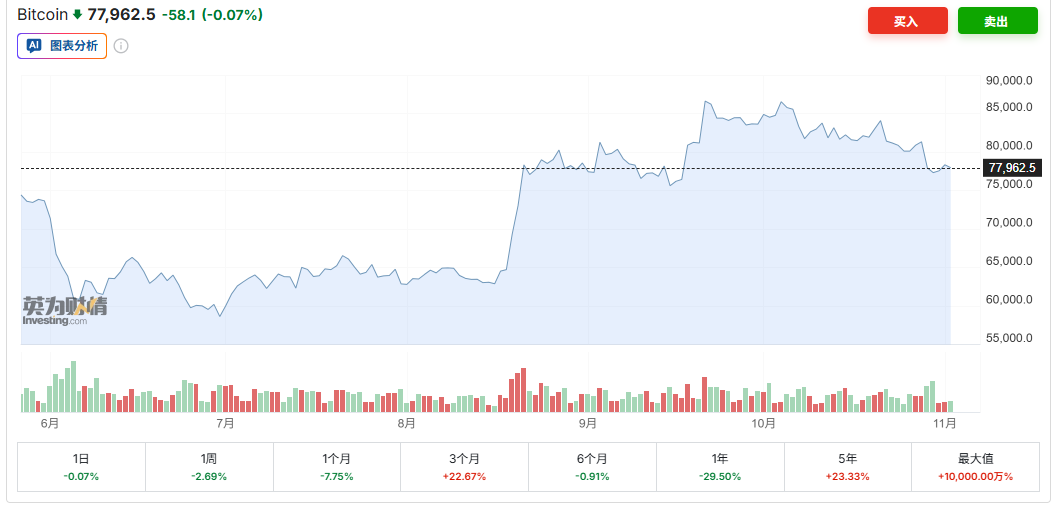
Orbit Markets co-founder Caroline Mauron said that Bitcoin held a critical level over the weekend, essentially a vote of confidence in Binance's statement. The market clearly believes that Binance has sufficient funds to cover losses.
Last week, Bitcoin was already under pressure due to the sell-off of risky assets, and its relatively strong performance was further highlighted. The way traders handled this incident was quite different from when FTX crashed in 2022. At the time, FTX, the second-largest exchange at the time, went from liquidity crunch to bankruptcy under Sam Bankman-Fried, and Bitcoin fell 19% in three days.
However, the tension underneath the surface of the market has not dissipated. Sean McNulty, a derivatives trader at market maker AQC Tech, pointed out that Binance's purchase of Bitcoin to make up for user losses is one of the reasons why Bitcoin's performance is stable, but the underlying sentiment is still uneasy.
He said that people see this incident as the tip of the iceberg. Considering the application of artificial intelligence (AI) in cyber attacks this year, it is expected that more hacking incidents will occur; “If Binance, the world's largest exchange, can be hacked, then no one is safe.”
The options market also reflects a rise in demand for short-term downside protection. According to options data from cryptocurrency derivatives platform Deribit, it is measured that the premium paid by traders is slightly higher than the one-day 25-delta bearish bias compared to betting on the same increase, rising by about 1 percentage point to 6.37 points within 24 hours.
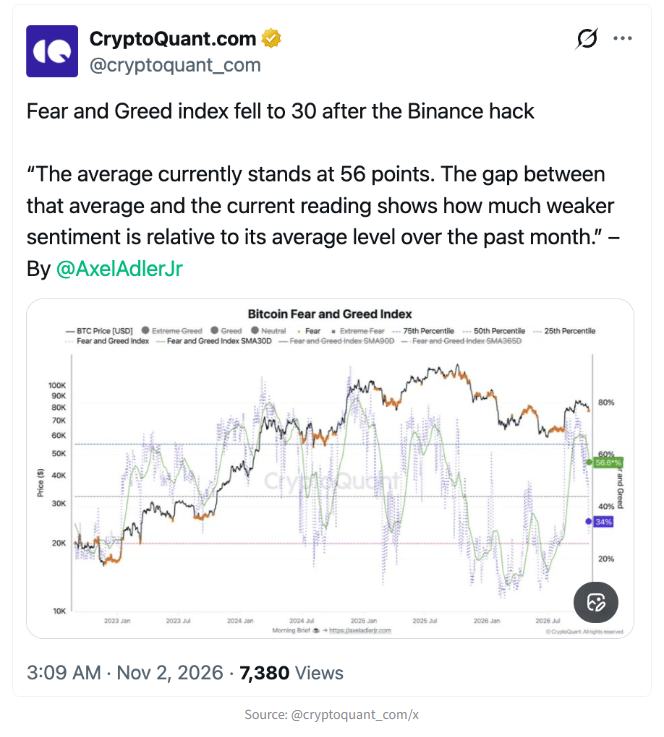
Meanwhile, Cryptoquant analyst Axel Adler pointed out that after the Binance hacking incident, the Fear and Greed Index dropped from an average level of 56 to 30, indicating that there is still uncertainty in the market. However, retail sentiment on Stocktwits is still in the “extremely bullish” range, and the popularity of related discussions has remained at a “normal” level over the past day.
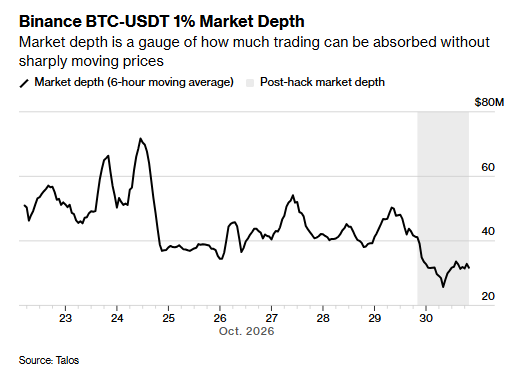
Kelly Ye, head of research at Talos, believes that the market sees this hacking incident as an “operational shock” rather than a “systemic shock.” She pointed out that the depth of the Binance order book once dropped by 25% to 30%, but buyers returned within a few hours, which is very different from the loss of confidence in the entire market in 2022. She also said that for institutions, the lesson is simple: no single trading place can safely hold risk or read prices.
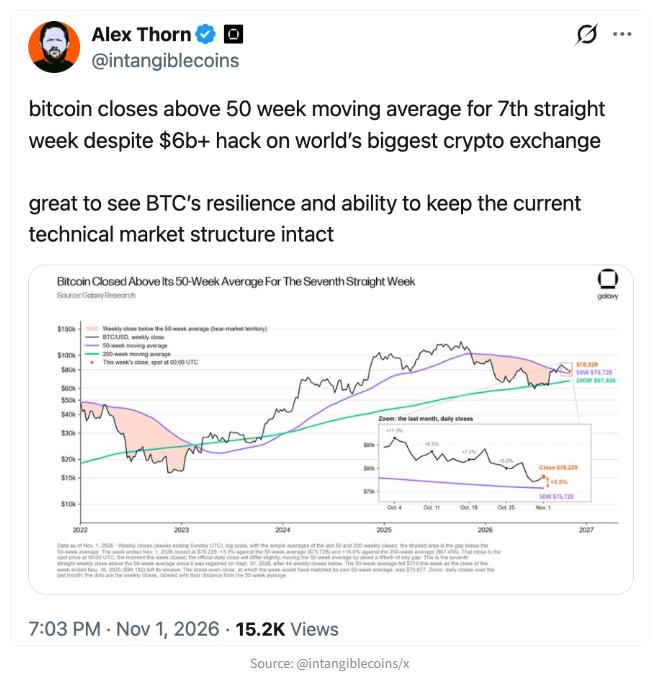
On the technical side, Galaxy Digital's Alex Thorn said that despite the world's largest crypto exchange being hacked over $6 billion, Bitcoin closed above the 50-week moving average for the seventh week in a row. He said that Bitcoin closed at $78,229 on Sunday, about 3.3% higher than the 50-week EMA of $75,728; Bitcoin regained that level on September 20 and had previously closed below it for 44 consecutive weeks.
Notably, the FBI said on Saturday that North Korea was responsible for the Binance theft, which occurred around October 29th. The FBI also linked the Binance and Bybit hacks to the North Korean hacker group TraderTraitor. Previously, the biggest crypto-related hacking incident was the theft of about $1.5 billion in Bybit in 2025; similar to the Binance incident, the Bybit hacking incident initially had a relatively mild impact on Bitcoin, but losses expanded over the next few days, and Bitcoin still fell by about 14% a week after the February 21 attack.
As for the aftermarket, analysts pointed out signs that this latest round of cryptocurrency pullback may be nearing its end.
MN Fund founder Michaël Van de Poppe said that as the US midterm elections approach and all parties are concerned about whether Bitcoin can maintain its recent technical strength in the last two months of the year, political uncertainty may also have been digested by the market. He believes that the US midterm elections “will not constitute a major event,” and judged that Bitcoin is at the end of the pullback, although it may still break another low in the next few weeks.
He also added that expectations for the last two months of this year were bullish and pointed out that the cryptocurrency market sentiment had quickly turned “extremely bearish,” but he didn't think this sentiment was reasonable.
However, ViaBTC chief analyst Jeff Ko still warned that changes in party control in Congress “may have a significant impact on how to advance the cryptocurrency market structure legislation”, which may be a larger variable facing the cryptocurrency market in the short term. According to information, the US midterm elections will be held on Tuesday local time.
Analyst Willy Woo pointed out from a relative performance perspective that Bitcoin fell 2.9% last week, while gold fell 3.0%, and ETF holders sold $643 million during the same period; he said, “Bitcoin is in a bull market.”
Meanwhile, cryptocurrency analyst Ted Pillows also mentioned that Bitcoin experienced five times of decline of more than 30% in the 2019 to 2021 bull market, and fell by more than 25% four times between 2023 and 2025. “We are currently only in the midst of the first pullback in this bull market.”