
3 Australian Founder Led Stocks With Up To 25% Earnings Growth
AI related demand is testing factory capacity and pushing up costs, which puts a premium on leaders who can move quickly, control spending and keep focus when conditions change fast. Founder led Australian companies often have that direct owner mindset, where the person in charge has real skin in the game. This article highlights three stocks backed by their original builders so you can assess whether this style of leadership fits your portfolio.
The three stocks highlighted here offer a compelling starting point if you want exposure to founder led businesses where leadership is directly aligned with shareholders. However, if you want the strongest names, these 7 top founder-led companies are at the top of the list.
Flight Centre Travel Group (ASX:FLT)
Flight Centre Travel Group is still shaped by founder Graham Turner’s owner mindset, with leisure and corporate travel brands that keep the business close to customers rather than distant from day to day operations.
Flight Centre Travel Group runs a founder influenced travel retail and management network, earning about A$1.4b from leisure travel, A$1.2b from corporate clients and A$248 million from Global HQ activities, with a market value of roughly A$2.4b.
"Although Flight Centre is reallocating capital toward cruise, luxury, Meetings & Events and foreign exchange, the recent guidance cut linked to a mix shift toward lower margin carriers highlights a risk that product mix and supplier choice continue to dilute yield, which can cap revenue per transaction and keep operating margins under pressure."
What happens if a single cost reclassification trend quietly reshapes how much of each travel dollar actually lands in long term shareholder returns?
That quiet shift in the plumbing of returns is exactly what the full narrative for Flight Centre Travel Group unpacks, showing where mix pressure could be masking Flight Centre Travel Group’s next leg of momentum.

Harvey Norman Holdings (ASX:HVN)
Harvey Norman Holdings gives this founder led screener real weight, with Gerry Harvey and family still steering the retail and franchise engine that underpins its broader mix of property, digital systems and other income producing assets.
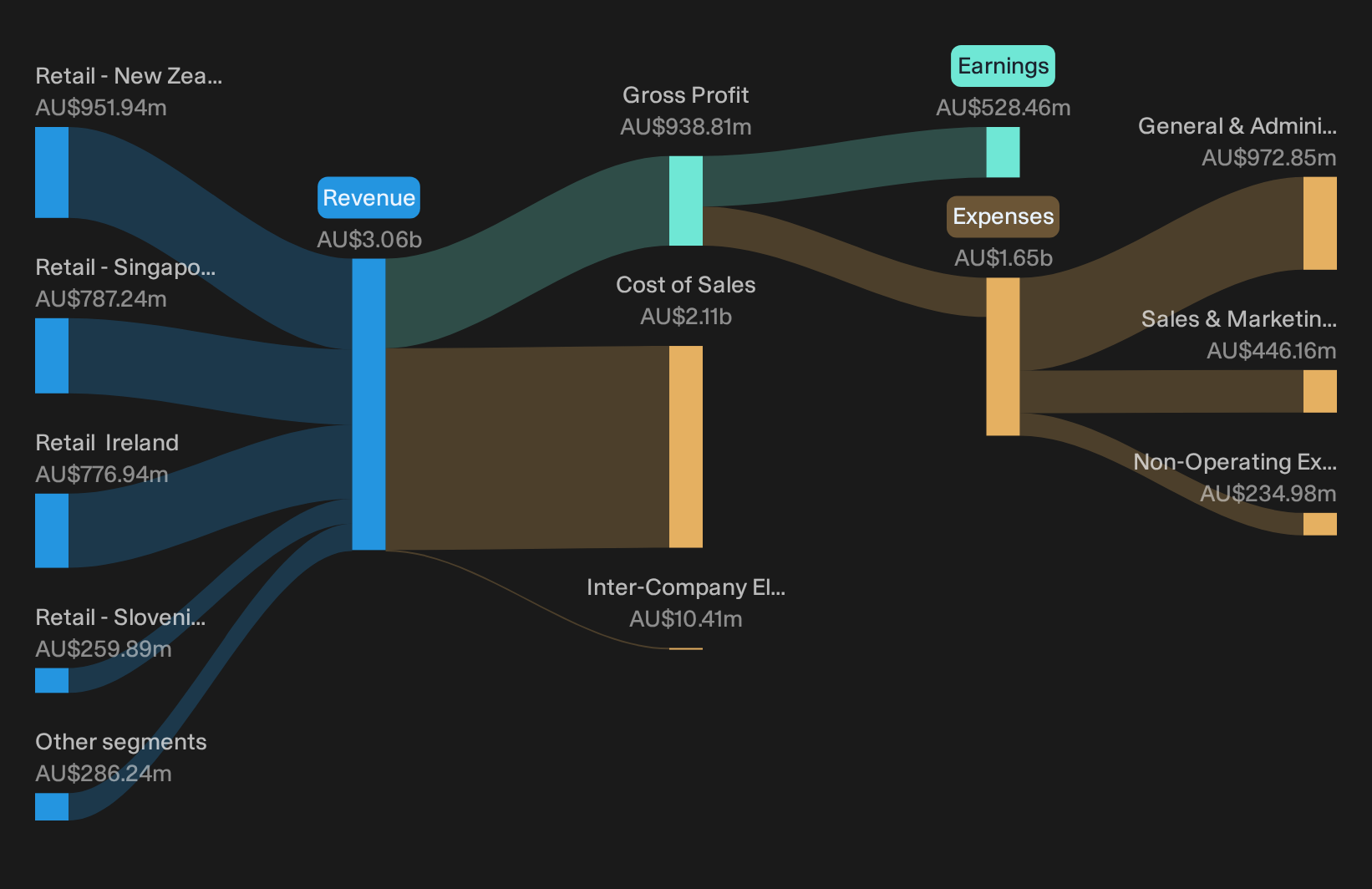
Harvey Norman Holdings runs a founder influenced retail and franchise group focused on furniture, bedding, electronics and IT, generating about A$952 million in New Zealand, A$777 million in Ireland, A$787 million in Singapore and Malaysia, A$260 million in Slovenia and Croatia, A$232 million from non franchised outlets and holding a market value near A$5.1b.
"It is worth noting, however, that just over 20% of 2025 profit can be attributed to property revaluations, non-cash gains that can be volatile and are not recurring operational earnings."
What really tests the Harvey Norman founder model now is how one less visible pressure shapes the balance between property wealth and retail cash flow.
That quiet shift in emphasis is exactly what the full narrative for Harvey Norman Holdings unpacks, showing where accelerating property gains might be masking how core retail returns evolve from here.
GenusPlus Group (ASX:GNP)
GenusPlus Group gives this founder led screen direct exposure to the nuts and bolts of the energy transition, with the Energy and Engineering arm connecting solar, wind and storage projects, while the wider Infrastructure and Services divisions keep revenue spread across more traditional rail, telco and utility work.
GenusPlus Group generated about A$837 million from Infrastructure, A$368 million from Energy and Engineering and A$152 million from Services, with corporate and other items reducing this, and holds a market value near A$1.7b.
For investors looking at founder led clean energy infrastructure, GenusPlus Group offers something very concrete, a business that actually builds and maintains the power lines, substations and storage links the grid now depends on.
"Although GenusPlus Group points to multi year opportunities in renewables and storage, the move to scale up battery, solar and substation work requires more complex engineering and project management, and the current comment that Energy & Engineering margins are a little bit low suggests execution pressures could restrain segment EBITDA if these projects prove harder to deliver profitably."
The real test for GenusPlus Group now is how one subtle shift in project pricing power shapes the balance between growth and future earnings quality.
That tipping point is exactly where the full narrative for GenusPlus Group shows how accelerating grid work, contract mix and capital discipline could reshape GenusPlus Group’s long run earnings power.

Seeking Alternatives Before The Crowd?
Fresh ideas move first. Markets may reward those who spot quiet momentum before it turns into a full breakout and leaves latecomers caught chasing. Scan these under the radar lists while it matters and consider acting early.
- Target steadier income streams by checking dividend heavyweights in the 4 dividend fortresses that aim to keep cash yields flying while others chase short lived stories.
- Hunt for future compounders by reviewing the 15 high quality undiscovered gems that sit off most radars for now but could gain momentum once attention shifts.
- Position ahead of critical infrastructure spending by combing through the 43 power grid technology and infrastructure stocks that focus on networks and hardware keeping electricity flowing as demand keeps building.
Have feedback on this article? Concerned about the content? Get in touch with us directly. Alternatively, email editorial-team@simplywallst.com