
Arbitrage trading can still make money, but the era of “lying and winning” may be over! Citi warns of risk of narrowing interest spreads
The Zhitong Finance App learned that Citigroup's US foreign exchange trading team expects that although it may be difficult to replicate the impressive returns of the previous period, it will continue to provide investors with profit opportunities. Fuad Muvdi, head of foreign exchange trading at Citigroup America, said that such transactions will still benefit from higher interest rates in emerging markets by borrowing low-yield currencies and then investing capital in markets with higher returns. Meanwhile, after Federal Reserve officials decided not to raise interest rates last week, he expected the dollar to weaken slightly.
Citigroup's bond, foreign exchange and commodities trading division reported the best third-quarter results in at least ten years, with revenue reaching US$4.4 billion. Among them, the volume of foreign exchange transactions was strong, offsetting the impact of the relatively weak performance of the interest rate trading business.
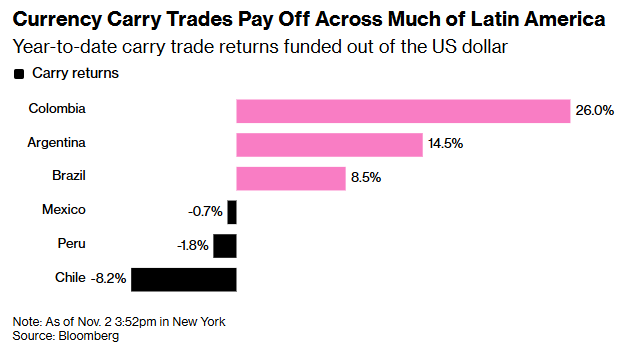
Currency arbitrage transactions have paid off in most parts of Latin America
The data shows that so far this year, the return on arbitrage transactions going long on the Colombian peso and shorting the US dollar is about 26%. Similar trading strategies for Argentine pesos and Brazilian reais have returns of over 14% and around 8.5%, respectively. However, the possibility of further interest rate hikes in some countries may reduce interest spreads between low-yield currencies and high-yield currencies, thereby weakening the returns on arbitrage transactions.
Citi remains optimistic about the performance of the Colombian peso, Brazilian real, and Argentine peso against the US dollar. However, this strategy is unlikely to reap the same strong returns as in recent years. “I still believe in the arbitrage trading strategy,” he said. But if I were to ask, would I bet all my risk exposure on this strategy today? No, I don't think this should be done.”
Fuad Muvdi pointed out that continued US inflation may cause the market's expectations of the US interest rate outlook to become more hawkish, which is a risk worth watching. He said, “Interest rate spreads may begin to narrow, leading to a natural correction in many of these currencies.”
Although there are still fluctuations surrounding Brazilian President Lula's quest for re-election, Fuad Muvdi believes Brazil is still one of the markets with room to rise. He said that the local interest rate in Brazil is around 15%, and even if the Brazilian real remains stable, investors can still obtain considerable additional income.
When talking about other markets, he said that market participants are becoming more cautious and selective. Mexico is one of the markets where Citi has observed that investors are beginning to “fall back in the bag.” “There is so much noise in the current market, and investors need to keep an eye on factors unique to each local market rather than see it as a trading strategy to buy and then ignore it,” he said.