
How Bauxite Expansion Plans At Rio Tinto (LSE:RIO) Have Changed Its Investment Story
- Rio Tinto Group has committed A$1.9b to develop the Kangwinan bauxite project in Queensland and advanced work on a large-scale Rondo Heat Battery study at its Yarwun alumina refinery, supported by staged funding from ARENA.
- The Kangwinan project is designed to replace aging bauxite capacity while lifting Weipa Operations’ output, and the Yarwun thermal storage study explores lower carbon heat for alumina refining, together highlighting how Rio Tinto manages long-life assets and energy costs.
- We will now look at how Rio Tinto Group’s investment narrative is influenced by the Kangwinan bauxite commitment and the Yarwun energy study.
Rio Tinto Group Investment Narrative Recap
To own Rio Tinto Group, you need to be comfortable with a long-cycle, capital-heavy miner that leans on disciplined project delivery, stable volumes and productivity gains rather than rapid growth. The Kangwinan spend and Yarwun study both sit within that pattern and do not change the main near-term swing factor, which is execution across the broader copper, iron ore, aluminium and lithium project slate.
The biggest risk still sits in ESG and operating setbacks, from class actions and community issues to outages at sites like Kennecott or Oyu Tolgoi. Kangwinan partly addresses resource replacement and cost efficiency, but it also adds more capital at work that could be exposed if approvals, social licence or logistics run into problems.
The A$1.9b Kangwinan decision is the clearest recent move that matters most for the current Rio Tinto Group story. It is framed as replacement capital, aimed at keeping Weipa bauxite output available for alumina refineries and export customers while older mines wind down, rather than a pure volume grab.
For you as an investor, the link to catalysts is straightforward. Delivery on Kangwinan at the forecast 22% internal rate of return, alongside the wider US$1.8b productivity ambition, would support the idea that Rio Tinto Group can keep refreshing its ore base while holding unit costs in check. Any construction delay, cost overrun or ESG disruption at Kangwinan would feed directly into the operational and legal risks already on the radar.
Rio Tinto Group Analyst Assumptions and Valuation Anchor
For Rio Tinto Group, the analyst framework that sits behind the Kangwinan and Yarwun story leans heavily on slow and steady compounding rather than big step changes. Consensus currently builds in revenue expansion of about 2.8% a year over the next three years, paired with profit margins moving from 19.6% today to 23.8% by around 2029. On earnings, the group of forecasters is working off current profit of about US$12.1b and a central estimate of US$15.9b by 2029, with a wide spread either side that runs from US$12.4b to US$21.5b.
The jump from US$12.1b to US$15.9b implies an earnings increase of roughly US$3.8b, which is a meaningful lift but not a transformation sized move for a miner of Rio Tinto Group’s scale. Set against a 2.8% annual top line growth rate and a higher margin profile, that earnings bridge effectively asks the business to squeeze more profit from each dollar of future revenue rather than rely on a surge in volume. For anyone watching Kangwinan and the Yarwun heat project, this context matters because it frames those investments as part of a broader push to keep margins firm while refreshing ore bodies and managing energy costs.
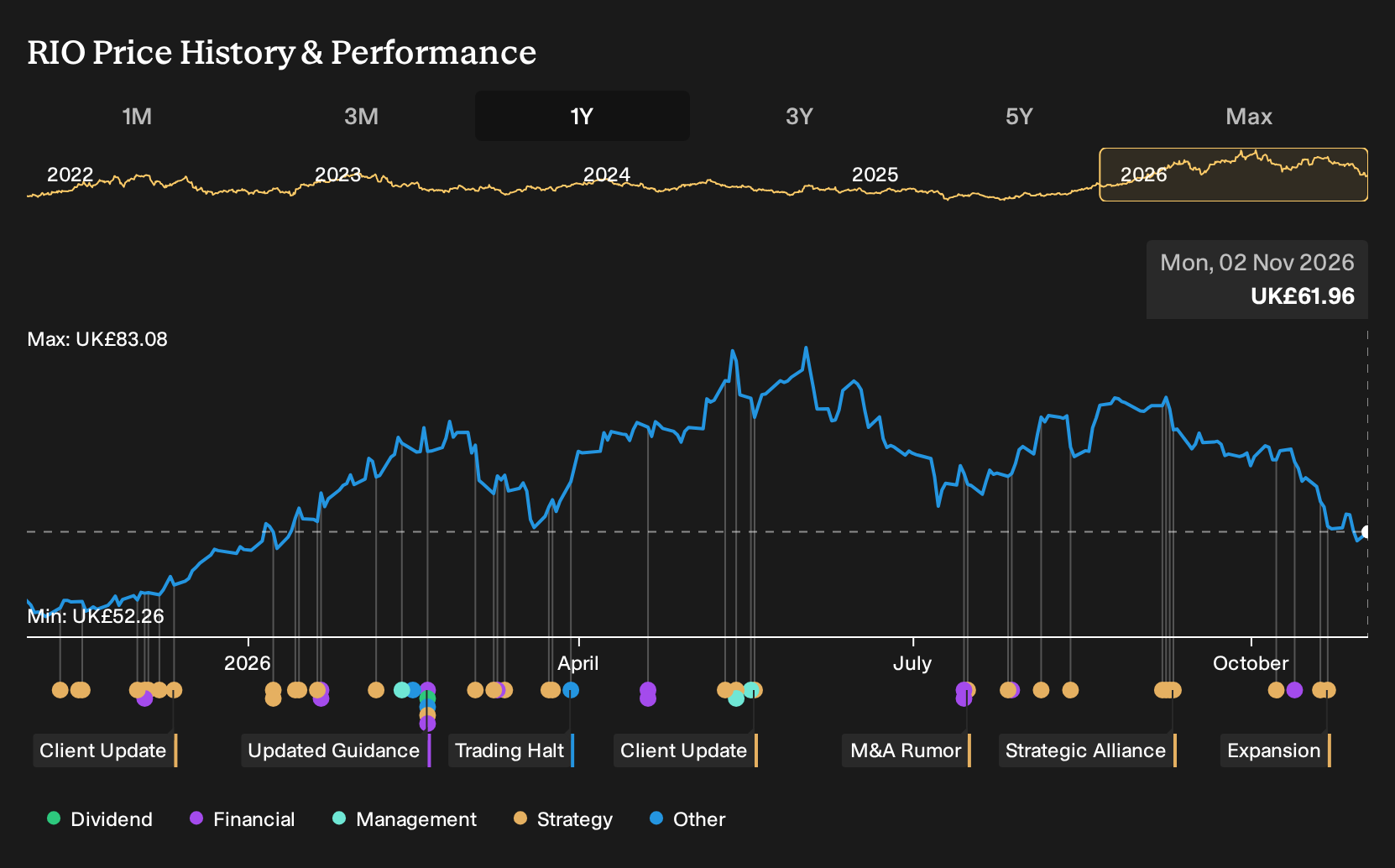
On the valuation side, the consensus anchor assumes that by 2029 Rio Tinto Group can generate about US$67.1b of revenue and US$15.9b of earnings. Analysts link that profile to a P/E ratio of 13.6x on those 2029 profits, compared with about 11.0x today and roughly 10.8x for the wider GB metals and mining group. The price targets that fall out of this work, with a central mark of £75.37 versus a recent share price around £60.94, reflect that higher multiple assumption as much as they reflect any change in absolute earnings. This is why your own view on how much investors might be willing to pay for those future cash flows matters just as much as your view on Rio Tinto Group’s project execution.
Rio Tinto Group's narrative projects US$67.1b revenue and US$15.9b earnings by 2029. This setup uses 2.8% yearly revenue growth and an earnings increase of about US$3.8b from current earnings of US$12.1b.
Uncover why Rio Tinto Group's fair value indicates a 22% potential upside to its current price. This discount could close faster than many expect.
Exploring Other Perspectives
One alternate view puts legal and ESG risk at the centre instead of project upside. Those cautious analysts were working off 2029 revenue of about US$55.2b and earnings of US$12.4b before this Kangwinan and Yarwun news, which is far more pessimistic. Use that gap as a prompt to explore how your own expectations might shift from here.
Explore 6 other Rio Tinto Group fair value estimates, including one that suggests up to 16% downside from the current price.
The Verdict Is Yours
Don't just follow the ticker; dig into the data and build a conviction that's truly your own.
- A great starting point for your Rio Tinto Group research is our analysis highlighting 3 key rewards and 1 important warning sign that could impact your investment decision.
- See our latest analysis for Rio Tinto Group. The report includes a comprehensive fundamental analysis summarized in a single visual, the Snowflake, making it easy to evaluate Rio Tinto Group's overall financial health at a glance.
Looking for more investment ideas beyond Rio Tinto Group?
If the Rio Tinto Group story has sharpened your view on long-life assets, capital discipline and risk, it can help to cross-check that thinking against a wider watchlist. The Simply Wall St Screener can surface very different types of opportunities, while still letting you filter for the balance sheet strength, income profile or risk level that fits your own plan.
- For investors who want potential mispricing with quality in mind, start with a focused set of 13 high quality undervalued stocks that already clear basic fundamentals checks.
- If your priority is resilience and sleep-at-night balance sheets, filter for companies that show up in the 5 resilient stocks with low risk scores and see which ones fit your risk tolerance.
- Those hunting for growth that is still off most radars can scan a curated pool of 5 high quality undiscovered gems and build a watchlist before the crowd arrives.
Have feedback on this article? Concerned about the content? Get in touch with us directly. Alternatively, email editorial-team@simplywallst.com