
Should Return To Profit Require Action From Celanese (CE) Investors?
- Celanese reported third quarter 2026 sales of US$2,556 million, net income of US$74 million and basic earnings per share of US$0.67, compared with a net loss and basic loss per share a year earlier.
- The shift from a prior period loss to positive earnings suggests that recent cost, mix and operational moves at Celanese are now showing up in headline profitability metrics.
- The focus now turns to how this return to profitability shapes Celanese's broader investment narrative and long term earnings story.
Scan how Celanese’s return to positive earnings compares with other industrials showing improving profit stories by reviewing the hand picked 34 high quality undervalued stocks.
Celanese Investment Narrative Recap
For an investor to stay with Celanese, the core belief is that the chemicals platform can turn volume pressure, inventory work downs and footprint changes into steadier earnings over time. The third quarter move back to profit gives some evidence that cost measures and mix efforts are starting to matter, even with revenue essentially flat year on year.
The key near term swing factor remains execution on the US$80 million to US$100 million cost reduction and footprint program while demand in acetate tow and Engineered Materials stays patchy. The biggest risk is that customer destocking and inventory absorption costs in nylon and acetyls persist, which could offset the recent profit improvement reported in this quarter.
The recent third quarter 2026 earnings release is the clearest data point to weigh against that thesis. Celanese reported sales of US$2,556 million, net income of US$74 million and basic earnings per share of US$0.67. A year earlier, the business reported a net loss and a basic loss per share instead, so the shift in reported profitability is substantial in dollar terms.
For catalysts, this return to earnings puts more focus on whether working capital, plant closures and Engineered Materials integration can lift free cash flow enough to handle interest costs and debt reduction. The risk is that equity income from joint ventures and pricing in acetate tow stay weak, which would leave quarterly profit more exposed to any stumble in those cost and footprint actions.
Celanese's narrative projects US$10.0 billion revenue and US$738.3 million earnings by 2029. This assumes revenue stays broadly flat and requires an earnings increase of about US$1.9b from current earnings of a US$1.2b loss.
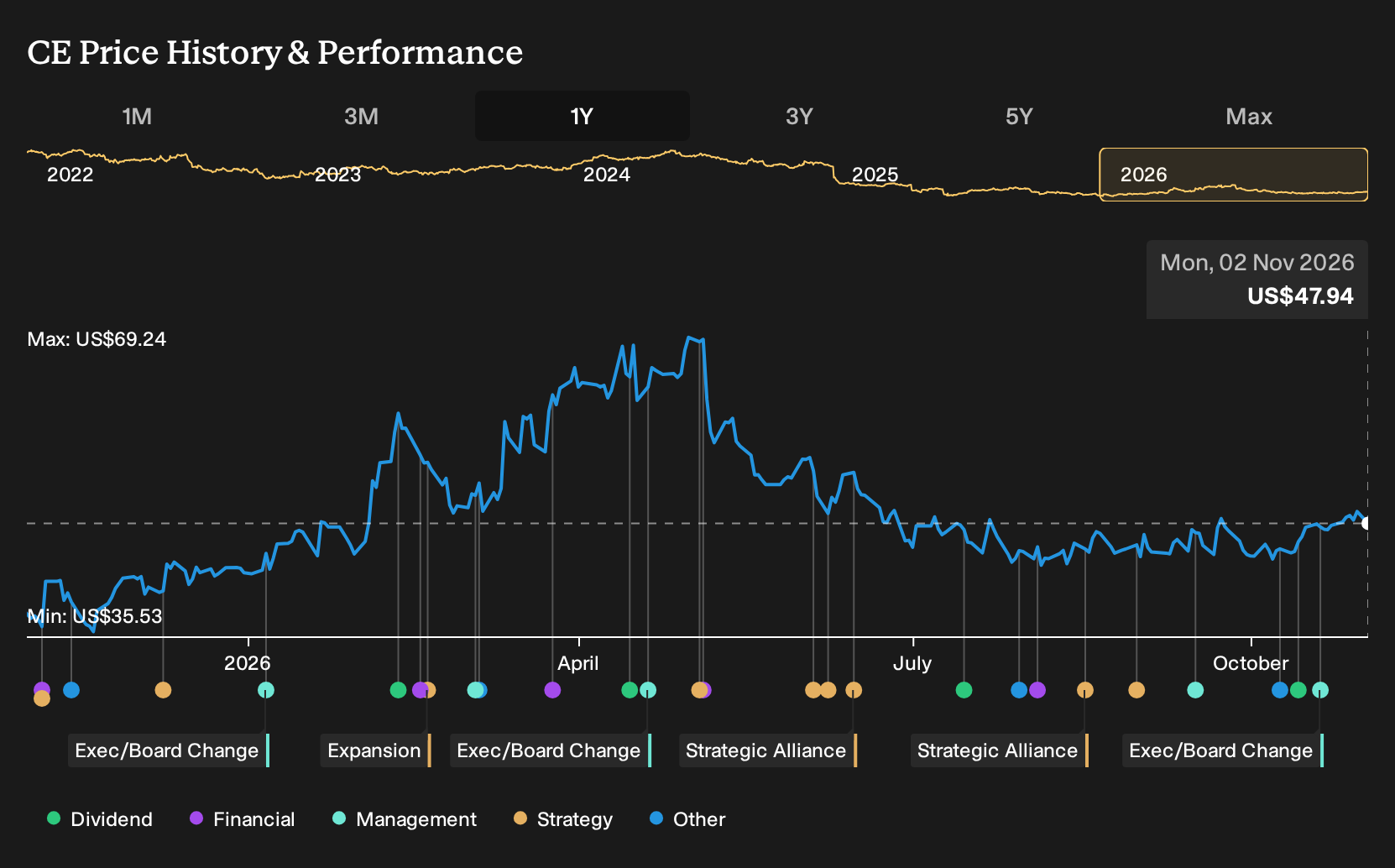
Uncover why Celanese's fair value indicates a 27% potential upside to its current price that could narrow quickly.
Exploring Other Perspectives
Some of the most optimistic analysts frame working capital and cash as the real swing factor for Celanese, not just quarterly profit. Before this earnings release, the bullish group was modeling revenue of about US$11.1b and earnings of roughly US$1.1b by 2029. You can compare that cash heavy story with other viewpoints and decide where you sit.
Explore 3 other Celanese fair value estimates, including one that suggests as much as 143% potential upside from the current price.
Decide For Yourself
Disagree with existing narratives? Extraordinary investment returns rarely come from following the herd, so consider your own analysis and judgment.
- A great starting point for your Celanese research is our analysis highlighting 3 key rewards and 1 important warning sign that could impact your investment decision.
- See our latest analysis for Celanese. The report includes a comprehensive fundamental analysis summarized in a single visual, the Snowflake, which makes it easier to evaluate Celanese's overall financial health at a glance.
Looking for more Celanese style investment ideas?
If this Celanese review has sharpened your thinking, you can use the Simply Wall St screener to look for other stocks that fit the kind of portfolio you want to build, rather than relying on whatever is in the headlines today.
- If capital preservation and smoother returns matter most to you, start with a group of 29 resilient stocks with low risk scores that score well on resilience and downside control.
- If balance sheet strength is your priority, filter for companies on the list of solid balance sheet and fundamentals (24 results) to see which businesses pair low leverage with solid fundamentals.
- If you prefer to back under followed stories, scan the 19 high quality undiscovered gems to find lesser known stocks with fundamentals that might justify a closer look.
Have feedback on this article? Concerned about the content? Get in touch with us directly. Alternatively, email editorial-team@simplywallst.com