
Hit the brakes after five consecutive interest rate hikes? The Chairman of the Reserve Bank of Australia sent a “wait and see” signal, and the Australian dollar fell in response
The Zhitong Finance App learned that Australian Federal Reserve Chairman Michelle Bullock hinted at a wait-and-see attitude towards further austerity after policymakers voted to raise the benchmark interest rate to an 18-year high to curb inflation. The Australian dollar then fell.
At a press conference in Sydney on Tuesday, Bullock stressed that the scale of this year's austerity has yet to be transmitted to the economy. Prior to her remarks, the nine-member Monetary Policy Committee raised the cash rate by 25 basis points to 4.85%. This is the fifth rate hike this year, continuing the most aggressive cycle of austerity in developed economies.
She stressed that the impact of recent rate hikes has yet to be felt, and said “the last two rate hikes haven't even begun to be transmitted.”
However, she added that the tightening policy is already curbing demand, and demand is beginning to “rebalance with respect to the slowdown in supply.”
Traders and economists interpreted her remarks as dovish. The Australian dollar weakened against the US dollar as traders lowered their expectations for further rate hikes.
Catherine Palmer, head of fixed income strategy at BlackRock Australia, said: “The challenge facing the RBA is that inflation remains stagnant and growth momentum is beginning to slow. As the full effects of this year's austerity policies are still being transmitted in the economy, we expect the Australian Federal Reserve to stand still here, evaluating new data and policy transmission while retaining the option of further austerity if inflationary pressure does not ease.”
Australia's interest rate hike comes at a time when the Bank of Sweden is also likely to raise interest rates this week, and the Bank of England is expected to raise borrowing costs for the first time in three years. Economies of all countries are struggling with the impact of energy-driven inflation. Last month, as officials became more hawkish in their public statements, and the popular CPI report, the market's expectations for the Federal Reserve's interest rate hike heated up sharply.
Consumer prices showed little sign of falling back to the central bank's target range of 2% to 3%. Federal Reserve Bank of Australia officials are worried that inflation expectations may begin to get out of control. Deputy Governor Andrew Hauser pointed out that more and more companies believe that 3% to 3.5% inflation is the “new normal,” and he called this scenario a “central bank nightmare.”
The Federal Reserve Board of Australia said: “The corporate communication survey shows that many companies are facing cost pressure and have either raised the prices of goods and services as a result, or are planning to do so.”
In addition to the impact of soaring fuel prices, Australia has also become more prone to inflation due to extremely weak productivity. This has forced officials to lower the potential growth rate, the level of expansion the economy can maintain until inflationary pressure arises.
Since the end of 2021, the RBA has failed to reach the midpoint of the 2.5% inflation target range. Under its dual mission, the central bank also seeks to achieve maximum sustainable employment. Bullock has hinted that this year's rise in unemployment will not be enough to ease inflationary pressure, highlighting the trade-off between these two goals.
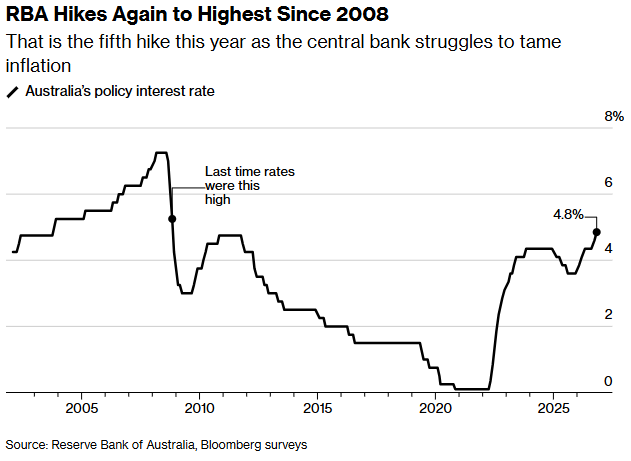
The Reserve Bank of Australia raised interest rates again, and interest rates reached the highest level since 2008
The central bank also released quarterly economic forecast updates in the “Monetary Policy Statement” on Tuesday. The forecast shows that potential inflation will return to the Reserve Bank of Australia's 2% to 3% target range about six months later than the August assumption. The economy is expected to slow down in 2027, and the unemployment rate will rise.
The Federal Reserve Bank of Australia now believes that the financial situation is “restrictive” and says that despite rising unemployment, the labor market situation is “still slightly tight.”
In addition to the gradual rise in the unemployment rate, the aggressive austerity of the Reserve Bank of Australia has also triggered a sharp cooling of the real estate market, which is a key mechanism for the transmission of monetary policy.
According to data from real estate consulting firm Cotality, housing prices in major Australian cities plummeted 1.4% in October, and this once prosperous industry is on its way to its biggest drop in 40 years.
The Federal Reserve Board of Australia said in a statement: “The economy is slowing down, housing prices are falling sharply, and the unemployment rate is rising. Higher interest rates and lower housing prices and turnover are expected to slow down growth in residential investment and household consumption.”
Security Group's Shane Oliver (Shane Oliver) believes that the downturn in the housing market will drag down economic growth through the so-called wealth effect, although this impact is not enough to divert the attention of the Federal Reserve of Australia from high inflation. He expects that by the second half of next year, this downturn will become a more important factor to consider.