
When the market asks if computing power returns cash flow to continue to support the premium? Strong demand for iPhones helped Apple (AAPL.US) profits exceed expectations Goldman Sachs invests in bullish research reports
The Zhitong Finance App learned that US consumer electronics giant Apple (AAPL.US) announced its results report for the fourth quarter of the 2026 fiscal year ending September 26 on Tuesday morning, Beijing time, and held a performance conference call shortly thereafter — this is also the first performance conference call since John Tenus became Apple's CEO. Wall Street financial giant Goldman Sachs sent a bullish research report to Apple soon after the results were announced. In the financial review, the Goldman Sachs analyst team determined that the performance of iPhone, Mac, and resilient gross margins should support the rise in stock prices and maintain the optimistic target price of “buy” and the 12-month target price of 390 US dollars. Based on the day's closing price of $338.32, Goldman Sachs's target price implied a potential increase of 15.3% over the next ten months, corresponding to a potential market value of about 5.67 trillion US dollars.
The key to Apple's financial data is that after the price increase for high-end products, the overall sales data for Apple's ecological products and demand for Apple's high-end product line are more resilient than Goldman Sachs anticipated; however, during the upcoming Christmas+New Year's Day holiday season, further increases in memory chip prices and Siri AI's cloud operating costs will erode the actual profit from every dollar of sales. In the fourth quarter of fiscal year 2026, Apple's revenue increased 12% year over year to US$114.477 billion, and diluted earnings per share (EPS) increased 14% to US$2.10, all exceeding the optimistic expectations of the Goldman Sachs analyst team. When Apple's earnings data first came out, the stock price was basically flat. The phone call revealed that the profit margin outlook for the holiday season may be relatively weak, then it once fell by about 4%, and the decline hovered around 3% during the night trading period.
Apple's stock price can be described as being very resilient when global technology stocks have plummeted recently. Compared to big tech giants such as Google's parent company Alphabet and Amazon and Facebook parent company Meta, the parent company of Facebook, who have frantically issued loans to buy AI computing power infrastructure, and the long-term steady free cash flow of these giants has turned significantly into a negative range under the AI infrastructure frenzy, Apple's continued strong free cash flow data has won a market premium.
Why was Apple's stock price able to buck the trend and outperform the NASDAQ 100 and Philadelphia Semiconductors amid the collapse in global technology stocks?
The US stock market closed from October 23 to 30. Apple's stock price fell 0.89%. The Nasdaq 100 Index, which has the title of “Global AI Trading and Technology Stock Weather Vane,” fell 1.98%, and Apple outperformed by about 1.09 percentage points. In particular, “Apple's stock price bucked the trend and outperformed the AI trading theme and a broad range of technology stocks” was the two trading days from October 29 to 30: Apple rose 0.23% cumulatively, while the NASDAQ 100 Index and the Philadelphia Semiconductor Index fell sharply by 4.79% and 8.52%, respectively.
Apple's stock price has rebounded by about 24% from its June low before earnings reports, increasing its market value by about 1 trillion US dollars. The price-earnings ratio is expected to rise 36 times over the next 12 months, the highest level since 2008. Underpinning this relatively strong round is verifiable cash returns: Apple's operating cash flow for the 2026 fiscal year was US$145.097 billion. After deducting US$9.041 billion in fixed asset cash expenses, free cash flow was approximately US$136.056 billion, an increase of 37.8% over the previous year. As the market is increasingly worried about Meta and cloud computing giants such as Google's parent company Alphabet continuously delaying cash recovery under the increasingly huge scale of AI investment, Apple can use strong existing cash flow to support valuations and accelerate the deployment of cutting-edge AI technology on a small scale of “burning money”; but once investors have paid high premiums for this certainty, lower than expected gross margins during the holiday season are enough to trigger a correction.
The strong resilience of Apple's stock price and the “AI computing power beta strategy weather vane” — the strong contrast between the trend of the Philadelphia Semiconductor Index, can be described as further showing that Apple's long-term extremely strong cash flow data hits the current market's most willing to pay a premium: when the AI infrastructure sector is being re-examined due to capital expenditure, rising AI financing costs, and ultimate return, Apple is showing investors a path based on strong cash flow to commercialize cutting-edge AI technology based on existing terminals, user data, and the strongest ecological distribution capabilities, plus it has already been sold demand The bursting demand for high-end folding screen iPhones starting at $1999 is expected to catalyze long-term and positive fundamental growth.
Bob O'Donnell, chief analyst at TechNalysis Research, told the media after the earnings report that the early response of Duo, which started at $1999, showed hot sales potential. The more immediate test now is whether Apple can solve the screen problems of some devices and increase production in a timely manner. Citibank analyst Asiya Merchant sees growth opportunities further: in addition to driving new product switches associated with more expensive folding screens, service expansion and Siri's future billing methods may also be catalysts, so the analyst maintained a “buy” rating and a target price of $365 after Apple's earnings report.
Who supported the profit surprise? Mac contributed the biggest difference in expectations, and iPhone verified high-end pricing resilience
According to the Goldman Sachs Research Report, Apple's iPhone revenue for the fourth fiscal quarter was 57.583 billion US dollars, up 17% year on year, higher than FactSet's agreed forecast of 56.616 billion US dollars; Mac product line revenue was 10.792 billion US dollars, up 24% year on year, higher than market expectations of 9.81 billion US dollars. Measured by Goldman Sachs's own quantitative models, Macs and iPhones contributed more revenue by $2.09 billion and $1,022 million, respectively, but the iPad and wearables, home and accessories combined were less than $2.304 billion. However, in the end, Apple's revenue was still $889 million higher than Goldman Sachs's optimistic forecast. This explains why Goldman Sachs continues to be optimistic about Apple's pricing capabilities, yet it has yet to summarize this quarter's earnings report into a full recovery in consumer electronics.
According to the Goldman Sachs analyst team, Apple's profit quality at this stage mainly depends on the overall revenue of the service business. Service revenue of US$31,573 billion hit a record high in a single quarter, with a year-on-year increase of 10%, which is basically in line with market expectations; however, service gross margin reached 76.0%, higher than market expectations of 75.2%, and higher than the 75.4% shown in Goldman Sachs's quantitative forecasting model. According to Goldman Sachs analyst team estimates, the service business accounts for about 27.6% of the Group's revenue, yet contributes 43.7% to gross profit. The gross margin of Apple products is about 37.2%, higher than market expectations of 36.7%, and is basically the same as the optimistic forecast of Goldman Sachs's quantitative model. According to Goldman Sachs, the biggest surprise in the service business is that service accounts for only about 28% of revenue, yet contributes about 44% of the group's gross profit.
Under the heavy pressure of the sharp rise in DRAM/NAND memory chip prices, Apple's gross margin for the fourth fiscal quarter was still optimistic — up to 47.9%. Although it was low for a year, it was higher than Goldman Sachs and Wall Street expectations under heavy storage costs. Of this, about 1 percentage point came from the positive impact of the Trump administration's tariff refunds; EPS also included a tariff refund contribution of about 0.05 US dollars. After excluding this factor, Apple's profit level is still better than expected, but the extent of exceeding expectations will be more moderate.
According to Goldman Sachs, every $100 of Apple's service revenue brings in gross profit of $76, which is higher than market expectations of $75.2 and Goldman Sachs's forecast of $75.4. Weighted by the revenue share of the two most critical weighted businesses (product business and service business), the Group's gross margin reached 47.9%, which was unexpectedly higher than the optimistic expectations of Goldman Sachs's quantitative model of 47.5%; operating profit was US$35.631 billion, and the operating margin was 31.1%, both exceeding market expectations of US$34.602 billion and 30.5%.
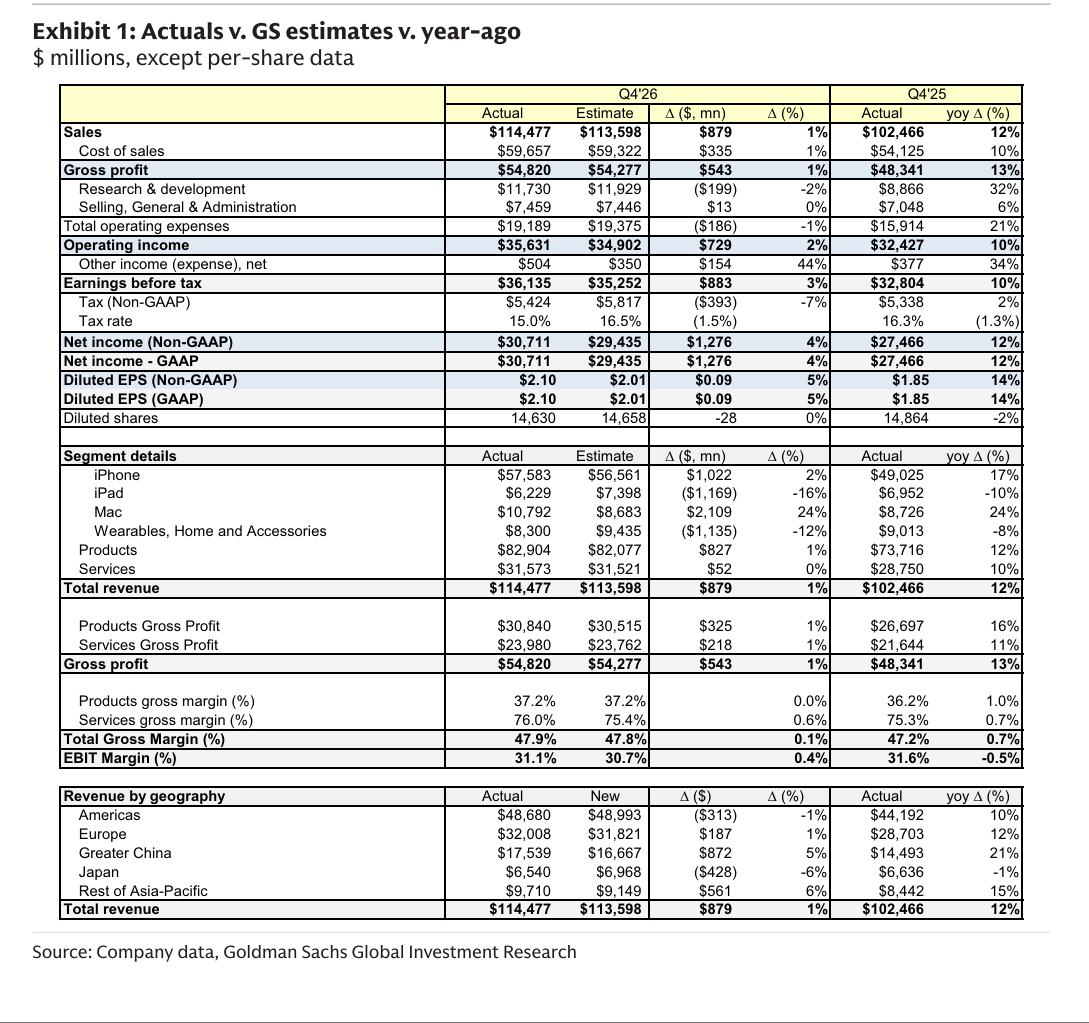
Tariff refunds increased the Group's gross margin by about 1 percentage point and increased earnings per share by about $0.05. Since Goldman Sachs has already included refunds in advance, it is even more noteworthy that Apple reported diluted earnings per share of $2.10 for the quarter, which is $0.09 higher than the forecast value of $2.01 that Goldman Sachs has already considered for tariff refunds. Excluding the $0.05 revenue from refunds, Apple's diluted earnings per share for the quarter were about 2.05 US dollars, which is still higher than Goldman Sachs and Wall Street analysts' consistent benchmark predictions; other net income indicators are higher than the forecast, and the effective tax rate is lower than the forecast, which is also helpful to earnings per share. From a regional perspective, Goldman Sachs underestimated the most: the region's revenue increased 21% year over year to US$17.539 billion, which is US$872 million higher than Goldman Sachs's forecast. By contrast, Apple's total global revenue was only $889 million higher than Goldman Sachs forecast.
Revenue led upward, but gross margin expectations unexpectedly declined: Why did the performance call change the direction of stock prices?
Goldman Sachs's latest research report on Apple's earnings report is its latest judgment on the global holiday shopping season before the full guidelines were revealed: revenue growth was as low as mid-single digits, gross profit margin 46% to 47%, and operating expenses of about $20 billion. In contrast, what Apple management actually gave was: revenue growth of 7% to 10%, better than market expectations of about 6%; gross margin was only 45% to 46%, which was lower than general market expectations and the median guidance range was lower than Goldman Sachs analysts' expectations of about 46.5%, and significantly lower than the 47.9% gross margin target for the fourth fiscal quarter shown in the latest performance report data; operating expenses were estimated at about 20.4 billion to 20.8 billion US dollars, which is also higher than Goldman Sachs's expectations.
Meanwhile, the service business with a high profit contribution is expected to grow by only 8% — 9%, which is lower than analysts' expectations of 10.7% as shown by LSEG Data & Analytics. However, the two specific reasons cannot be confused: third-party licensing and exchange rates mainly slow the growth rate of service revenue; the continued upward trend in the price of memory chips is the primary reason why the Group's gross margin is under pressure, and there are other costs associated with expanding Siri AI. The latest slight decline in the market after the performance conference call is the judgment on profitability during the holiday season, and Apple management still expects that the quarter's revenue will reach a record high for the company.
Goldman Sachs analysts said that the Apple performance call also revealed a key detail of Apple's AI business model. End-side inference already has specific value: Gap runs lossless prevention models locally with Mac mini in hundreds of stores, eliminating cloud inference fees paid per call volume. At the same time, tasks that require server processing by Siri AI will incur cloud costs, which Apple will include in service sales costs; starting in the December quarter, deferred revenue allocated to bundled services in device sales prices and confirmed during the device usage period will also reflect the addition of Siri AI, a high-performance AI system.
The management plans to set usage limits for some server-side functions and provide paid expansion in the future, but did not disclose independent AI revenue. There is also a time gap on the hardware side: From June to September, Apple's manufacturing procurement commitments increased by 33 billion US dollars, which helped guarantee supply, but that did not mean that 33 billion US dollars of low-cost storage was locked in. Old inventory can temporarily cushion price increases. As high-priced new materials are put into production, price increases and whether the share of high-end models can maintain gross profit margins will be the test for next season.
Why is Goldman Sachs still paying $390? Its core bet is that more than 2.5 billion active devices and more than 1.5 billion paid subscriptions will enable Apple to sell more services and devices to existing users at lower customer acquisition costs, and the strong profits brought by these sales data will cover the cost of increasing memory chip prices and purchasing cloud computing power capacity on a large scale; Goldman Sachs analysts added in the research report that the huge equipment base and brand loyalty will help reduce customer acquisition costs and drive repeat purchases and service consumption, and Goldman Sachs is betting that in the next five years, services are expected to contribute most of the Group's additional gross profit.
Goldman Sachs determined that most of the Group's gross profit increase in the next five years will come from services and roll forward about 40 times the expected EPS valuation for another year; the 2027 and 2028 EPS estimates listed in the model are $9.16 and $9.76, respectively. This target is quite sensitive to valuation multiples: the implied profit of about $9.75 remains unchanged at $390. If the market only gave 35 times the expected price-earnings ratio (Forward P/E), the valuation would be around $341, almost back to the closing price on the earnings day. Longer switching cycles, disruptions in the supply of key components, service competition and platform supervision, and insufficient return on capital from repurchases or mergers and acquisitions are all risks listed by Goldman Sachs; the most immediate of these is whether service profit growth can support a 40-fold valuation.
Furthermore, according to Goldman Sachs analysts, when global investors continue to examine the trillion-dollar return on AI infrastructure investment, Apple relies on existing terminals, operating system portals, and ecological distribution capabilities to promote AI commercialization while still generating sufficient cash flow, making it easier to obtain a more significant valuation premium over the long term compared to other tech giants — the most typical example is “From October 29 to 30, Apple increased by 0.23%, and the Philadelphia Semiconductor Index fell sharply by 8.52% during the same period.”
The major differences among Wall Street investment institutions over Apple's stock price prospects after the financial report was announced mainly focused on whether price increases, product portfolio, and service monetization can offset the cost mix that may continue to increase in the near future.
Citigroup continues to maintain an optimistic “buy” rating. The target price forecast is still $365, with an implied increase of about 7.9%, corresponding to about 5.30 trillion US dollars; Asiya Merchant, the agency's senior analyst, emphasizes that EPS still exceeds expectations after deducting tariff refunds, as well as opportunities for new products, service expansion, and future charges for Siri. UBS Group, on the other hand, continues to maintain a cautious rating of “neutral,” with a target price of $296, an implied decrease of 12.5%, corresponding to about $4.30 trillion. UBS Group analyst David Vogt acknowledged the quarterly performance of iPhones and Macs, but believed that rising component prices, pressure on search and App Store growth, and the temporary nature of tariff refunds limited the valuation space.