
OpenAI Wants to Buy Google AI Chips. What That Means for GOOGL Stock Here.
OpenAI is already one of the largest buyers of NVIDIA (NVDA) GPUs, but the ChatGPT maker may be looking to diversify its AI computing infrastructure with Alphabet (GOOGL) in-house chips. According to a recent report, OpenAI plans to purchase Google’s Tensor Processing Units (TPUs), potentially giving Alphabet a major new customer for its fast-growing AI chip business.
The reported move is significant because Google’s TPUs are emerging as a credible alternative to Nvidia’s dominant GPUs, particularly as AI companies look for more cost-efficient computing options. OpenAI has already been renting Google’s AI chips, while its latest reported plan would mark a deeper commitment to the technology. The deal also comes shortly after OpenAI announced plans to make its advanced AI models available through Google Cloud, further strengthening the commercial relationship between the two companies.
Thus, the potential OpenAI deal could provide another boost to its TPU business and Google Cloud, although the company is also facing substantial infrastructure costs as it scales AI capacity. With investors closely watching whether Alphabet’s massive AI investments can translate into sustainable revenue growth, can OpenAI’s reported move boost investor confidence?
About Alphabet Stock
Headquartered in Mountain View, California, Alphabet is one of the world’s leading technology companies, with businesses spanning Google Services, Google Cloud, and innovative ventures such as Waymo and Verily. The company continues to strengthen its competitive position through significant investments in artificial intelligence and cloud computing, two of its most important long-term growth drivers. With a market cap of approximately $3.4 trillion, Alphabet remains a global technology powerhouse and a prominent member of the Magnificent Seven.
GOOGL has had a challenging year, with shares down marginally over the past 52 weeks and 10.6% year-to-date (YTD). The stock is also trading about 31.5% below its 52-week high of $408.61 reached earlier in the year.
Meanwhile, the weakness accelerated dramatically on Oct. 29, when GOOGL slumped 12.5% intraday, closing at $283.82, marking the stock’s worst trading day on record. The selloff continued in the next session as the stock slumped another 1.4% as investors reacted to its latest quarterly results and growing concerns over the financial burden of its AI investments.
Although Alphabet delivered 25% year-over-year (YOY) revenue growth to $127.6 billion in the third quarter, its $2.12 earnings per share fell well short of Wall Street expectations. Plus, Alphabet’s aggressive AI infrastructure spending has raised concerns about cash flow and returns on investment. The company’s AI-related capital spending reached massive levels, while third-quarter free cash flow turned negative, intensifying worries that the cost of competing in AI could weigh on profitability in the near term.
Notably, the company continues to see strong Google Cloud growth and increasing demand for its AI infrastructure, including TPUs, which could provide important long-term catalysts.
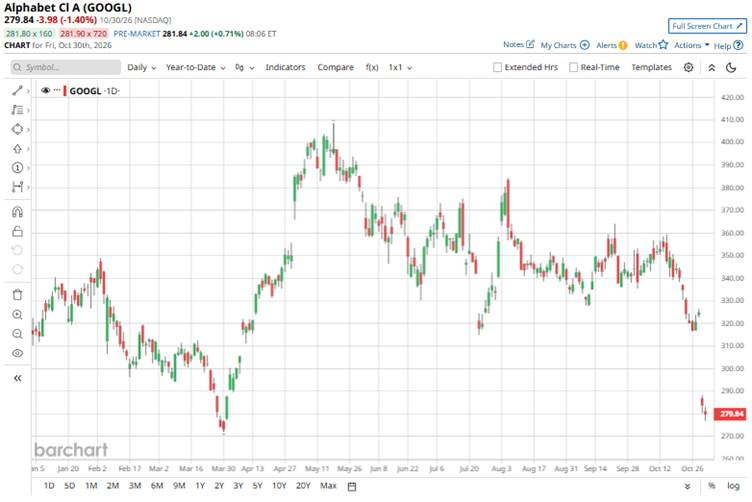
GOOGL currently trades at a premium compared to the sector median but a discount to its own historical average at 13.91 times forward earnings.
Strong Cloud Growth Offset by Rising Costs
Alphabet reported its third-quarter 2026 results on Oct. 28, after the market close. The company generated $127.6 billion in revenue, up 25% YOY, marking its 13th consecutive quarter of double-digit revenue growth. Operating income increased 30% to $40.6 billion, while operating margin expanded to 31.8% from 30.5% a year earlier.
However, the bottom line was considerably weaker. Net income available to common stockholders fell 25.2% to $26.2 billion, while EPS declined 26.1% to $2.12 from $2.87. The decline was largely attributable to an $8.2 billion net loss in other income and expense, primarily reflecting unrealized losses on Alphabet’s equity investments, including its investment in SpaceX.
The most important growth engine was Google Cloud, where revenue surged 103% YOY to $30.7 billion. Cloud operating income more than tripled to $11.1 billion from $5.7 billion, while its operating margin expanded to 36.2% from 23.7%, amid strong demand for AI infrastructure and solutions, core Google Cloud services, and sales of its Tensor Processing Unit (TPU) systems. Cloud backlog reached $561 billion, with the company expecting to recognize just over 55% of that backlog as revenue over the next 24 months.
Meanwhile, Google Services revenue increased 11% to $96.3 billion. Within that segment, Google Search and other revenue rose 12% to $63.4 billion, while YouTube advertising revenue increased 9% to $11.2 billion. Google Network revenue edged up just 1% to $7.5 billion, while revenue from subscriptions, platforms and devices increased 11% to $14.3 billion.
AI spending was another major focus. Alphabet spent $51.4 billion on capital expenditures in Q3, with the vast majority directed toward technical infrastructure supporting AI. The heavy investment contributed to negative free cash flow of $9.1 billion, compared with positive free cash flow in the year-ago period.
Coming to the fourth quarter, Alphabet warned that foreign-exchange headwinds will be somewhat larger, particularly for Search and YouTube advertising. Management also expects Search growth to face tougher comparisons as it laps the acceleration that began in late 2025. In Cloud, TPU system sales are expected to continue scaling in Q4, with a meaningful revenue ramp expected in 2027. Plus, Cloud margins could face near-term pressure as Alphabet uses third-party computing capacity to meet strong demand.
Alphabet maintained its full-year 2026 capital-expenditure guidance of $195 billion to $205 billion, but management said CapEx is expected to increase significantly in 2027. The company also cautioned that higher infrastructure spending will continue to pressure its income statement through higher depreciation and data-center operating costs.
In addition, analysts are forecasting EPS of around $20.05 for fiscal 2026, an 84.5% YOY jump, but a 25.4% decline to $14.96 in 2027.
What Do Analysts Expect for Alphabet Stock?
Several Wall Street analysts took a more cautious stance on Alphabet following its third-quarter results, with a broad wave of price-target reductions on Oct. 29.
Wedbush analyst Ygal Arounian maintained an “Outperform” rating on Alphabet on Oct. 29, but sharply lowered the price target to $387 from $445. The target reduction came after Alphabet’s third-quarter results exposed several concerns that have become increasingly important to investors.
Also, RBC Capital analyst Brad Erickson maintained an “Outperform” rating on Alphabet, but lowered the price target to $400 from $425. The more cautious price target followed Alphabet’s mixed third-quarter results, which RBC described as a “messy” quarter.
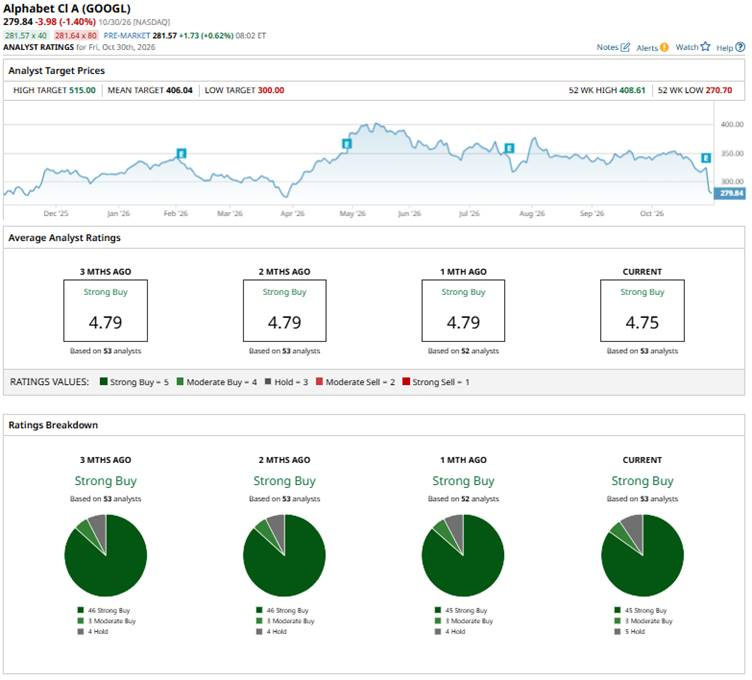
Overall, GOOGL has a consensus “Strong Buy” rating. Of the 53 analysts covering the stock, 45 advise a “Strong Buy,” three suggest a “Moderate Buy,” and the remaining five analysts are on the sidelines, giving it a “Hold” rating.
GOOGL’s average analyst price target of $406.04 indicates an upside of 45.1%, while the Street-high target price of $515 suggests that the stock could rally as much as 84%.
On the date of publication, Subhasree Kar did not directly have a position in any of the securities mentioned in this article. All information and data in this article is solely for informational purposes. For more information please view the Barchart Disclosure Policy here.