
Palantir (PLTR.US) US commercial revenue surged 148%, yet Wall Street is debating whether the “AI application myth” can continue to be written
The Zhitong Finance App learned that after the performance report of Palantir Technologies (PLTR.US), an AI application leader focusing on “AI+ data analysis” was revealed on Tuesday morning Beijing time, two key facts can be described as being established at the same time: that is, US commercial revenue surpassed US government revenue for the first time, proving that AI software is being monetized on a large scale on the enterprise side; however, on the other hand, the year-on-year growth rate of the total value of new US commercial contracts fell to 11% from more than 153% last quarter. There are huge differences over how far Palantir can see the next round of AI application growth trajectory. This is why Wall Street analysts, both in terms of performance and guidance, agree that the stock price still fell sharply by about 10% before the US stock market.
Regarding the latest performance report of AI application leader Palantir and the optimistic future outlook given by management, the core judgment of Morgan Stanley's latest research report is that Palantir is the main beneficiary of the promotion of corporate “sovereign AI” and open weighting models. The focus is that the revenue growth rate accelerated for the 13th consecutive quarter in the third quarter, and the adjusted operating margin reached 61.7%; at the same time, customer growth and various order indicators have slowed.
As a result, Morgan Stanley has taken a seemingly contradictory and consistent move: drastically revising revenue and profit forecasts for 2027 and 2028, raising the target price from $205 to $233, while maintaining “equal weight” (Equal-weight) — a relatively cautious rating that favors a neutral stance, but not to the most optimistic rating of “increase in holdings.” At a closing price of $178.34, $233 corresponds to a potential increase of 30.65%.
After surging 340% in 2025, Palantir's stock price has accumulated a cumulative increase of more than 130% throughout 2025, which can be called a “bull market myth in the AI application software sector”. Some senior Wall Street analysts, including Morgan Stanley, believe that the stock still has room to rise. In the past October, Palantir's stock price fell from $187.05 to $184.11, with a monthly decline of about 1.57%, outperforming the NASDAQ 100 Index and the Philadelphia Semiconductor Index by about 5.08 and 13.79 percentage points respectively. However, from the phased high of $212.94 in the trading session on October 12 to the closing of $178.34 before the November 2 earnings report, the stock price has already retracted sharply by about 16%, and has not been able to continue to break out of the independent market at a time when AI trading is in decline.
US commercial revenue surpassed government business for the first time. Why is the nearly doubling of revenue unable to suppress order concerns?
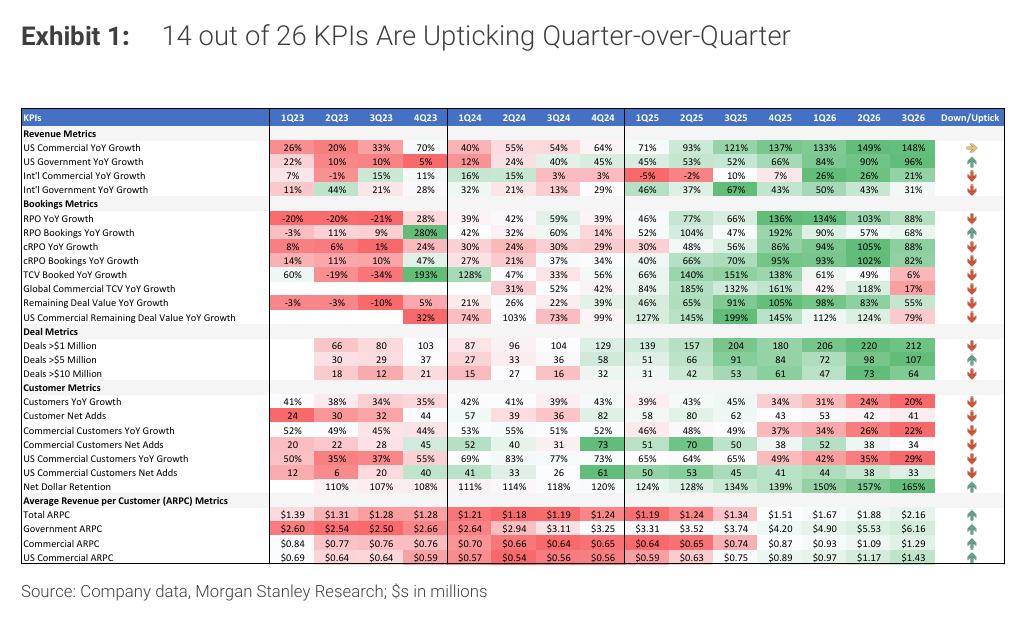
According to Palantir's financial data, the company's third-quarter revenue increased from $1,181 billion to US$2,313 million in the same period last year, up 96% year on year and 20% month-on-month, higher than the market's consensus forecast of US$2.18 billion; adjusted earnings per share of US$0.44, higher than the market's agreed expectation of US$0.41. The strongest increase was still in the US: commercial revenue of US$984 million, up 148% year on year and 29% month on month, surpassing the US government's revenue side of about US$953 million for the first time; the latter increased 96% year over year, which is also higher than 90% in the previous quarter.
In contrast, international business and government revenue increased by 21% and 31%, respectively, and there was no simultaneous explosion in the US market. Earnings were also supported by cash: GAAP operating profit of US$1,085 million, profit margin of 47%; adjusted operating profit of US$1,427 million, profit margin of approximately 62%. According to the company's caliber, the “40 Rule” score of revenue growth plus adjusted operating profit margin reached 158%. Operating cash flow was US$1,255 million. After deducting expenses for the purchase of property and equipment, the free cash flow was approximately US$1,197 million; the company's adjusted free cash flow was US$1,216 million.
The “Rule of 40” is an empirical measure of whether a software company can balance growth and profit. According to Palantir's caliber, adding the year-on-year revenue growth rate to the adjusted operating profit margin, a total of 40% would meet the standard. Palantir's third-quarter revenue increased by about 96% year-on-year, meaning revenue was nearly double that of the same period last year; the adjusted operating margin was about 62%, which meant that every $100 of revenue left an adjusted operating profit of about $62. The two add up to about 158%, which is far above the 40% reference line. Here, 158% is the overall score, not profit margin, nor profit growth rate.
The guidance is as strong as management's performance outlook. Revenue for the fourth quarter is expected to be US$2,649 million to US$2,653 million, with a median value of about 7.8% higher than the consensus forecast of US$2.46 billion compiled by LSEG; the annual revenue guidance was raised to US$8.530 billion to US$8.534 billion, the implied growth rate rose from about 82% to 91%. US commercial revenue is expected to exceed US$3.559 billion, an increase of at least 143%, and the adjusted free cash flow for the full year is expected to be US$4.8 billion to US$5 billion. According to Damo's estimates, if revenue for the fourth quarter were 5% higher than the median guideline, the year-on-year growth rate could be close to 98%, but this is Damo's scenario estimate, not a company promise.
What the seller and buyer are really arguing about is the order after the revenue. The total value (TCV) of new contracts signed by the company this quarter was US$2,918 million, up only 6% year on year; US commercial TCV was US$1,463 million, up only 11% year on year. The remaining performance obligation (RPO) at the end of the period was approximately US$4.9 billion, an increase of 88% year over year, but remained flat from month to month. Damo also noticed that the net increase in US commercial customers fell from 38 to 33.
The management explained during the conference call that the initial term of multiple sovereign AI contracts amounting to tens of millions of dollars was shorter than usual; shortening the term itself would reduce the full contract amount, and contracts with an original term of less than 12 months were not included in the RPO disclosed by the company. At the same time, the net dollar retention rate rose from 157% to 165%, and the total value of new contracts signed by US businesses over the past 12 months has increased by 62%. Therefore, the Damo analyst team emphasized that the sharp drop in order growth in a single quarter cannot be directly explained as a collapse in demand; however, the market needs to see this batch of short-term renewals and expansion on schedule to confirm how likely today's revenue growth rate is to continue.
From model capabilities to customer AI workflow budgets: Why did Damo raise cash flow but lower valuation multiples?
The key to Palantir benefiting from the smart wave is that it can connect models to the actual processes of the enterprise. Traditional data warehouses can calculate which orders may be postponed; Palantir's business entity (Ontology) further links orders, inventory, factory, and personnel authority, so that the intelligent body can propose transfer plans within the authorized scope, trigger approval, and use execution results to check decisions.
The “sovereign AI” shown by Damo in financial reports is not limited to government procurement: enterprises can retain control over proprietary data and model weights, conduct post-training and evaluation of open weighting models through AIP Evolve, and select models suitable for cost and performance according to the task.
Two specific examples from the management conference call quoted by Damo showed that L3Harris completed fine tuning in less than 48 hours on a specific task, and the initial performance surpassed the original cutting-edge model, reducing the cost by 95%; a global home appliance company started with a $1 million pilot and expanded to an annual contract amount of 15 million US dollars in the third quarter, covering commercial, financial, and supply chain processes. The former explains why customers are adopting, while the latter explains how Palantir can generate more revenue from adoption.
This strong ability to expand contracts is the main basis for Damo's repair model. The bank revised its 2027 and 2028 revenue forecasts by 19% and 28%, respectively, to US$14.08 billion and US$21.14 billion, implying a year-on-year increase of 65% and 50%; of these, the US commercial revenue forecast was revised to US$6.80 billion and US$11.42 billion. The adjusted operating margin for the same period increased from the original estimate of 61.0% and 62.1% to 63.5% and 65.5%. The adjusted earnings per share rose from $2.31 and $3.27 to $2.79 and $4.31, and the free cash flow in the model rose to approximately $8.39 billion and $12.84 billion. This also explains how resilient the stock price is compared to chip stocks: Palantir can sell more and larger workflows to the same customer, and has already generated considerable cash flow. There is no need to build a new data center before it has a chance to earn the next software revenue.
Damo raised the target price but maintained “equal power” because it is optimistic about the growth opportunities brought by sovereign AI, but it still has reservations about whether the huge customer base can maintain the current pace of contract expansion for a long time.
Damo research found that some major customers spending more than $5 million are still sensitive to prices and overall deployment costs. The average household revenue of the top 20 customers has reached US$146 million in the past 12 months, while the overall year-on-year growth rate of the number of customers fell from 24% to 20%; the more they relied on old customers to expand procurement, the more that growth depended on whether new use cases could prove returns over and over again. Damo's benchmark target of $233 already assumes a 37% compound increase in revenue over the next five years, reaching 41.2 billion US dollars in 2031, free cash flow of 27.5 billion US dollars, and a profit margin of about 67%.
In terms of valuation, Damo changed the original “free cash flow of 7.07 US dollars per share in 2030, 41 times” to “10.98 US dollars per share in 2031, 30 times”, then discounted at a 13% weighted average cost of capital, and added back net cash of $7.9 per share. The target price increase is based on higher cash flow forecasts rather than a more expensive multiple of the stock — this also means that the target price given by Damo can still rise is because Damo expects Palantir to earn more cash in the future, while retaining a cautious stance on how fast old customers can continue to expand purchases. If new customers and single customer spending expanded faster, the Dama bull market scenario was $336; if deployment costs limited promotion, the bear market scenario was only $91, up 88.4% and down 49.0% from the benchmark closing price, respectively.
Wall Street is very divided: how can the same earnings report support both $265 and $130?
After the financial report, Citigroup maintained a “buy” rating for Palantir. The target price was raised from 250 to 265 US dollars, which is expected to rise sharply by 48.6% over the next 12 months. The Citigroup analyst team values US commercial and government business at the same time being strong, and believes that the contract period affects the comparability of order numbers. UBS maintained “buying” and Baird maintained “outperforming the market,” with target prices of $250, corresponding to an increase of 40.2%; UBS pointed out that the growth rate of US commercial revenue exceeded its estimated range, but the RPO remained flat month-on-month and weaker than expected by its quantitative model. Piper Sandler, on the other hand, maintained an “increase in holdings”, and the target price rose from 231 to 235 US dollars, corresponding to the potential upward potential of a 31.8% increase.
On the cautious side, Cantor Fitzgerald maintained a “neutral” target price of $207, corresponding to a potential upward potential increase of 16.1%; the Royal Bank of Canada capital market raised the target price sharply from 90 to $130, yet it still “outperformed the market”, corresponding to a 27.1% decline in pessimistic downside. These ratings and target prices are enough to show that the real difference between Wall Street and Long and Short is not whether the AI software has customers, but rather whether existing customers can expand their contracts for a long enough period of time to support today's valuations. Therefore, the most recognizable sign for next quarter is whether the amount of new contracts signed by US businesses can recover, while net dollar retention rates and cash profit margins remain strong.