
Learn Why The Bull Case For Cabot (CBT) Could Change Following Earnings Beat
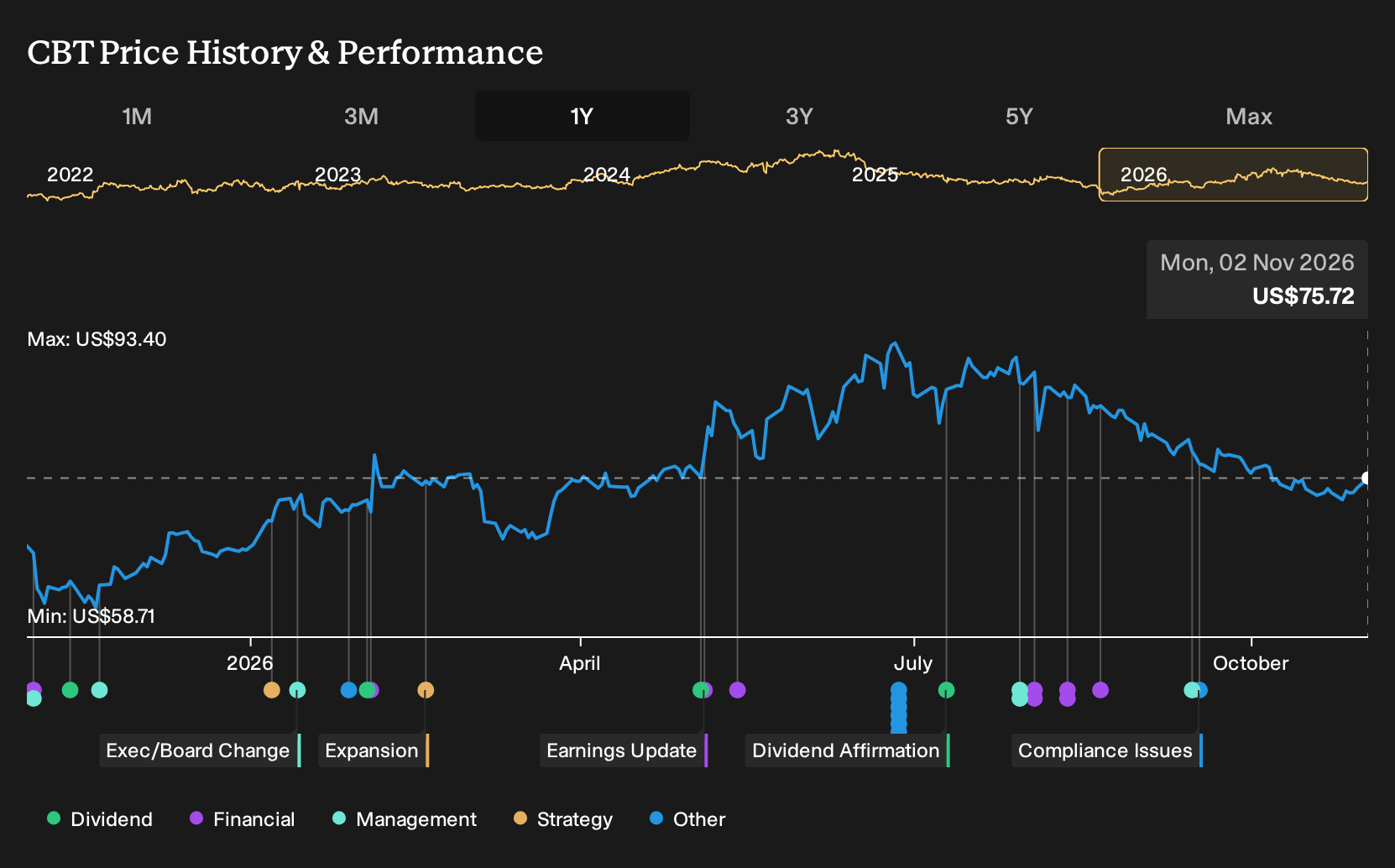
- Cabot reported fourth quarter 2026 revenue of US$1,009 million and net income of US$66 million, with adjusted EPS of US$1.61 beating analyst expectations, while full year profit and EPS from continuing operations were lower than the prior year.
- The company paired solid Performance Chemicals and Reinforcement Materials contributions with a US$50 million U.S. Department of Energy grant for battery additives, and issued fiscal 2027 adjusted EPS guidance above consensus despite margin pressure and softer year-on-year profitability.
- We will now examine how Cabot's earnings beat, alongside margin pressure and higher 2027 EPS guidance, could reshape the broader investment narrative.
Compare Cabot's earnings story with peers by scanning a curated set of list of solid balance sheet and fundamentals (24 results) that may offer similar resilience with different risk and return trade offs.
Cabot Investment Narrative Recap
To own Cabot, you need to believe the specialty materials portfolio can keep earning attractive returns even as profit margins stay under pressure. The latest quarter shows that picture is mixed. Quarterly revenue and earnings from continuing operations were higher than a year ago, yet full year profit contracted. That combination suggests the short term swing factor is execution on pricing and mix, not just volume growth.
The biggest near term catalyst is whether Cabot can translate demand in battery materials and performance chemicals into firmer profitability after a year where net income fell to US$213 million from US$331 million. The key risk is that compressed margins and higher debt costs limit how much of that earnings power actually reaches the bottom line.
The most relevant update for that thesis is Cabot's fiscal 2027 adjusted EPS guidance of US$6.15 to US$6.75. Management is effectively telling you they see room to rebuild earnings after a year where full year EPS from continuing operations declined from US$6.02 diluted to US$4.02. Your view on Cabot probably hinges on how achievable that rebound looks.
The US$50 million U.S. Department of Energy grant for battery additives sits at the intersection of that opportunity and risk. It supports expansion of conductive additives capacity, which feeds directly into Cabot's battery materials catalyst and its exposure to EVs and energy storage. The operational question is whether the firm can ramp that business efficiently enough to lift overall profitability while still managing debt levels and capital spending sensibly.
Cabot's current revenue outlook from analysts points to 3.5% yearly expansion, with earnings today of US$281.0 million expected to reach US$479.7 million by 2029. That consensus path assumes revenues reach about US$4.0 billion and implies an earnings increase of roughly US$198.7 million over that period.
Uncover why Cabot's fair value indicates a 17% potential upside to its current price, which could narrow quickly.
Exploring Other Perspectives
You also need to weigh a very different concern. The most pessimistic analysts focus on competitive pressure in Battery Materials and worry that Cabot’s customer share gains could stall. Before these results, they were penciling in revenue of about US$3.9b and earnings of roughly US$884.2m by 2029. That is a far more aggressive earnings path than consensus, paired with a much lower assumed P/E of 5.2x. This signals a belief that the market might heavily discount that outcome. Their view was formed before this earnings beat and new 2027 guidance, so you may want to compare those older assumptions with the fresh information and see which storyline feels closer to your own expectations.
Explore 2 other Cabot fair value estimates, including one that suggests it could be worth just $86.07.
The Verdict Is Yours
Don't just follow the ticker; dig into the data and build a conviction that's truly your own.
- A great starting point for your Cabot research is our analysis highlighting 4 key rewards and 2 important warning signs that could impact your investment decision.
- See our latest analysis for Cabot. The report includes a comprehensive fundamental analysis summarized in a single visual, the Snowflake, making it easy to evaluate Cabot's overall financial health at a glance.
Looking For More Ideas Beyond Cabot?
If Cabot has sharpened your thinking about earnings power, balance sheets, and risk, use that same lens to scout other opportunities with the Simply Wall St Screener. You can filter for quality, resilience, and income so you are comparing like for like rather than chasing headlines.
- For investors who care about capital strength and staying power, start with a list of solid balance sheet and fundamentals (24 results) that already clear a high bar on financial resilience.
- If value is your priority and you want candidates where quality and price both matter, scan the 34 high quality undervalued stocks that match your comfort level on fundamentals.
- Income focused readers who want cash returns today can review a focused group of 4 dividend fortresses that pair higher yields with supporting balance sheets.
Have feedback on this article? Concerned about the content? Get in touch with us directly. Alternatively, email editorial-team@simplywallst.com