
Kadant (NYSE:KAI) beats expectations in strong Q3 2026 but quarterly revenue guidance misses expectations

Industrial equipment manufacturer Kadant (NYSE:KAI) beat Wall Street’s revenue expectations in Q3 2026, with revenue up 15.3% year on year to $313.2 million. On the other hand, next quarter’s revenue guidance of $294.5 million was less impressive, coming in 2.6% below analysts’ consensus estimates. Its non-GAAP profit of $3.64 per share was 27.4% above analysts’ consensus estimates.
For more on Kadant, read our free full research report.
Kadant (KAI) Q3 2026 highlights:
- Revenue $313.2 million vs S&P analysts’ consensus estimates of $302.1 million (15.3% year-on-year growth, 3.6% beat)
- Adjusted EPS $3.64 vs S&P analysts’ consensus estimates of $2.86 (27.4% beat)
- Adjusted EBITDA $71.71 million vs analysts’ consensus estimates of $64.42 million (22.9% margin, 11.3% beat)
- Revenue guidance $294.5 million at the midpoint for Q4 2026, below analysts’ consensus estimates of $302.4 million
- Adjusted EPS guidance Management slightly raised its full-year adjusted EPS guidance to $12.66 at the midpoint
- Operating margin 17.1%, up from 15.7% in the same quarter last year
- Free cash flow margin 18.6%, up from 16.2% in the same quarter last year
- Market capitalization $3.35 billion
Summary and Outlook “Looking ahead to the remainder of the year, we expect aftermarket demand to remain stable and project activity to show some improvement, although the timing of large capital orders continues to be influenced by economic and geopolitical uncertainty,” continued Mr. Powell. “Our strong year-to-date performance positions us to deliver a record-setting 2026. We expect revenue of $1.195 to $1.210 billion in 2026, revised from our previous guidance of $1.190 to $1.210 billion, and GAAP EPS of $9.88 to $10.03, revised from our previous guidance of $9.78 to $10.03. We are raising our adjusted EPS guidance and now expect $12.58 to $12.73 for 2026, revised from our prior guidance of $12.43 to $12.68. Our revised adjusted EPS guidance excludes $2.19 per share of intangible amortization expense and $0.51 per share of acquisition-related costs. For the fourth quarter of 2026, we expect revenue of $287 to $302 million, GAAP EPS of $2.01 to $2.16, and adjusted EPS of $2.67 to $2.82, which excludes $0.55 per share of intangible amortization expense and $0.11 per share of acquisition-related costs.”
Revenue growth
A company’s long-term revenue performance can indicate its overall quality. Any business can report a good quarter or two, but the best consistently grow over the long term. Over the last five years, Kadant grew its revenue at a solid 10.1% compounded annual growth rate. Its growth beat the average industrials company and shows its offerings resonate with customers.
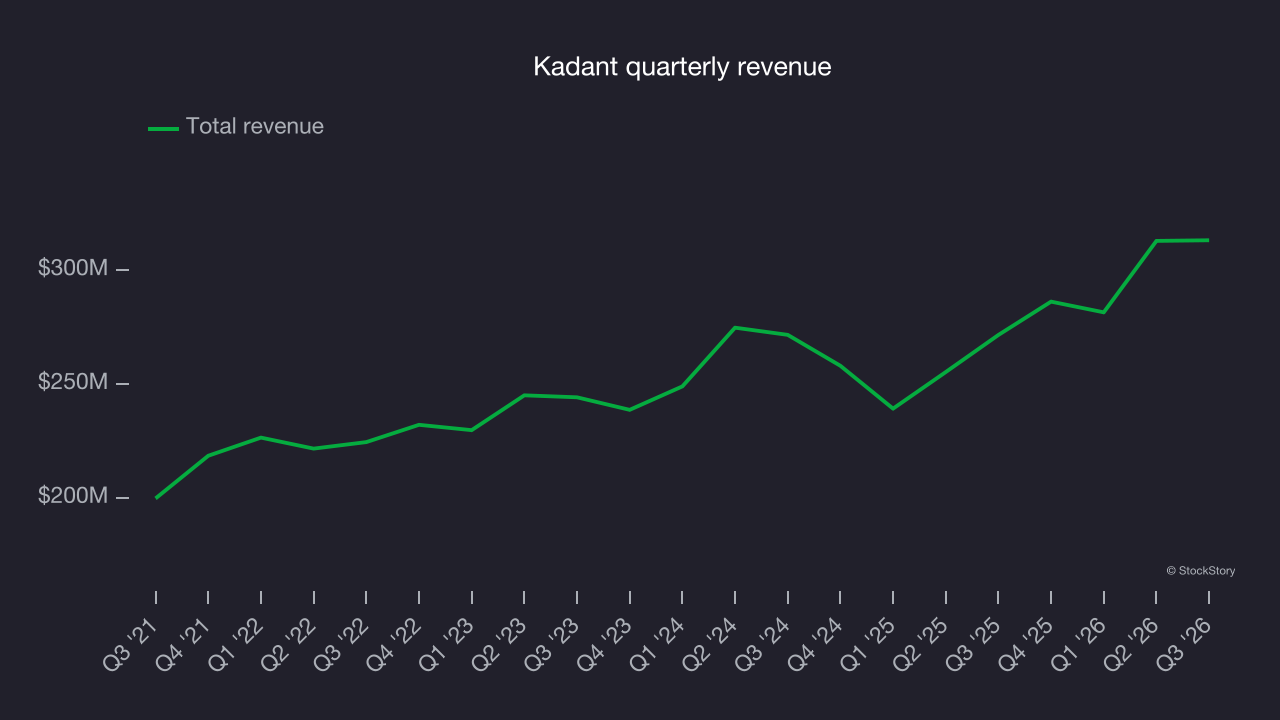
Long-term growth is the most important, but within industrials, a half-decade historical view may miss new industry trends or demand cycles. Kadant’s recent performance shows its demand has slowed as its annualized revenue growth of 7.4% over the last two years was below its five-year trend. Decelerating revenue growth in the sector is a concern, as it could signal changing consumer tastes aided by low switching costs. 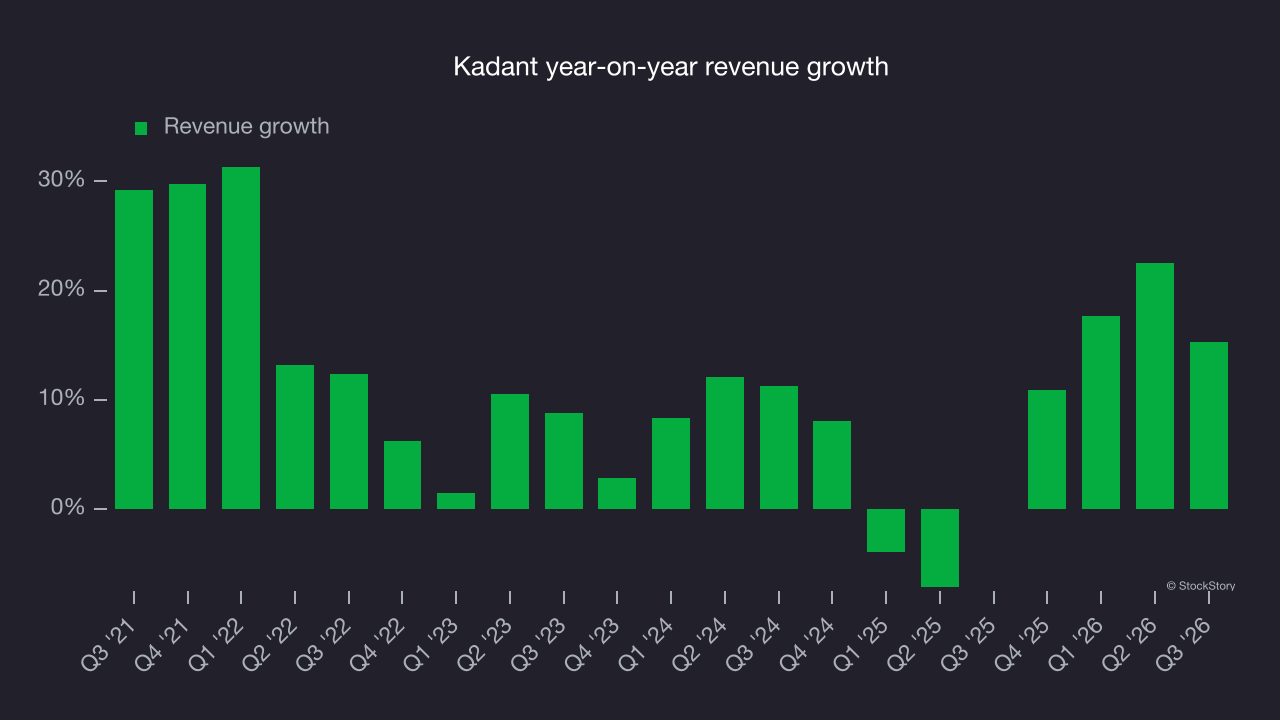
A closer look at the company’s revenue dynamics starts with its three most important segments: Fluid Handling, Industrial Processing and Material Handling, which are 32.7%, 45.8% and 21.5% of revenue. Over the last two years, Kadant’s revenue in all three segments increased. Its Fluid Handling revenue (piping, cleaning and filtration) averaged year-on-year growth of 5.1% while its Industrial Processing (paper and timber processing equipment) and Material Handling (wood production equipment) revenues averaged 14.9% and 6.2%. 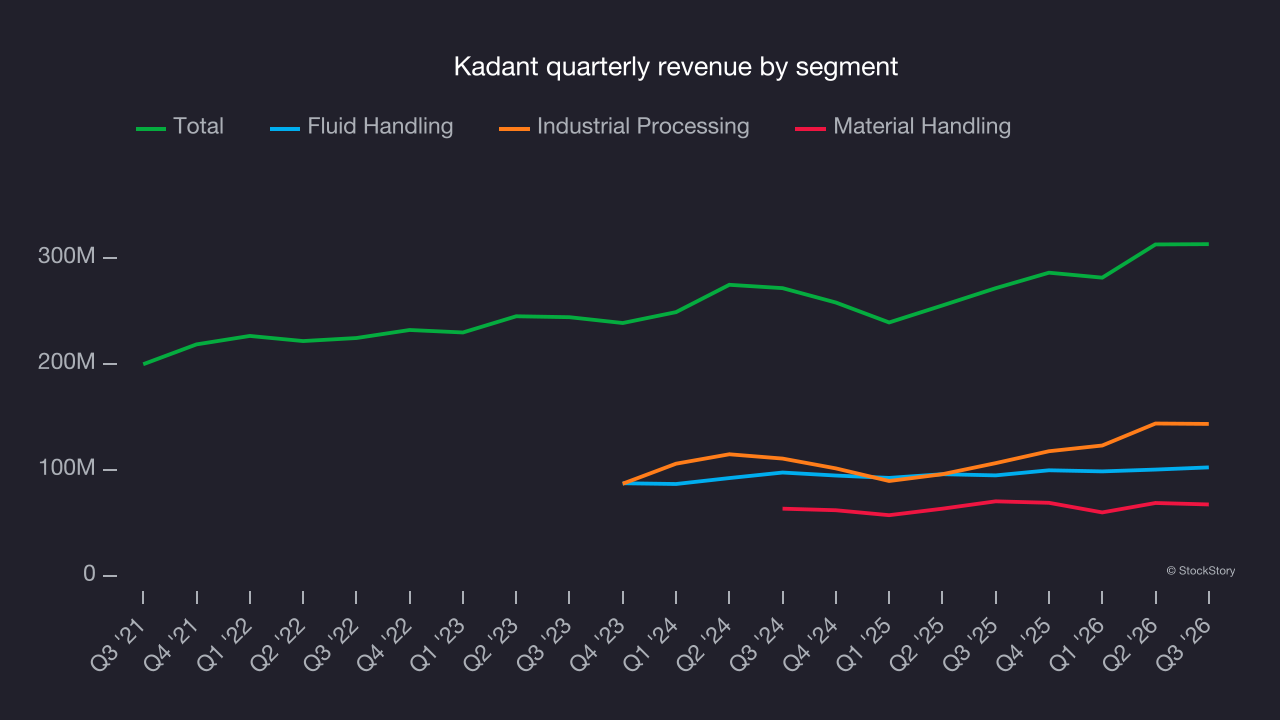
This quarter, Kadant reported year-on-year revenue growth of 15.3%, and its $313.2 million of revenue exceeded Wall Street’s consensus estimates by 3.6%. Company management is currently guiding for a 2.9% year-on-year increase in revenue next quarter.
Looking further ahead, sell-side analysts expect revenue to grow 4.8% over the next 12 months, according to S&P, a slight deceleration versus the last two years. This projection is underwhelming and implies its products and services will face some demand challenges.
Operating margin
Operating margin is an important measure of profitability as it shows the portion of revenue left after accounting for all core expenses, from the cost of goods sold to advertising and wages. It’s also useful for comparing profitability across companies with different levels of debt and tax rates because it excludes interest and taxes.
Kadant has performed well over the last five years. It demonstrated high profitability for an industrials business, with an average operating margin of 16.5%. This result is unsurprising given its favorable gross margin baseline.
Looking at the trend in its profitability, Kadant’s operating margin decreased by 3 percentage points over the last five years. This raises questions about the company’s expense base because its revenue growth should have given it leverage on its fixed costs, resulting in better economies of scale and profitability.
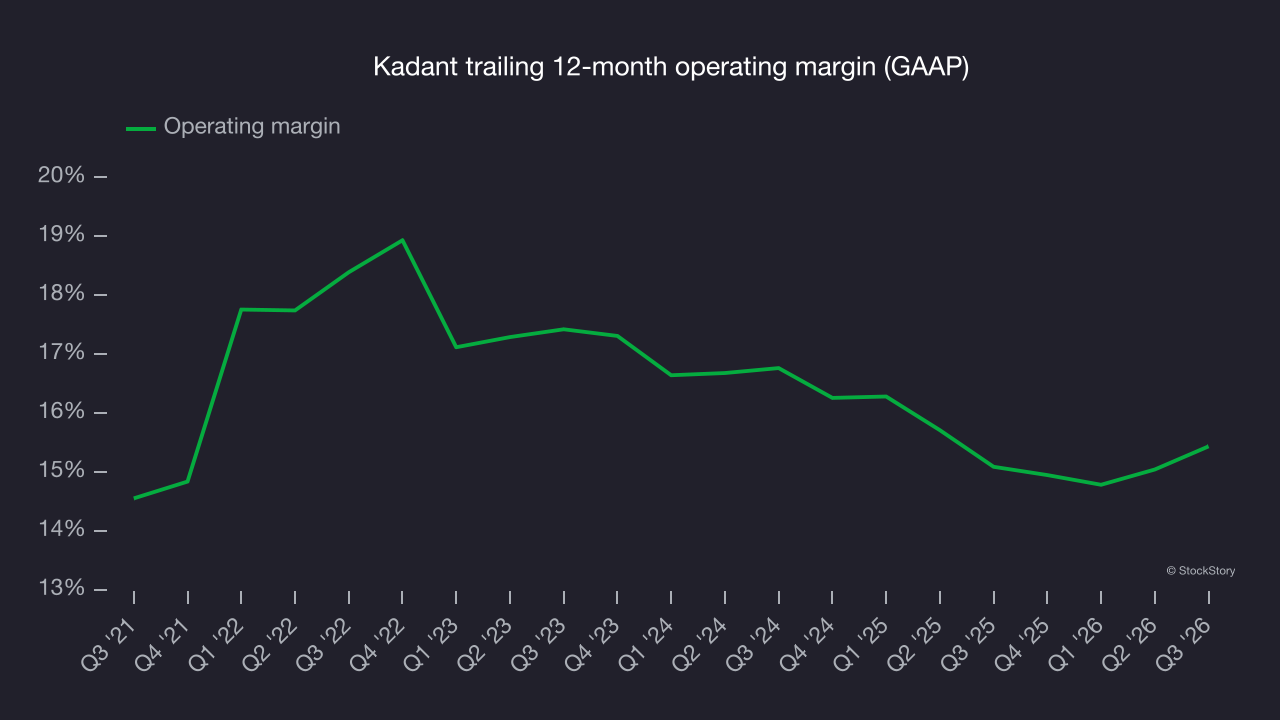
This quarter, Kadant generated an operating margin of 17.1%, up 1.4 percentage points year on year. The increase was a positive sign, and because its operating margin rose more than its gross margin, the company appears to have been more efficient with expenses such as marketing, research and development and administrative overhead.
Earnings per share
We track the long-term change in earnings per share (EPS) for the same reason as long-term revenue growth. Compared to revenue, however, EPS highlights whether a company’s growth is profitable.
Kadant’s strong 11.9% annual EPS growth over the last five years aligns with its revenue performance. This indicates its incremental revenue was profitable.
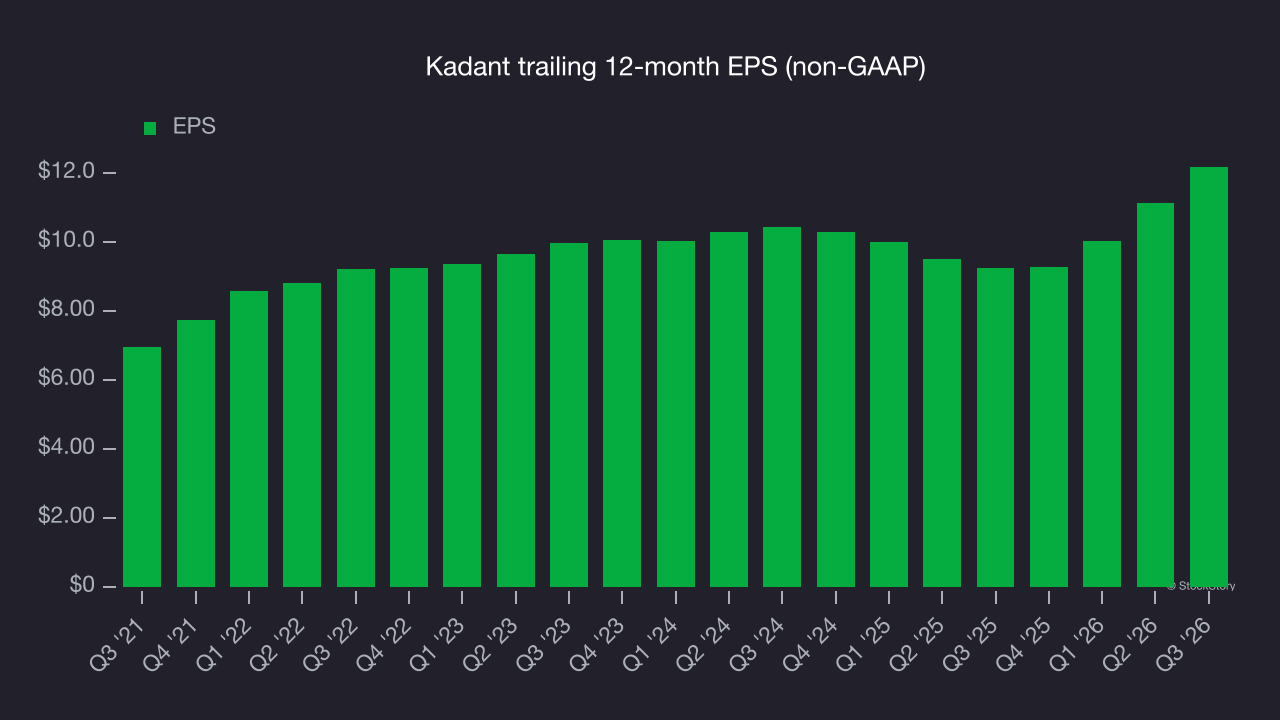
Like with revenue, we analyze EPS over a shorter period to see if we are missing a change in the business.
For Kadant, its two-year annual EPS growth of 8% was lower than its five-year trend. An acceleration in growth would be welcome.
In Q3, Kadant reported adjusted EPS of $3.64, up from $2.59 in the same quarter last year. This result came in well above analysts’ consensus estimates, a positive outcome for shareholders. Over the next 12 months, Wall Street expects Kadant’s full-year EPS to grow 8.3% from $12.17 to $13.18, according to S&P.
Key takeaways from Kadant’s Q3 results
Kadant’s Q3 had some important positives: EPS beat analysts’ consensus estimates, and EBITDA topped Wall Street’s consensus by a wide margin. But the outlook fell short, with both EPS and revenue guidance for next quarter missing consensus estimates. Shares remained flat at $282.63 immediately after the results.
The latest quarter is only one piece of the longer-term business quality picture. Quality, combined with valuation, can help determine whether the stock is a buy. For more, read our full research report here (it’s free).