
US midterm election bets soar, predicts market bets on Democrats sweeping both houses
The Zhitong Finance App learned that the forecast market showed on Tuesday that expectations for the Democratic Party to sweep the US Congress continue to heat up, and bets on the midterm elections have already exceeded 1.48 billion US dollars. This new type of market is facing a new test. As polling stations in various places began to close one after another, betting prices further shifted in favor of the Democratic Party. At around 19:00 EST on Tuesday (8:00 Beijing time on the 4th), the predicted market prices compiled by the analytical company BetInt showed that the probability of the Democratic Party winning the House of Representatives was 98%, an increase of 4 percentage points over the afternoon of the same day.
The market fluctuated sharply, and its implicit probability that the Democratic Party would control the Senate rose to 88%, up 14 percentage points from earlier in the day, and then fell back to around 80%.
According to BetInt data, when the first batch of polling stations closed at 18:00 EST (7:00 Beijing time on the 4th), about 2 million US dollars poured in to bet that the Democratic Party would gain control of both houses of the Senate and the House of Representatives at the same time and win fiercely contested Senate elections and some gubernatorial elections in Ohio, Texas, and Maine.
The prediction market became famous in 2024, when they withstood the trend of traditional polls and predicted that Trump would win the presidential election. Since then, they have accumulated a large following in the global media and investors.
This type of market claims that the odds provided are extremely accurate, but several high-profile mistakes in the US primary election and Brazil's presidential election suggest that they are not infallible, and the implicit Democratic Party sweep in the market on Tuesday will also be strictly scrutinized.
Analysts say that if the midterm election results seriously deviate from predicted market odds, the industry's reputation could be damaged, especially with record stakes.
The biggest platforms, Kalshi and Polymarket, are also under pressure to prevent misconduct: several candidates have already bet on elections they are participating in; research by the Washington non-profit Anti-Corruption Data Collective (ACDC) also found that relatively small bets can leverage political market conditions.
“Tuesday is indeed a real test for a new generation of forecasting markets,” said Yesha Yadav (Yesha Yadav), associate dean of the Vanderbilt University School of Law, adding that this year's numerous congressional elections will help fill the industry's overall report card.
Polymarket and Kalshi said they have strengthened controls and are fully capable of preventing misconduct. Kalshi prohibits politicians and campaign workers from participating in political bets. The two companies also said that when large bets drive price changes, their markets will quickly self-correct.
Sean Patrick Maloney (Sean Patrick Maloney), CEO of the Coalition for Predictive Markets (Coalition for Prediction Markets), said that these markets don't claim to be perfect, but in “a world full of chaotic and biased news sources,” they provide an unbiased way to predict events.
Research says this type of market is well calibrated in terms of size
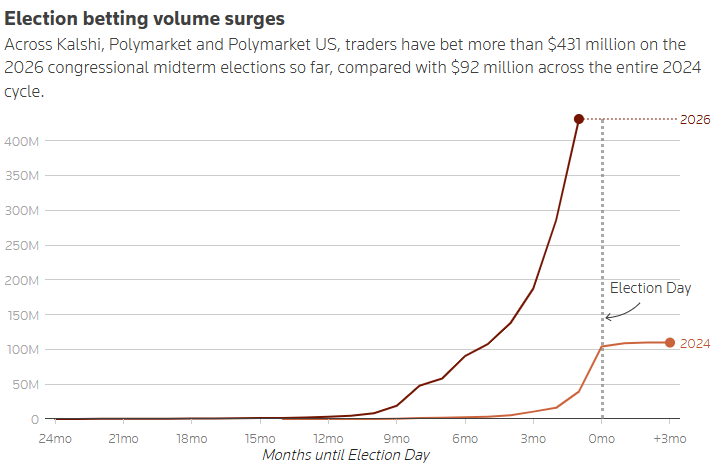
Kalshi announced on Monday that the total trading volume of all midterm election bets reached $1.33 billion; according to ACDC data, the Polymarket congress-related market is about $145 million.
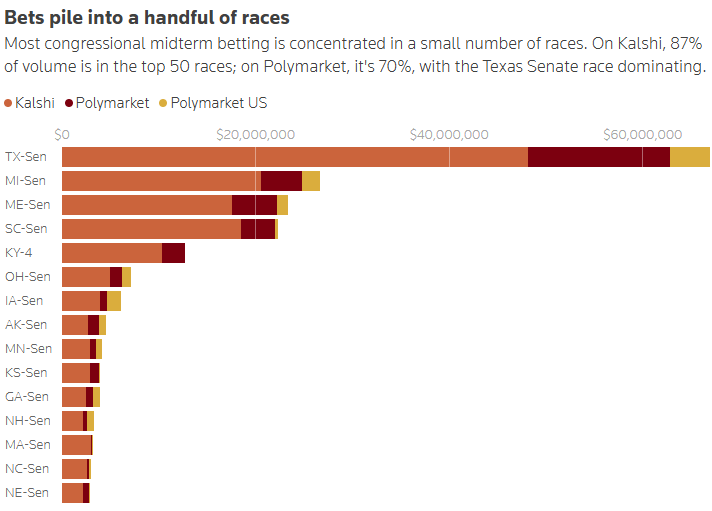
The non-profit organization says it has opened more than 2.8 million midterm election-related markets so far, with a small number of elections—including Senate elections in Texas, Michigan, Maine, and South Carolina—contributing most of the trading volume.
For example, as of October 29, the Texas Senate election had attracted nearly $67 million in bets, according to ACDC data. BetInt data showed that on Tuesday evening, the market implied that the probability of Texas Democratic candidate James Talarico (James Talarico) defeating the state's Republican Attorney General Ken Paxton (Ken Paxton) was 75%, up 3 percentage points from earlier in the day.
In the Michigan Senate election, which has already attracted more than $26 million in bets, the market implied that Democrat Abdul El-Sayed (Abdul El-Sayed) had an 83% chance of defeating Republican Mike Rogers (Mike Rogers), an increase of 7 percentage points from earlier in the day.
The overall findings of academic research, including a 2025 Vanderbilt University paper that analyzed nearly 2,500 markets in the 2024 general election, predicted that the market was well calibrated. Calibration measures whether the odds are reliable, and accuracy measures whether the market picks a winner.
Joshua Clinton (Joshua Clinton), a political science professor at Vanderbilt University who led the 2025 study, said that due to lack of competition in most elections, broad performance indicators may not reflect the market's performance in a balanced election.
Harry Crane (Harry Crane), a statistics professor at Rutgers University, said that a small group of seasoned profit-seeking traders seemed to contribute a large share of forecasting market capital and helped correct prices.
Clinton said that even the most sophisticated traders can make mistakes. For example, prices on Kalshi and Polymarket only gave Brazilian President Luiz Inacio Lula da Silva (Luiz Inacio Lula da Silva) a 20% chance of defeating his right-wing rival Flavio Bolsonaro (Flavio Bolsonaro), and Lula actually won last month. Clinton argues that this is probably because sophisticated traders have overly revised the risk that “polls often underestimate the appeal of right-wing candidates.”
A spokesperson for the two companies said that there is a 20% chance of an incident happening at any time, and the collapse of political elections is no exception.
Carlos Hardenberg (Carlos Hardenberg), portfolio manager at MCP Emerging Markets (MCP Emerging Markets), said the lesson for investors is that these markets are useful reference indicators. “But that should not be confused with certainty.”